


SKU #54931
·
48 views
Mila
Pepper
User rating
0 votes0% positive reviews
No ratings yet — be the first.
Direction
Sweet
Growing
Open Ground
Ripening Period
55 - 65 days
Fruit; color (biological maturity)
Bright Red
Prices in stores
from85.9 €per 1000 seeds
pack from 0.49 € per pack
2 offers from 2 stores
Store offers · 2 from 2 stores
Prices are updated on loadLoading offers…
Available at: Agrise · Сад от А до Я
Aggregator catalog: prices are collected automatically from store websites, normalized by AI and converted at the current exchange rate. Before ordering, confirm the price and availability on the store's website. This block is not indexed by search engines — the data is loaded after the page opens.
About product
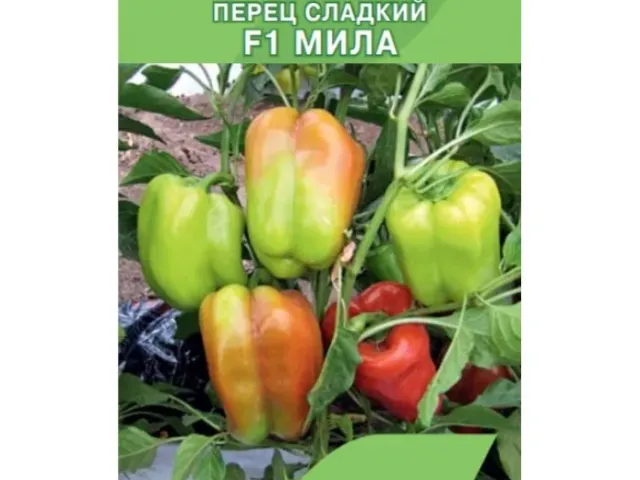
MILA pepper is a fast-maturing hybrid designed for early harvest in open ground. The plant is compact and does not require pruning, simplifying care. Fruits have a cube-like shape with a smooth, glossy surface. In technical ripeness, they are light green, and in biological ripeness, they turn into a rich red hue. The weight of one fruit is 180-200 grams, with a thick wall reaching 7-8 mm, ensuring…
Direction
Sweet
Growing
Open Ground
Ripening Period
55 - 65 days
Fruit; color (biological maturity)
Bright Red
Description
MILA pepper is a fast-maturing hybrid designed for early harvest in open ground. The plant is compact and does not require pruning, simplifying care. Fruits have a cube-like shape with a smooth, glossy surface. In technical ripeness, they are light green, and in biological ripeness, they turn into a rich red hue. The weight of one fruit is 180-200 grams, with a thick wall reaching 7-8 mm, ensuring juicy and fleshy fruits. Marketable yield reaches 7.5 kg per square meter. The pepper is distinguished by high levels of ascorbic acid and sugars, making it especially nutritious and flavorful. The flesh is incredibly sweet with a pronounced spicy aroma, and the skin is tender, enhancing its appeal for fresh consumption and processing.
The MILA hybrid exhibits high resistance to major diseases, including Tobacco Mosaic Virus (TMV), Cucumber Mosaic Virus (CMV), and Tomato Bronzing Virus, contributing to a stable and high-quality harvest. Thanks to its market qualities and disease resistance, this pepper is an excellent choice for both hobby and commercial cultivation.
For successful cultivation of MILA pepper, it is essential to ensure regular watering and select the appropriate fertilization program. Root feeding begins immediately after transplanting seedlings, increasing fertilizer doses as fruits form. It is recommended to conduct an agrochemical soil analysis for accurate calculation of fertilizer doses, taking into account soil type and climatic conditions. Different fertilizer formulations with varying macronutrient ratios are applied during different growth stages: phosphorus for seedling adaptation, nitrogen for improved flowering, and potassium for fruit growth. Foliar feeding enhances nutrient uptake and compensates for microelement deficiencies during critical growth phases, promoting higher yield and fruit quality.
The MILA hybrid exhibits high resistance to major diseases, including Tobacco Mosaic Virus (TMV), Cucumber Mosaic Virus (CMV), and Tomato Bronzing Virus, contributing to a stable and high-quality harvest. Thanks to its market qualities and disease resistance, this pepper is an excellent choice for both hobby and commercial cultivation.
For successful cultivation of MILA pepper, it is essential to ensure regular watering and select the appropriate fertilization program. Root feeding begins immediately after transplanting seedlings, increasing fertilizer doses as fruits form. It is recommended to conduct an agrochemical soil analysis for accurate calculation of fertilizer doses, taking into account soil type and climatic conditions. Different fertilizer formulations with varying macronutrient ratios are applied during different growth stages: phosphorus for seedling adaptation, nitrogen for improved flowering, and potassium for fruit growth. Foliar feeding enhances nutrient uptake and compensates for microelement deficiencies during critical growth phases, promoting higher yield and fruit quality.
Video · 9 videos
Suggest a video →Crop & resistance
Disease resistance
Specifications hover over for a hint about the specification
|
Direction
Direction
Existing varieties and types of cabbage are grown for fresh consumption, long-term storage, and technical processing. |
|
|---|---|
|
Growing
Growing
Eggplant is grown in open fields and under protective cover on small areas. |
|
|
Ripening Period
Ripening Period
It takes 70-100 days until pepper reaches flowering stage, 130-160 days until technical fruit ripeness, and 135-180 days until physiological ripeness. |
55 - 65 days |
|
Fruit; color (biological maturity)
Fruit; color (biological maturity)
Biological maturity of pepper fruits occurs 35-45 days after technical maturity. Biologically mature fruits acquire red, yellow, or pink coloration, and their vitamin C and A, sugar, and dry matter content significantly increases. |
|
|
Fruit; shape
Fruit; shape
Spherical, oval, flattened or cylindrical shape. |
|
|
Fruit; weight
Fruit; weight
Table watermelons weigh 0.6-16 kg. |
160-190 grams |
| Fruit; wall thickness | 7-8mm |
| Registration year | 2015 |
| Catalog | Catalog → Pepper |
| Legal data |
Show · 13
|
| Country | Russia |
Not yet комментариев. Be the first!
Alternatives
Pepper seeds · similar varieties






See also
Often considered together with this variety





Recently viewed
Products you’ve viewed on this site
Reviews · 0