


SKU #3622
·
266 views
Pear Volga Autumn
Pear
User rating
0 votes0% positive reviews
No ratings yet — be the first.
Type of Sort
Autumn variety of pear
Store offers · 2 from 2 stores
Prices are updated on loadLoading offers…
Available at: Саженцы и черенки · Sadoviy Mir
Aggregator catalog: prices are collected automatically from store websites, normalized by AI and converted at the current exchange rate. Before ordering, confirm the price and availability on the store's website. This block is not indexed by search engines — the data is loaded after the page opens.
About product

Late-autumn variety developed by the Samara Research Institute of Horticulture and Medicinal Plants. Obtained by pollinating the 'Sinyaya' (Kopylova) variety with a pollen mixture of 'Bessemyanka' and elite No. 94 ('Bere Zimnya' Michurin's Ch Bon Louise).
Tree in early age has a pyramidal crown, later becoming oval, of medium density, with a well-defined central leader. Main type of fruiting s…
Type of Sort
Autumn variety of pear
Description
Late-autumn variety developed by the Samara Research Institute of Horticulture and Medicinal Plants. Obtained by pollinating the 'Sinyaya' (Kopylova) variety with a pollen mixture of 'Bessemyanka' and elite No. 94 ('Bere Zimnya' Michurin's Ch Bon Louise).
Tree in early age has a pyramidal crown, later becoming oval, of medium density, with a well-defined central leader. Main type of fruiting structures — rings, located on woody tissue.
Shoots are curved, upright, greenish-brown. Leaf buds are small, conical, slightly swollen. Leaves are egg-shaped with a pointed tip, leathery. Leaf blade has a serrated margin, slightly wrinkled, folded like a boat along the central vein. Petiole is of medium length.
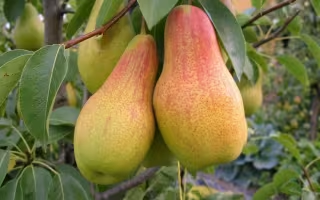
Fruits are pear-shaped or short-pear-shaped, average weight 110 g, surface slightly warty. Main color at harvest is greenish-yellow, turning yellow upon ripening. Lenticels are large, green, scattered over the entire fruit. On the side of the calyx, fruits often show pitted rustiness. Peduncle is medium length, curved in an arc, with a swelling. Nectary is small and narrow, absent in some fruits. Receptacle is deep and ridged. Seed cavity is rhomboid. Seeds are egg-shaped, with a narrow tip.
Flesh is white, juicy, sweet, semi-oily. Flavor is sour-sweet, 3.8-4.0 points.
Tree bears fruit annually from 6-7 years old, moderately. Harvesting takes place at the end of September; fruits are edible from October to November and can be stored in storage facilities until January.
Flowering occurs at medium timing. In severe winters, fruiting structures are damaged. Degree of infection by scab and fruit rot is lower than in the 'Bessemyanka' variety.
Video · 1 video
Suggest a video →Crop & resistance
Crop
Specifications
| Type of Sort | |
|---|---|
| Catalog | Catalog → Pear |
Not yet комментариев. Be the first!
Alternatives
Pear saplings · similar varieties




See also
Often considered together with this variety




Recently viewed
Products you’ve viewed on this site
Reviews · 0