


SKU #3645
·
561 views
Ilyinka
Pear
User rating
2 votes50% positive reviews
No ratings yet — be the first.
Type of Sort
Summer variety of pear
Prices in stores
from2.34 €per seedling
pack from 2.09 € per pack
6 offers from 5 stores
Store offers · 6 from 5 stores
Prices are updated on loadLoading offers…
Available at: Agro-market · Квіти Буковини · Megasad · Наша Дача · Sadco · Сади Буковини · Сади Сад · Семена Буковины · Світ Рослин
Aggregator catalog: prices are collected automatically from store websites, normalized by AI and converted at the current exchange rate. Before ordering, confirm the price and availability on the store's website. This block is not indexed by search engines — the data is loaded after the page opens.
About product

Early summer variety of folk selection. Its genetic origin is unknown.
The tree is vigorous (height 5.8 m, diameter 5.0-5.5 m), with a vertically oval crown formed by powerful few branches of dark brown color.
Shoots are medium in length, curved, bare, with numerous elongated lenticels. Buds are widely conical, bare, strongly pressed against the shoot. The leaf plate is medium-sized, roun…
Type of Sort
Summer variety of pear
Description
Early summer variety of folk selection. Its genetic origin is unknown.
The tree is vigorous (height 5.8 m, diameter 5.0-5.5 m), with a vertically oval crown formed by powerful few branches of dark brown color.
Shoots are medium in length, curved, bare, with numerous elongated lenticels. Buds are widely conical, bare, strongly pressed against the shoot. The leaf plate is medium-sized, rounded, dark green, smooth, slightly concave, leathery, shiny, with wavy serrated edges. Stipules are long, wedge-shaped.
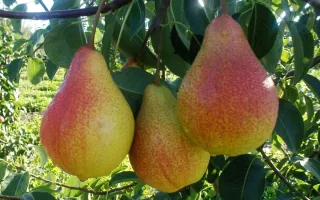
Fruits are medium in size, weighing up to 130 g, even, short pear-shaped. The skin is dry to the touch. On the main light green color there is a noticeable blurred pink blush occupying 1/5 of the surface of the fruit. Subcutaneous spots are large, greenish, surrounded by an aureole. Pedicel length up to 4 cm, curved, woody, obliquely set with a small ledge, bare. The saucer is medium in size, open. Sepals are short and sharp. Cup-shaped receptacle is medium, weakly pleated. Calyx tube is cup-shaped, small, of moderate width. Heart-shaped locule is bulbous, small, located closer to the apex of the fruit, asymmetrical. Seed chambers are closed, smooth. Seeds are rounded-ovoid, dark brown.
The pulp is white, medium consistency, coarsely granular, semi-oily, with a small amount of large stony cells, sweet taste, with a weak aroma. Chemical composition of fruits: dry matter — 15.9 (14.0-18.4%), sum of sugars — 8.9% (7.4-10.7%), titratable acids — 0.18% (0.13-0.27%), on a wet weight basis, sugar to acid ratio — 52.4 (28.8-83.8), ascorbic acid — 7.0 mg/100g (4.2-11.3 mg/100g), P-active substances (catechins) 13 mg/100g, flavonoids — 8.0 mg/100g, sum of phenolic compounds — 240 mg/100g, sum of pectin substances — 0.55% on a wet weight basis.
The fruits begin to ripen in the second half of July and are stored for no more than a week. Purpose of the fruits is consumption in fresh form and for processing.
Begins bearing fruit in the 7th-8th year. Yield of 60 kg from a tree, periodicity of fruiting is slightly expressed. According to the results of field assessment, the variety is winter-hardy and drought-resistant. Resistant to fungal and bacterial diseases.
Merits of the variety: good yield, resistance to pests and diseases, adverse environmental factors, good appearance.
Drawbacks of the variety: vigorous tree growth, mediocre taste assessment of fruits.
With the participation of Ilyinka, a new variety Palmyra (Ussuriyskaya Ch Ilyinka) was bred, originator — well-known Far Eastern breeder A. M. Lukashov. The Palmyra variety is zoned in the Far East region.
Video · 3 videos
Suggest a video →Crop & resistance
Crop
Specifications
| Type of Sort | |
|---|---|
| Catalog | Catalog → Pear |
Not yet комментариев. Be the first!
Alternatives
Pear saplings · similar varieties




See also
Often considered together with this variety



Recently viewed
Products you’ve viewed on this site
Reviews · 0