Local Volga autumn variety of folk selection. Currently, alongside the 'Astrachan Early' variety, it occupies one of the leading positions in the pear assortment of the Lower Volga region. The variety was tested and approved in the Lower Volga region.
A vigorous, fast-growing tree (height 6.5 m, width 4.4 m) with a sparse, vertically-oval crown and moderate leafiness. Main branches are curved, medium thickness, branching off the trunk at a right angle (90°), bark gray and light-gray, cracked.
Shoots of medium length, curved, reddish-brown, bare, shiny, fairly thick, with a moderate number of large, elongated-oval buds. Buds are large, broad-conical, without hairs, strongly deviated. Leaves are medium-sized, equilateral, round, green, smooth, shiny, leathery, with slightly wavy and finely serrated edges. Petioles are hairless and lack anthocyanin; stipules absent.
Buds are white, 9-11 in number. Flowers are large, white. Pedicels are slightly hairy, sepals light-green, lanceolate. Petals are large, round. Stamens 23-25, filaments white, anthers bright pink. Stigmas are at the same level as stamens.
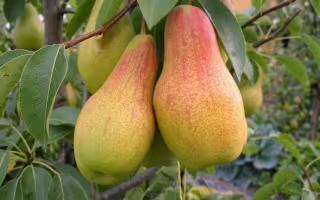
Fruits of medium size (mass 130 g), uniform, pear-shaped, very oily to the touch. Mainly yellow, with a slight light-pink blush. Skin spots are medium-sized, green, clearly visible, numerous on the fruit surface. Peduncles are long, curved, woody, without swelling, protruding from a depression, bare, brown. Calyx is small, narrow, wrinkled without swelling. Calyx is medium, half-open, sepals short and pointed. Receptacle is deep, slightly wrinkled, with pearls. Heart is spindle-shaped, small, located closer to the apex, axial, symmetrical. Seed chambers are closed, bud-shaped. Seeds are wedge-shaped, dark-brown, often underdeveloped.
Fruit flesh is white, coarse-grained, with a high content of large stone cells, medium-fleshed, sweet, with a moderate aroma. Chemical composition of the fruit: dry matter — 18.8%, total sugars — 12.6%, titratable acids — 0.47% on fresh weight, sugar-to-acid ratio — 26.8, ascorbic acid — 6.4 mg/100g, total pectin substances — 1.21% on fresh weight.
Fruits remain firmly attached to the tree until harvest. Harvested in the second decade of September, they can be stored for up to 30 days. Fruit quality is medium. The variety is table-type, intended for processing, especially for compotes.
Best pollinators: Bere Ligela, Lyubimitsa Klappa. Trees begin fruiting in the 10th year. High annual yield, averaging 70 kg per tree. Trees can produce good yields even at 100 years of age.
Cold and drought resistance, according to field evaluations, is high. The variety is resistant to pests but susceptible to scab.
Advantages of the variety: tree longevity, annual yield, resistance to pests.
Disadvantages of the variety: vigorous trees, satisfactory fruit quality, susceptibility to scab.





Reviews · 1