


SKU #3636
·
267 views
Daughter of Amur
Pear
User rating
0 votes0% positive reviews
No ratings yet — be the first.
Type of Sort
Autumn variety of pear
Prices in stores
from13.37 €per seedling
pack from 9.97 € per pack
2 offers from 2 stores
Store offers · 2 from 2 stores
Prices are updated on loadLoading offers…
Available at: Лучший Сад · Sadovod Proskurina
Aggregator catalog: prices are collected automatically from store websites, normalized by AI and converted at the current exchange rate. Before ordering, confirm the price and availability on the store's website. This block is not indexed by search engines — the data is loaded after the page opens.
About product

This autumn variety was obtained at DalNIISKh through hybridization of the 'Tema' variety with 'Shuranovka No. 5'. Authors: A. V. Bolonyaev, A. V. Chuyko, G. T. Kazymin. Passed state testing in Primorsky and Khabarovsk regions. Showed satisfactory winter hardiness on elevated sites on its own rootstock. In valleys, coastal areas, and islands, it is relatively winter-hardy. When grafted onto winte…
Type of Sort
Autumn variety of pear
Description
This autumn variety was obtained at DalNIISKh through hybridization of the 'Tema' variety with 'Shuranovka No. 5'. Authors: A. V. Bolonyaev, A. V. Chuyko, G. T. Kazymin. Passed state testing in Primorsky and Khabarovsk regions. Showed satisfactory winter hardiness on elevated sites on its own rootstock. In valleys, coastal areas, and islands, it is relatively winter-hardy. When grafted onto winter-hardy and scion-forming rootstocks — seedlings of Ussuri pear — it is suitable for cultivation in collective and backyard gardens of Jewish Autonomous, Amur, and Sakhalin regions.
Medium-sized tree, with a round-elongated crown, skeletal branches branching at 40-60° angles in whorls, brownish-green in color. Medium-density crown, strong foliage. Fruit buds form on two- to three-year-old shoots as simple rings and short twigs with fruit buds at the tips.
Medium-thickness shoots, straight or slightly curved, brownish-green. Medium-sized, round, dark-brown, semi-pressed buds. Leaves of medium size, round-elongated shape. Veining poorly expressed. Leaf blade of medium density, dark green on top, light green on bottom, without hairs, finely toothed margin, long, curved petiole.
Flowers of medium size. Buds white with slight reddish tint. Sepals bowl-shaped. Stigmas short, almost fused. Style of stigmas positioned below small light-brown anthers.
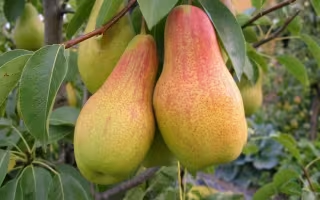
Fruits slightly below average size (average weight 68 g, maximum 90 g), relatively uniform, oval in shape, smooth surface slightly warty near the peduncle. Main color yellow, covering color brownish-red mottled blush, subcutaneous dots small, brownish-light. Peduncle short, medium thickness. Depressions almost absent, calyx narrow, shallow, half-closed.
Flesh white, medium density, semi-oily, harmonious sour-sweet taste, with distinct aroma. Fruits contain dry matter — 15.1%, total sugars — 8.3%, titratable acids — 1%, tannins — 0.9%, ascorbic acid — 18 mg/100g, pectic substances — 0.6%.
Fruits ripen by mid-September. Suitable for consumption 10 days after harvest, remain fresh for up to a month, and can be stored for up to two months in cold storage facilities.
Fruits intended for table use, also suitable for pickling, drying, and making compotes.
Fruit-bearing begins in the 4th-5th year of tree life, mass fruiting in the 7th-8th year. High and annual yield; on state trial plots at 8 years old — 41 centners/ha. Fruits well in mixed plantings with 'Lukashovka' and 'Bolonyaevka'.
Variety resistant to scab and other diseases.
Advantages of the variety: relatively large fruits for local varieties with high taste quality.
Disadvantages of the variety: weak winter hardiness for cultivation in valley sites, insufficient fruit storability.
Variety used in breeding.
Crop & resistance
Crop
Disease resistance
Specifications
| Type of Sort | |
|---|---|
| Catalog | Catalog → Pear |
Not yet комментариев. Be the first!
Alternatives
Pear saplings · similar varieties


See also
Often considered together with this variety



Recently viewed
Products you’ve viewed on this site
Reviews · 0