


SKU #3644
·
268 views
Zoya
Pear
User rating
0 votes0% positive reviews
No ratings yet — be the first.
Type of Sort
Autumn variety of pear
Store offers · 1 from 1 stores
Prices are updated on loadLoading offers…
Available at: Лучший Сад
Aggregator catalog: prices are collected automatically from store websites, normalized by AI and converted at the current exchange rate. Before ordering, confirm the price and availability on the store's website. This block is not indexed by search engines — the data is loaded after the page opens.
About product

Early-autumn variety obtained at the Scientific Research Institute of Horticulture of Siberia named after M. A. Lisavenko by selection among seedlings from open pollination of lukašovka varieties. Breeder: N. N. Tikhonov. Grown in gardens of the Altai region and southern Krasnoyarsk region. Approved since 1988 for the West Siberian and East Siberian regions. Not suitable for new plantings. Trees…
Type of Sort
Autumn variety of pear
Description
Early-autumn variety obtained at the Scientific Research Institute of Horticulture of Siberia named after M. A. Lisavenko by selection among seedlings from open pollination of lukašovka varieties. Breeder: N. N. Tikhonov. Grown in gardens of the Altai region and southern Krasnoyarsk region. Approved since 1988 for the West Siberian and East Siberian regions. Not suitable for new plantings.
Trees are medium-sized with oval, sparse crowns. Most of the yield is formed on complex rings, spear-like branches, and fruiting twigs.
Shoots are curved, reddish-brown, with small, sparse catkins. Leaves are small, dark green, leathery, shiny, egg-shaped, with a long pointed tip, wavy, finely serrated edges, and short crimson cilia; arranged in a boat-like fashion. Leaves in the upper part of the shoots are usually deformed with ragged edges, and turn bright red earlier than others in autumn. Petioles are short and long, crimson, with sickle-shaped stipules.
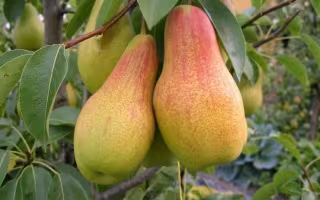
Fruits are very small (weighing 36-45 g), pear-shaped. Main color is yellow-green, with a dark red, blurred covering on the sun-exposed side. Peduncle is long and thick. Calyx is large and open.
Flesh is white, juicy, oily, slightly acidic-sweet, of good flavor. Chemical composition of fruits: total sugars — 10.3% (7.5-14.1), titratable acids — 0.66% (0.48-0.97), tannins — 94 mg/100g (58-153), ascorbic acid — 8.7 mg/100g (4.9-15.8), P-active compounds — 235 mg/100g (100-370).
Harvesting ripeness occurs in the third decade of August, storage life up to 15 days. Variety is of universal use.
Fruit bearing starts in the fourth year, yield is low, fruiting is regular. Winter hardiness is moderate, susceptible to severe frosts in moderate degree. Recovery ability is good.
Advantages of the variety: early fruiting, early ripening of fruits.
Disadvantages of the variety: very small fruits, short storage life.
Crop & resistance
Crop
Specifications
| Type of Sort | |
|---|---|
| Catalog | Catalog → Pear |
Not yet комментариев. Be the first!
Alternatives
Pear saplings · similar varieties




See also
Often considered together with this variety


Recently viewed
Products you’ve viewed on this site
Reviews · 0