


SKU #3623
·
357 views
Pear Volshebnitsa
Pear
Type of Variety
Autumn variety of pear
Your mark
0 votes
0% positive ratings
Store offers · 2 from 2 stores
2 offers in 2 stores — from 2.91 € per seedling.
Available at: Fixgarden · kingsadru
Prices are collected automatically from store websites and converted at the current exchange rate. Check the price and availability on the store website before ordering.
Description
Autumn variety from the Samara Regional Experimental Station for Horticulture, obtained in 1953 by pollinating elite No. 37 (Bergamot Volzhsky Ch Williams) with a pollen mixture of Myasoedovka and Lyubimitsa Klappa. Breeder S. P. Kedrin. The variety has passed State Testing.
Strong-growing tree. Pyramidal crown shape, becoming rounded with age, with a distinctly prominent central leader. Moderate crown density. Skeletal branches are slender, emerging from the trunk at a large angle. Bark color of skeletal branches is gray. Moderate shoot-forming ability, high bud dormancy breaking. Fruit formation type — rings and spear-like fruits.
Medium-thick shoots, curved, with thin tips, whitish coating, sparsely hairy. Numerous small, whitish, rounded tubercles, located closer to the base of the shoot. Leaf buds are small, triangular, slightly rounded. Leaves are medium-sized, intensely green, shiny, oval, with a pointed apex. Leaf margin is wavy, finely serrated. Leaf blade is folded along the main vein. Leaf venation is well-defined. Stipules are lance-shaped, small.
Flowering occurs at medium timing, so any of the common varieties can serve as pollinators. In nurseries, Cypress seedlings are good pollinators.
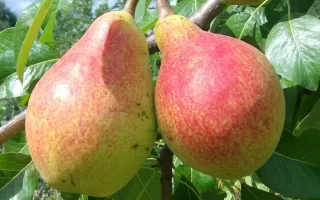
Fruits are below average size, weighing 100-110 g, up to 160 g maximum. Fruit shape is pear-shaped or egg-shaped. Surface is slightly rough. Skin is medium thickness, not coarse, covered with a waxy coating on ripe fruits. Color upon harvest is greenish-yellow, turning yellow after short storage, with well-defined medium-sized brown spots scattered over the fruit surface. Peduncle is medium thickness, long, straight or oblique, often curved. Funnel is narrow, shallow, not present on all fruits. Receptacle is open or semi-open, relatively large, located in a wide but not deep dish. Sub-receptacle tube is funnel-shaped, shallow. Seed cavity is medium-sized, rhombic, located in the center of the fruit. Seed chambers are medium-closed.
Flesh is creamy, semi-oily, juicy, sour-sweet, with a distinctive nutmeg flavor, no gritty cells.
Fruits are harvested from September 10–15, and can be stored for a month.
Fruit-bearing begins at 6–7 years after planting in the orchard. Yield is sharply periodic, good. At age 10, trees yield up to 40 kg. Cold hardiness is at the level of Bessemyanka.
Advantages of the variety: semi-oily, juicy, flesh with sour-sweet flavor.
Disadvantages of the variety: insufficient frost resistance in Samara conditions, manifested as scorching of the bark on the central leader.
Crop & resistance
Crop
Specifications
| Type of Variety | |
|---|---|
| Catalog | Catalog → Pear |
No reviews yet. Be the first to share your experience.
Alternatives
Pear saplings · similar varieties





See also
Often considered together with this variety




Recently viewed
Products you’ve viewed on this site
Reviews