


SKU #3604
·
1 049 views
Pear Bere Early Morettini (Bere Prekos Morettini)
Pear
User rating
2 votes100% positive reviews
No ratings yet — be the first.
Type of Sort
Summer variety of pear
Prices in stores
from3.47 €per seedling
pack from 2.51 € per pack
3 offers from 3 stores
Store offers · 3 from 3 stores
Prices are updated on loadLoading offers…
Available at: БаТаня · Demetra · Паросток · Persikovod · Ycadba
Aggregator catalog: prices are collected automatically from store websites, normalized by AI and converted at the current exchange rate. Before ordering, confirm the price and availability on the store's website. This block is not indexed by search engines — the data is loaded after the page opens.
About product

Summer variety, obtained in Italy by A. Morettini from crossing the varieties Coscia and Williams. The variety was tested in the North Caucasus region and Ukraine. A good early variety, found in commercial and home orchards, as well as in amateur fruit growing.
Medium-sized tree, with a pyramidal, slightly branched crown. Leafiness above average. Main branches diverge from the trunk at an angl…
Type of Sort
Summer variety of pear
Description
Summer variety, obtained in Italy by A. Morettini from crossing the varieties Coscia and Williams. The variety was tested in the North Caucasus region and Ukraine. A good early variety, found in commercial and home orchards, as well as in amateur fruit growing.
Medium-sized tree, with a pyramidal, slightly branched crown. Leafiness above average. Main branches diverge from the trunk at an angle of 35-40°.
Shoots are weakly curved, straight, occasionally slightly bent, with greenish-brown bark. Buds are barely noticeable, sparse, light brown, medium-sized. Buds on one-year-old shoots are densely arranged, dark brown, small, slightly raised, hairless. Bark on the trunk is gray, on main branches gray with a greenish tint. Branching capacity is average. Leaves are medium-sized, egg-shaped, with a pointed tip. Leaf blade is slightly curved along the main vein upward. Margins are finely serrated.
Flowering is early.
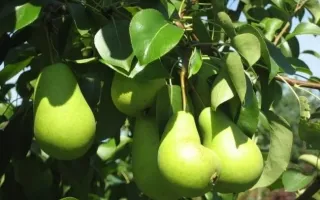
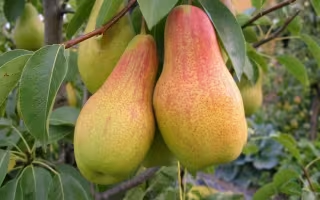
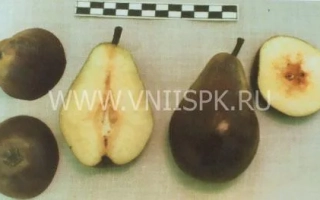
Fruits are above average size, broad pear-shaped. Skin is thin, smooth, glossy, slightly oily to the touch; during harvest, fruits are greenish-yellow, and in consumption, light yellow with a faint pink blush on the sun-exposed side, covering approximately one-third of the fruit. Skin dots are small, greenish or light brown. Peduncle is medium length and thickness, slightly twisted and positioned at an angle in a small depression. Receptacle is half-closed, with a wide, small dish.
Flesh is white, very juicy, oily, tender, melting, tart-sweet, aromatic, with high flavor quality. Contains dry matter — 18.5%, sugars — 11.1%, titratable acids — 0.64%, ascorbic acid — 8.8 mg/100g, P-active catechins — 48.7 mg/100g of dry matter.
Harvest ripeness occurs at the end of July to early August. Storage life is 7-10 days. Fruits are mainly consumed fresh.
Begins fruiting in the fifth year after planting in the orchard. Yield is average. Grows well and bears fruit on wild pear and quince rootstocks.
Tree is drought-tolerant but not sufficiently cold-hardy. Resistance to scab is good.
Advantages of the variety: medium tree size, compatibility with quince rootstock, attractive, high-quality fruits.
Disadvantages of the variety: weak drought tolerance.
Used in breeding.
Video · 1 video
Suggest a video →Crop & resistance
Crop
Disease resistance
Specifications
| Type of Sort | |
|---|---|
| Catalog | Catalog → Pear |
Not yet комментариев. Be the first!
Alternatives
Pear saplings · similar varieties




See also
Often considered together with this variety




Recently viewed
Products you’ve viewed on this site
Reviews · 0