


SKU #3599
·
678 views
Bere Ziffar (Ziffar)
Pear
User rating
1 vote100% positive reviews
No ratings yet — be the first.
Type of Sort
Summer variety of pear
Prices in stores
from1.48 €per seedling
pack from 2.08 € per pack
11 offers from 11 stores
Store offers · 11 from 11 stores
Prices are updated on loadLoading offers…
Available at: Agro-market · Drevolaz · Green Optima · Кліома Сервіс · Квіти Буковини · Megasad · Розплідник-Дачник · Приватний плодорозсадник Таміла · Sadovodd · Сади Буковини · Сади Валерії · Семена Буковины · Світ Рослин
Aggregator catalog: prices are collected automatically from store websites, normalized by AI and converted at the current exchange rate. Before ordering, confirm the price and availability on the store's website. This block is not indexed by search engines — the data is loaded after the page opens.
About product

This early-maturing variety originated as a chance seedling discovered by N. Ziffar near Angers (France) in 1810. The variety was officially registered in the North Caucasus and Lower Volga regions. Medium-sized tree with a spherical, sparse, spreading and drooping crown and slender branches. Bark on the trunk is dark and flaking. Trees develop satisfactorily in the first years in the garden,…
Type of Sort
Summer variety of pear
Description
This early-maturing variety originated as a chance seedling discovered by N. Ziffar near Angers (France) in 1810. The variety was officially registered in the North Caucasus and Lower Volga regions.
Medium-sized tree with a spherical, sparse, spreading and drooping crown and slender branches. Bark on the trunk is dark and flaking. Trees develop satisfactorily in the first years in the garden, but their growth slows down from the start of commercial fruiting.
Shoots are thin, long, hanging, dark brown-red in color. Leaves are light green, small, elongated-elliptical in shape. Leaf margin is nearly straight, slightly wavy. Petiole is thin, medium length.
Flowers are large, petals rounded and closely spaced. Flowering is early.
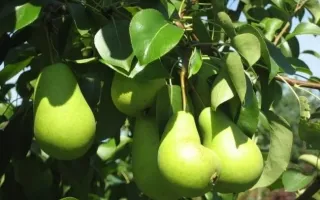
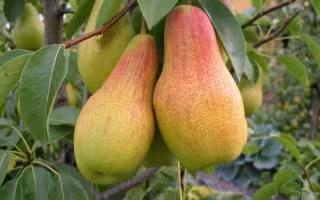
Fruits are below average size (mass 75-100 g), regular pear-shaped. Skin is thin and tender, green when harvested, turning greenish-yellow later, with a blush on the sun-exposed side. Light-brown spots are noticeable all over the skin. Pedicel is sometimes short, but more often fairly long, with a flared top end, thick, sometimes straight, sometimes angled, with fairly distinct folds at its base. No depression at the pedicel. Calyx is small and shallow, sometimes warty; receptacle large, half-open; sepals large and long.
Flesh is white, tender, melting, juicy, tart-sweet, very good flavor (rating 4.3-4.6 points).
Fruits contain 13.7% dry extractives, 8.7% sugars, 0.27% titratable acids, 9.6 mg/100g ascorbic acid, 46 mg/100g raw mass of P-active catechins.
Harvesting maturity occurs July 20-25.
Fruits set often in clusters, 2 to 6 fruits, and remain firmly attached until ripening. Ripen simultaneously, shelf life 3-5 days, suitable for fresh consumption.
Not compatible with quince and requires intermediate planting. The variety is rather demanding on soil, growing best on deep, fertile soils.
Trees begin fruiting at 6-7 years on vigorous rootstocks. Fruit production is moderate in early years, but increases later. In the central Kuban region, at 12-17 years of age, average yield is 60-80 centners per hectare; in the eastern Kuban subzone, at 18-19 years — 100 centners per hectare.
Cold hardiness of young trees and saplings is low; with age, trees become more resilient. Sometimes frost cracks can be observed not only on young shoots, but also on main branches, and even on the trunk. Fruits are practically resistant to scab. Significantly affected by fruit moniliosis.
Advantages of the variety: early ripening and high fruit flavor quality.
Disadvantages of the variety: insufficient winter hardiness, small fruit size, and low fruit shelf life.
The variety is promising for selection for early ripening. Varieties developed with its participation: Nektarnaya (Bere Bosk Ch Bere Ziffar) by the Lower Volga Research Institute of Fruit and Vegetable Crops, and Rannaya Sergeeva (Panna Ch Bere Ziffar) by the Stavropol Research Institute of Fruit and Vegetable Crops.
Video · 8 videos
Suggest a video →Crop & resistance
Crop
Disease resistance
Specifications
| Type of Sort | |
|---|---|
| Catalog | Catalog → Pear |
Not yet комментариев. Be the first!
Alternatives
Pear saplings · similar varieties


See also
Often considered together with this variety


Recently viewed
Products you’ve viewed on this site
Reviews · 0