


SKU #3598
·
534 views
Bere Dilly
Pear
User rating
1 vote100% positive reviews
No ratings yet — be the first.
Type of Sort
Autumn variety of pear
Store offers · 1 from 1 stores
Prices are updated on loadLoading offers…
Available at: Agrolife
Aggregator catalog: prices are collected automatically from store websites, normalized by AI and converted at the current exchange rate. Before ordering, confirm the price and availability on the store's website. This block is not indexed by search engines — the data is loaded after the page opens.
About product

Autumn variety, originating from a chance seedling found in 1811 in Belgium by gardener Meris, an employee of Van Mons, and named after the renowned pomologist A. Dilly. The variety was officially registered in the republics of the North Caucasus (Kabardino-Balkaria, North Ossetia), Stavropol Krai. It is widely grown in the southwestern regions of Ukraine, Moldova, Georgia, and the republics of C…
Type of Sort
Autumn variety of pear
Description
Autumn variety, originating from a chance seedling found in 1811 in Belgium by gardener Meris, an employee of Van Mons, and named after the renowned pomologist A. Dilly.
The variety was officially registered in the republics of the North Caucasus (Kabardino-Balkaria, North Ossetia), Stavropol Krai. It is widely grown in the southwestern regions of Ukraine, Moldova, Georgia, and the republics of Central Asia.
Young trees exhibit rapid growth, later forming a large, dense, broad-pyramidal crown. In mature trees, branches are of medium length, dark gray in color with a brownish tint, and have hanging tips.
Shoots are brownish-gray, smooth, with rare, large, light-colored lenticels. Leaf buds are pointed, relatively large, and freely standing. Leaves are large, broadly egg-shaped, occasionally broadly oval, with a short-pointed apex. Leaf margins are finely toothed, petioles are thin and long.
Flowering time is medium.
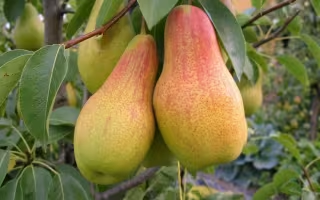
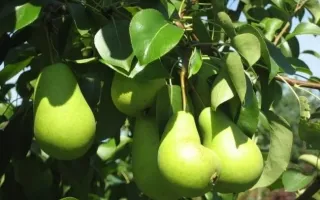
Fruits are large (270 g), very large on young trees (up to 500 g), round-pear or broad-pear-shaped, unequal-sided. Skin is dense; green when picked, turning pale-yellow at maturity with large rust spots, rusted at poles, sometimes with a slight striped blush on the sun-exposed side. Peduncle is medium-length, slightly curved, thick, with a flared end. It is situated in a shallow, slightly wavy, rusted, irregularly shaped depression. The receptacle is deep, nodular, often rusted; the calyx is open, large, sepals upright with tips bent outward, broad, greenish when picked, turning brownish at maturity. The seed cavity is elongated-elliptical, clearly defined by small gritty cells, seed chambers well-developed, medium-sized, elongated-oval. Seeds are dark chestnut-colored, elongated, with a pointed apex, hollow axis. The sub-calyx tube is small, reverse-conical.
Flesh is white, medium density, semi-soft, juicy, sweet, slightly bitter, with satisfactory or good flavor. High flavor qualities are manifested only under favorable growing conditions and at full fruit maturity. On the Kuban region, fruits contain 9.08% sugars, 0.17% titratable acids.
Fruits set more often singly, but remain on trees insufficiently firmly. Harvesting occurs in the second half of September. In storage, they ripen over two months.
Best pollinators are: Clapp’s Favorite, Saint-Germain, Bere Ardanpon. This variety is not used as a pollinator, as it has non-viable pollen.
Trees grafted onto pear begin fruiting at 6-7 years, onto quince — at 4-5. Yield is annual and rather high. Mature trees in Kuban conditions yield 100 kg/tree. The Bere Dilly variety demands high soil requirements. Best soils are fresh, warm loams or chernozems. On inadequately watered soils, fruits are often small, tasteless, and drop prematurely. On overly moist soils, fruits become watery and are severely affected by scab. Winter hardiness is moderate. The variety is susceptible to scab and leaf burn.
Advantages of the variety: large fruits, high yield.
Disadvantages of the variety: high requirements for growing conditions, fruit drop, susceptibility to scab and leaf burn.
Video · 2 videos
Suggest a video →Crop & resistance
Crop
Specifications
| Type of Sort | |
|---|---|
| Catalog | Catalog → Pear |
Not yet комментариев. Be the first!
Alternatives
Pear saplings · similar varieties




See also
Often considered together with this variety



Recently viewed
Products you’ve viewed on this site
Reviews · 0