


SKU #3617
·
417 views
Pear Visible (Rough)
Pear
Type of Variety
Summer variety of pear
Your mark
0 votes
0% positive ratings
Store offers · 9 from 9 stores
9 offers in 9 stores — from 5.57 € per seedling.
Available at: 1sad · AgronomVIP · biolocus-plant-pro · greenpoint24-ru · Лучший Сад · plodovyimir-ru · rassadacvetov-ru · Sadovnik-sam · vihervimma-fi
Prices are collected automatically from store websites and converted at the current exchange rate. Check the price and availability on the store website before ordering.
Description
Late-season variety selected by VSTISP, obtained by pollinating the interspecific hybrid VI-53-67 with pollen from southern varieties. Authors: Yu. A. Petrov and N. V. Efimova. Widely grown in suburban gardens of Moscow and neighboring regions. Approved for the Central region.
The tree has a spreading crown in its youth, later becoming pyramidal and moderately dense, formed by strong branches with numerous large, ring-like buds, on which fruiting is mainly concentrated.
Shoots are long, medium-thick, light-brown. Leaves are medium-sized, smooth, with slightly raised serrated edges. Petioles are medium in length and thickness with lanceolate stipules.
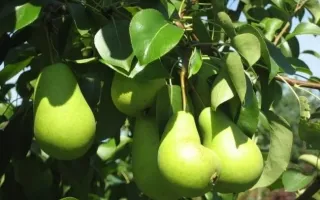
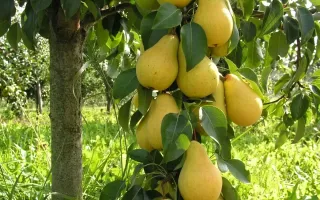
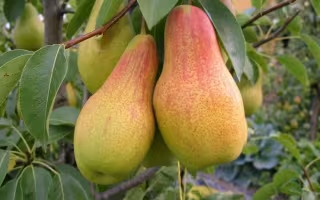
Fruits are medium to large in size, elongated-persimmon-shaped, symmetrical, with a ridged, uneven surface. Main color is greenish-yellow, covered with a slight orange blush. Pedicel is medium in length and thickness, curved. Receptacle is medium-sized, closed over a short funnel-shaped sub-receptacle tube. Seed chambers are closed, containing medium-sized, elongated, brown seeds. Central cavity is medium-sized.
Flesh is white, very juicy, tart-sweet, of excellent flavor. Ripening is late-season. Ripening is asynchronous; harvesting is best done in two or three batches. Ripe fruits are better retained on the tree; after harvest, they do not store well.
Fruits are suitable for fresh consumption and processing.
Fruit production begins on the 4th-5th year (from the year of growth in the nursery). Winter hardiness is high, comparable to older medium-Russian varieties. The variety is resistant to fungal diseases.
Advantages of the variety: high ecological stability, high regular yields, high commercial and consumer fruit quality.
Disadvantage of the variety: short fruit storage period.
The variety is valuable for commercial and home gardens, as well as for breeding.
Video · 1 video
Suggest a video →Crop & resistance
Crop
Disease resistance
Specifications
| Type of Variety | |
|---|---|
| Catalog | Catalog → Pear |
No reviews yet. Be the first to share your experience.
Alternatives
Pear saplings · similar varieties




See also
Often considered together with this variety



Recently viewed
Products you’ve viewed on this site
Reviews