


SKU #3605
·
330 views
Bere Russian
Pear
User rating
1 vote0% positive reviews
No ratings yet — be the first.
Type of Sort
Autumn variety of pear
Store offers · 1 from 1 stores
Prices are updated on loadLoading offers…
Available at: Дворик
Aggregator catalog: prices are collected automatically from store websites, normalized by AI and converted at the current exchange rate. Before ordering, confirm the price and availability on the store's website. This block is not indexed by search engines — the data is loaded after the page opens.
About product

Autumn-winter variety selected at the Rossoshanskaya Zonal Experimental Station for Fruit Growing. Developed by A. M. Ulyanishcheva from crossing Bere Winter Michurin with Lesnaya Krasavitsa. Submitted for State Testing in the Central Chernozem and Rostov regions in 1984. Trees are medium-sized, broad-pyramidal, of medium density. Bark of the trunk is gray, scaffold branches are grayish-brown. Fr…
Type of Sort
Autumn variety of pear
Description
Autumn-winter variety selected at the Rossoshanskaya Zonal Experimental Station for Fruit Growing. Developed by A. M. Ulyanishcheva from crossing Bere Winter Michurin with Lesnaya Krasavitsa. Submitted for State Testing in the Central Chernozem and Rostov regions in 1984.
Trees are medium-sized, broad-pyramidal, of medium density. Bark of the trunk is gray, scaffold branches are grayish-brown. Fruit-bearing type is ring-like.
Shoots of medium thickness, straight, brownish, hairy. Bud break is good, branching is weak. Buds are small and sparsely arranged.
Leaves are small, egg-shaped, short-pointed, dark green with a bluish tint, smooth, weakly glossy, weakly hairy, with fine blunt-serrated edges. Petiole is of medium length and thickness.
Inflorescence — umbrella-shaped cluster. Buds are white-pink; flowers are small, dish-shaped, white, aromatic, with a bare stigma and stigma level with the anthers. Flowering period of Bere Russian is early.
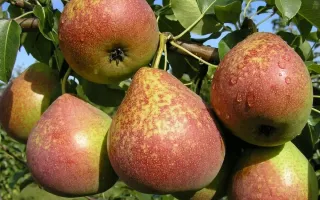
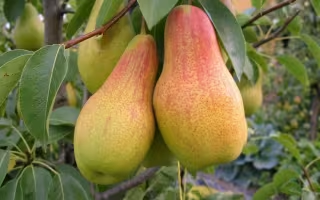
Fruits are medium to above-average size, weighing 154 g, up to 200 g maximum, rounded-conical. Skin is rough with noticeable russeting. Main color is golden-yellow, covering color is dark red, blurred, covering most of the fruit. Under-skin dots are small and barely noticeable. Peduncle is of medium length and thickness. Calyx is small, of medium width. Receptacle is open; dish is small, broad, smooth. Receptacle tube is medium-sized, sac-like. Seeds are medium-large, broad, brown.
Flesh is creamy-white, tender, very juicy, oily, slightly acidic-sweet, with moderate aroma. Appearance is attractive (rating 4.8 points), taste excellent (4.7 points). Chemical composition of fruits: sugar content — 10.6%, titratable acids — 0.24%, ascorbic acid — 10.6 mg/100g.
Harvesting maturity occurs in mid-September; consumer period extends from October to mid-January. According to consumer maturity period, the variety belongs to the autumn-winter group, with maximum storage life of 120 days.
Fruits hold firmly until harvest. Transportability is good due to strong skin. Variety is for dessert use.
Variety is self-sterile. Age of fruiting — at 7 years after grafting in the nursery. Average yield 156 centners/ha, maximum 599 centners/ha. Fruits regularly bear.
Winter hardiness in southern Voronezh region is good. Most severe frosts occurred in winters 1976-77 at minimum temperature -31.8є and 1978-79 at minimum temperature -32.2є with sharp temperature fluctuations throughout the winter. Degree of fruit wood frost damage was 2 points, degree of bark frost damage was 1.3 points. Frost resistance during flowering, like other varieties, is not strong. Severe flower frost damage (up to 100%) occurred during the end of flowering when temperature dropped to -6є on May 6-7, 1999, and to -2є for 8 days from May 2-20, 2000. Resistant to scab and powdery mildew. Affected by septoria in epiphytic years.
Advantages of the variety: good, regular yield, high quality of fruits during autumn-winter consumer period, full resistance to scab.
Disadvantages of the variety: moderate winter hardiness.
Video · 6 videos
Suggest a video →Crop & resistance
Crop
Disease resistance
Specifications
| Type of Sort | |
|---|---|
| Catalog | Catalog → Pear |
Not yet комментариев. Be the first!
Alternatives
Pear saplings · similar varieties




See also
Often considered together with this variety





Recently viewed
Products you’ve viewed on this site
Reviews · 0