


SKU #3738
·
718 views
Red-cheeked Northern
Pear
User rating
0 votes0% positive reviews
No ratings yet — be the first.
Type of Sort
Summer variety of pear
Store offers · 7 from 3 stores
Prices are updated on loadLoading offers…
Available at: Lemana Pro · Sadovnik-sam · Зелений Пітомник · Интернет магазин садовых растений Все Сорта
Aggregator catalog: prices are collected automatically from store websites, normalized by AI and converted at the current exchange rate. Before ordering, confirm the price and availability on the store's website. This block is not indexed by search engines — the data is loaded after the page opens.
About product

This summer variety was obtained at the All-Russian Scientific Research Institute of Genetics and Selection of Fruit Plants named after I. V. Michurin by S. P. Yakovlev through crossing the Northern variety with Red-cheeked. It is of interest for the middle belt and may, in the future, replace Northern in certain regions. It is recommended in the Central Chernozem region.
The tree is tall, fas…
Type of Sort
Summer variety of pear
Description
This summer variety was obtained at the All-Russian Scientific Research Institute of Genetics and Selection of Fruit Plants named after I. V. Michurin by S. P. Yakovlev through crossing the Northern variety with Red-cheeked. It is of interest for the middle belt and may, in the future, replace Northern in certain regions. It is recommended in the Central Chernozem region.
The tree is tall, fast-growing, with a broad-pyramidal crown; due to high shoot-forming ability, it may become somewhat dense, with branches diverging at a sharp angle. Bark on the trunk and skeletal branches is brown and smooth. The predominant type of fruiting structures during fruiting is simple rings.
Shoots of medium thickness, slightly curved, weakly curved, brown, glabrous. Buds are medium-sized, pressed, pointed. Leaves are medium-sized, green, elongated. Blade is horizontal, glossy, with coarse venation, apex slightly acute, base wedge-shaped, folded, curved, leaf margin serrated, stipules saber-shaped, petiole medium-sized, thin, glabrous.
Flowers are medium-sized, on long pedicels, saucer-shaped, white, 4-6 per inflorescence, petals entire, weakly fused, weakly double, stigmas at the level of stamens. Flowering is early, flowers exhibit high frost resistance.
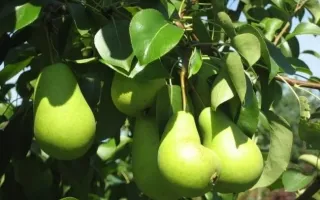
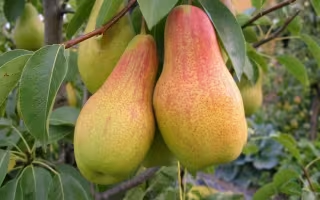
Fruits are slightly below average size, medium-sized, oval in shape, surface smooth. Color at harvest: main light-yellow, covering brown on a significant portion of the fruit; during storage, main light-yellow, covering brown-red on the sun-exposed side. Peduncle is medium-sized, thin, upright. Calyx is small, medium-sized, open, cup-like, short, wide, sac-like. Heart is medium-sized, elliptical, chambers medium-sized, open. Seeds are large, egg-shaped, brown.
Flesh is slightly creamy, medium density, semi-oily, juicy, slightly tart-sweet taste, weak aroma, no bitterness or gritty cells. Chemical composition of fruits: total sugars — 9.4%, titratable acids — 0.75%, ascorbic acid — 7.0 mg/100g, P — active substances (catechins) — 46 mg/100g, pectin substances — 0.64%, arbutin — 3.81%.
Fruits ripen in mid-August, harvest period lasts up to two weeks. By ripening time, it fills the gap between the earliest variety, Michurinskaya Skorospelka, and Northern. Flavor deteriorates during storage.
Fruits remain firmly attached to the tree, sufficiently transportable. Good for processing into juice and compote.
Self-fertility is low, requires pollinators; the best is the Yakovlev Memorial variety.
Trees begin fruiting in the 5th year after planting in the garden, fruiting is regular, yield of 8-year-old trees around 120 centners/ha. Winter hardiness is high, slightly lower than Northern. Resistant to the most common fungal diseases, primarily scab, and only in certain years may suffer from septoria leaf spot.
Advantages of the variety: early fruiting, high winter hardiness and resistance to scab, attractive appearance of fruits, versatility of use.
Disadvantages of the variety: small fruit size.
Video · 9 videos
Suggest a video →Crop & resistance
Crop
Disease resistance
Specifications
| Type of Sort | |
|---|---|
| Catalog | Catalog → Pear |
Not yet комментариев. Be the first!
Alternatives
Pear saplings · similar varieties



See also
Often considered together with this variety


Recently viewed
Products you’ve viewed on this site
Reviews · 0