

SKU #63036
·
34 views
ASGEOS
Onion
User rating
0 votes0% positive reviews
No ratings yet — be the first.
Type
Leek
Direction
Salad
Maturation Period
150 - 160 days
Harvest Method
Manual
About product

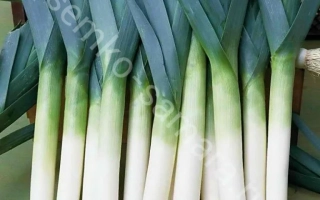
Asgeos leek belongs to mid-late varieties with universal purpose. It is characterized by dark green leaves with a bluish tint and a medium waxy coating, reaching a length of 70 cm and a width of about 6.5 cm. The number of leaves on the plant is approximately 11-12 pieces. The whitened part, or "leg", has a cylindrical shape with a weakly expressed bulb, a length of 16-17 cm and a diameter of 3.5-…
Type
Leek
Direction
Salad
Maturation Period
150 - 160 days
Harvest Method
Manual
Description
Asgeos leek belongs to mid-late varieties with universal purpose. It is characterized by dark green leaves with a bluish tint and a medium waxy coating, reaching a length of 70 cm and a width of about 6.5 cm. The number of leaves on the plant is approximately 11-12 pieces. The whitened part, or "leg", has a cylindrical shape with a weakly expressed bulb, a length of 16-17 cm and a diameter of 3.5-3.8 cm. The flavor of the leek is semi-sharp, which makes it suitable for consumption fresh, as well as for canning and drying. The mass of one plant varies from 320 to 400 grams depending on growing conditions. The Asgeos variety is distinguished by high marketable yield, which reaches 228 centners per hectare in the Central region, and up to 343 centners per hectare in the North Caucasus. Plants have a compact leaf arrangement, which allows for thickening the planting in a row, which is especially important for small garden plots. For growing, it is recommended to use seedlings sown in February, which are planted in open ground at the beginning of May with interrow spacing of 40 cm and a distance between plants in a row of 10-15 cm. The planting depth should be 2-3 cm more than in seedling cups. During the summer, top dressing with cow manure solution and hilling are carried out for maximum whitening of the leg. Asgeos leek stores well, maintaining taste qualities for 5-6 months when stored in boxes with sand in a cool cellar. The variety is resistant to a number of diseases, which facilitates its growing in various climatic conditions, including Siberia. Thanks to its characteristics and universality of application, Asgeos is an excellent choice for growing both on suburban plots and in more large-scale enterprises, including mechanized cultivation.
Specifications hover over for a hint about the specification
|
Type
Type
Galia (Galia) type — relatively new, of Israeli origin, although there are indications that this variety may originate from Spain. The fruits of this type are round or oval, weighing about 1 kg. The surface is smooth, covered with a delicate, connected netting, turning yellow whe... |
|
|---|---|
|
Direction
Direction
Existing varieties and types of cabbage are grown for fresh consumption, long-term storage, and technical processing. |
|
|
Maturation Period
Maturation Period
Vegetation period from emergence to technical maturity 30-50 days. |
150 - 160 days |
|
Harvest Method
Harvest Method
Most existing onion varieties are harvested manually. This is because onion bulbs are very sensitive to mechanical damage. However, there are varieties whose bulbs have a hard consistency and are suitable for mechanical harvesting. |
|
|
Yield
Yield
Overall bulb harvest per unit area. Depends on both onion variety characteristics and agronomic practices, fertilizers, and irrigation. Under optimal growing conditions, an onion yield of 100 tons per hectare and above is not considered record-breaking. |
More than 100 tons/ha |
|
Storage
Storage
Depending on the variety characteristics, the storage period for heads may vary from one month for early varieties to eight months for late cabbage varieties. |
5 - 6 months |
| Registration year | 1995 |
| Catalog | Catalog → Onion |
| Legal data |
Show · 3 |
| Country | Russia |
Store offers
Prices are updated on loadLoading offers…
Aggregator catalog: prices are collected automatically from store websites, normalized by AI and converted at the current exchange rate. Before ordering, confirm the price and availability on the store's website. This block is not indexed by search engines — the data is loaded after the page opens.
Not yet комментариев. Be the first!
Alternatives
Onion seeds · similar varieties






See also
Often considered together with this variety



Recently viewed
Products you’ve viewed on this site
Reviews · 0