


SKU #74212
·
64 views
Karolina
Mustard
User rating
0 votes0% positive reviews
No ratings yet — be the first.
Assignment
Feed, Celestial
Ripening Period
85–95
Plant Height
60–90
Registration year
1994
Prices in stores
from1.6 €per 1 kg
pack from 1.6 € per 1 kg
2 offers from 2 stores
Store offers · 2 from 2 stores
Prices are updated on loadLoading offers…
Available at: Агроексперт-Трейд · Bubochka · Ryda
Aggregator catalog: prices are collected automatically from store websites, normalized by AI and converted at the current exchange rate. Before ordering, confirm the price and availability on the store's website. This block is not indexed by search engines — the data is loaded after the page opens.
About product

The «Carolina» mustard variety belongs to the medium-late and mature types, ensuring high productivity of both seeds and green mass. The plant develops quickly: the vegetative period up to the stage of maturity for cutting is 40–50 days, and up to seed harvest – 85–100 days. The yield of dry matter reaches 5.5–6.5 t/ha, and seeds – 1.5–2.0 t/ha. Crude protein content in dry matter is in the range…
Assignment
Feed, Celestial
Ripening Period
85–95
Plant Height
60–90
Registration year
1994
Description
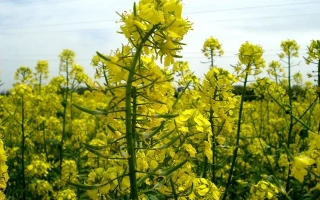
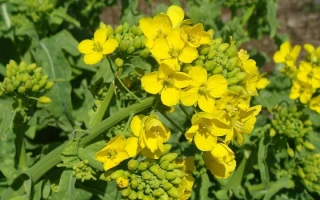
The «Carolina» mustard variety belongs to the medium-late and mature types, ensuring high productivity of both seeds and green mass. The plant develops quickly: the vegetative period up to the stage of maturity for cutting is 40–50 days, and up to seed harvest – 85–100 days. The yield of dry matter reaches 5.5–6.5 t/ha, and seeds – 1.5–2.0 t/ha. Crude protein content in dry matter is in the range of 17–19%, and fiber – 21.5%. Plant height ranges from 35 to 105 cm, flowers are white or light yellow, and inflorescences have a raceme form. The fruit is a pod with small seeds.
«Carolina» is widely used as a forage, technical, and cover crop. Due to high drought resistance and green mass quality, the plant is suitable for green fertilizer production: with early sowing (300 g/centner), it quickly gains mass, and after mass flowering, plants can be mowed, chopped, and incorporated into the soil without allowing full pod formation. This approach allows for effective use of mustard as a cover crop, improving soil structure and increasing nutrient availability.
Sowing rate is 15–18 kg/ha (or 300 g/centner for green fertilizer), and seed burial depth is 2–3 cm. The plant has been cultivated for over three thousand years, with its homeland considered to be the Mediterranean, but in Ukraine it has been grown since the 18th century, and its popularity has grown in recent decades. The flowering phase occurs from June to July, and fruit maturation happens in August or September.
«Carolina» is widely used as a forage, technical, and cover crop. Due to high drought resistance and green mass quality, the plant is suitable for green fertilizer production: with early sowing (300 g/centner), it quickly gains mass, and after mass flowering, plants can be mowed, chopped, and incorporated into the soil without allowing full pod formation. This approach allows for effective use of mustard as a cover crop, improving soil structure and increasing nutrient availability.
Sowing rate is 15–18 kg/ha (or 300 g/centner for green fertilizer), and seed burial depth is 2–3 cm. The plant has been cultivated for over three thousand years, with its homeland considered to be the Mediterranean, but in Ukraine it has been grown since the 18th century, and its popularity has grown in recent decades. The flowering phase occurs from June to July, and fruit maturation happens in August or September.
Crop & resistance
Crop
Specifications hover over for a hint about the specification
| Assignment | |
|---|---|
|
Ripening Period
Ripening Period
It takes 70-100 days until pepper reaches flowering stage, 130-160 days until technical fruit ripeness, and 135-180 days until physiological ripeness. |
85–95 |
| Plant Height | 60–90 |
| Registration year | 1994 |
| Catalog | Catalog → Mustard |
| Legal data |
Show · 1
|
| Country | Ukraine |
Not yet комментариев. Be the first!




See also
Often considered together with this variety





Recently viewed
Products you’ve viewed on this site
Reviews · 0