


SKU #70535
·
76 views
Sugar
Hazelnut
VNIILMUser rating
0 votes0% positive reviews
No ratings yet — be the first.
Nut; Fruit mass
1.5-2.0 grams
Registration year
1995
About product

Sugar – a hybrid red-leaved hazelnut obtained by crossing purple-leaved hazel varieties, Barcelona and Trebizonde. The plant is characterized by medium growth strength (up to 5 m) and a dense, wide crown. The bushes have dark-cherry colored leaves, which turn reddish shades in the autumn period. Sugar quickly increases yield: the first crop appears by the third year after planting, and at the age…
Nut; Fruit mass
1.5-2.0 grams
Registration year
1995
Description
Sugar – a hybrid red-leaved hazelnut obtained by crossing purple-leaved hazel varieties, Barcelona and Trebizonde. The plant is characterized by medium growth strength (up to 5 m) and a dense, wide crown. The bushes have dark-cherry colored leaves, which turn reddish shades in the autumn period. Sugar quickly increases yield: the first crop appears by the third year after planting, and at the age of seventeen the tree can produce up to 8 kg of dry nuts, and at the age of ten – from 10 to 12 kg. High winter hardiness allows it to withstand temperatures down to ‑40 °C.
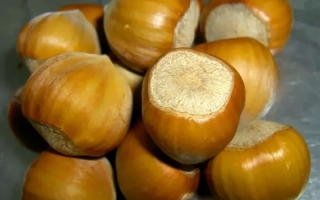
The nuts of the variety are characterized by a golden-brown shell with thin stripes and a length of about 18 mm, which corresponds to the requirements of the Turkish standard TS‑3075. The mass of the nut in the shell ranges from 1.5 to 1.8 g, and the kernel yield is 48–56 %. The fat content reaches 71 %, while the taste and aroma are rated at 4.5 points on the tasting scale. Due to high sweetness and rich taste, the nuts received the name 'Sugar'.
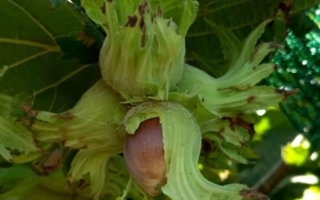
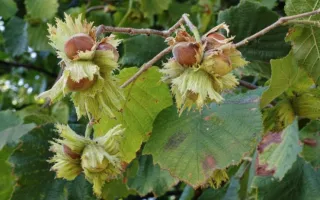
The variety is characterized by good shade tolerance and undemandingness to soils: it grows both on loams and sandy soils, is not afraid of winds and frosts. Blooming begins in early spring before the leaves unfold; during this period, golden stamens-ears appear, up to 5 cm long. The fruit is an oval or spherical nut enclosed in a bell-shaped, light-green husk. Sugar is self-pollinating, but in the presence of pollinators (for example, the variety Galley) yield increases. The plant is suitable for both commercial plantations and amateur gardens, and can also be used in living fences due to its decorativeness.
The nuts of the variety are characterized by a golden-brown shell with thin stripes and a length of about 18 mm, which corresponds to the requirements of the Turkish standard TS‑3075. The mass of the nut in the shell ranges from 1.5 to 1.8 g, and the kernel yield is 48–56 %. The fat content reaches 71 %, while the taste and aroma are rated at 4.5 points on the tasting scale. Due to high sweetness and rich taste, the nuts received the name 'Sugar'.
The variety is characterized by good shade tolerance and undemandingness to soils: it grows both on loams and sandy soils, is not afraid of winds and frosts. Blooming begins in early spring before the leaves unfold; during this period, golden stamens-ears appear, up to 5 cm long. The fruit is an oval or spherical nut enclosed in a bell-shaped, light-green husk. Sugar is self-pollinating, but in the presence of pollinators (for example, the variety Galley) yield increases. The plant is suitable for both commercial plantations and amateur gardens, and can also be used in living fences due to its decorativeness.
Video · 2 videos
Suggest a video →Specifications
| Nut; Fruit mass | 1.5-2.0 grams |
|---|---|
| Registration year | 1995 |
| Catalog | Catalog → Hazelnut |
| Manufacturer | VNIILM |
| Legal data | |
| Country | Russia |
Store offers
Prices are updated on loadLoading offers…
Aggregator catalog: prices are collected automatically from store websites, normalized by AI and converted at the current exchange rate. Before ordering, confirm the price and availability on the store's website. This block is not indexed by search engines — the data is loaded after the page opens.
Not yet комментариев. Be the first!


See also
Often considered together with this variety






Recently viewed
Products you’ve viewed on this site
Reviews · 0