


SKU #70533
·
69 views
KARAMANOVSKY
Hazelnut
User rating
0 votes0% positive reviews
No ratings yet — be the first.
Nut; Shape
Round
Registration year
1999
Prices in stores
from2.68 €per seedling
pack from 1.94 € per pack
6 offers from 5 stores
Store offers · 6 from 5 stores
Prices are updated on loadLoading offers…
Available at: Agro-landing · Agrosyla · Кліома Сервіс · Kustik · Posadka · Rassadnik · Sadco · Садовий-Розмай · Ycadba
Aggregator catalog: prices are collected automatically from store websites, normalized by AI and converted at the current exchange rate. Before ordering, confirm the price and availability on the store's website. This block is not indexed by search engines — the data is loaded after the page opens.
About product

Karamanovsky filbert – one of the largest and most high-yielding early-ripening varieties. Nuts reach a mass of 6.5 to over 8 grams, making them among the largest among all filberts. The tree has an average height (up to 4 m) and a crown width of 3–3.5 m, semi-dwarf growth, and a spreading but not too dense branch cover. Bushes are easily formed into a standard form, which is convenient for mechan…
Nut; Shape
Round
Registration year
1999
Description
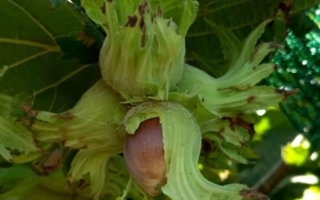
Karamanovsky filbert – one of the largest and most high-yielding early-ripening varieties. Nuts reach a mass of 6.5 to over 8 grams, making them among the largest among all filberts. The tree has an average height (up to 4 m) and a crown width of 3–3.5 m, semi-dwarf growth, and a spreading but not too dense branch cover. Bushes are easily formed into a standard form, which is convenient for mechanized harvesting.
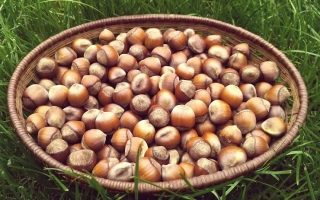
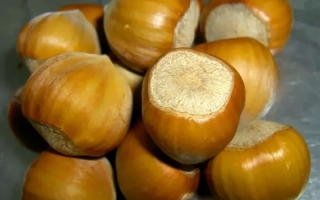
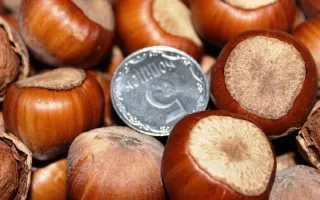
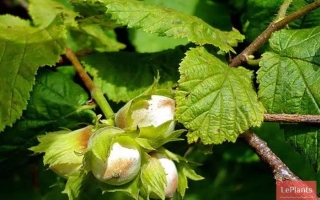
The fruiting characteristics of Karamanovsky are impressive: nuts of round shape with a slightly pointed apex, medium shell thickness (≈1.1 mm), light brown color, and a light kernel. The hull is longer than the nut, light green, and easily separates at maturity, which facilitates processing. The kernel is dense, occupying 48–50% of the fruit mass, containing about 70% fat and 18% protein, as well as B group vitamins and vitamin E. The ripening period is average, usually the second half of August.
Karamanovsky is distinguished by high yield: up to 7 kg of nuts can be collected from one tree, which at dense planting gives 2–2.5 tons/ha of dry nuts. The variety is resistant to frost and drought, and also protected from main pests (weevil, bud mite, longhorn beetle). It is self-fertile within 95–97%, but for maximum productivity, the planting of pollinators – Cosford, Sirena, or Dolinsky – is recommended. Due to the large size and high fat content, nuts are widely used both in the food industry (oil, baking) and in household consumption.
Karamanovsky grows easily on fertile soils, but also withstands dry spells and severe frosts. This makes it a universal choice for farmers who want a stable yield of large nuts with high quality and market price.
The fruiting characteristics of Karamanovsky are impressive: nuts of round shape with a slightly pointed apex, medium shell thickness (≈1.1 mm), light brown color, and a light kernel. The hull is longer than the nut, light green, and easily separates at maturity, which facilitates processing. The kernel is dense, occupying 48–50% of the fruit mass, containing about 70% fat and 18% protein, as well as B group vitamins and vitamin E. The ripening period is average, usually the second half of August.
Karamanovsky is distinguished by high yield: up to 7 kg of nuts can be collected from one tree, which at dense planting gives 2–2.5 tons/ha of dry nuts. The variety is resistant to frost and drought, and also protected from main pests (weevil, bud mite, longhorn beetle). It is self-fertile within 95–97%, but for maximum productivity, the planting of pollinators – Cosford, Sirena, or Dolinsky – is recommended. Due to the large size and high fat content, nuts are widely used both in the food industry (oil, baking) and in household consumption.
Karamanovsky grows easily on fertile soils, but also withstands dry spells and severe frosts. This makes it a universal choice for farmers who want a stable yield of large nuts with high quality and market price.
Video · 6 videos
Suggest a video →Crop & resistance
Specifications
| Nut; Shape | |
|---|---|
| Registration year | 1999 |
| Catalog | Catalog → Hazelnut |
| Legal data |
Show · 2
|
| Country | Georgia |
Not yet комментариев. Be the first!




See also
Often considered together with this variety




Recently viewed
Products you’ve viewed on this site
Reviews · 0