


SKU #70530
·
63 views
Galina
Hazelnut
User rating
0 votes0% positive reviews
No ratings yet — be the first.
Nut; Shape
Round
Registration year
2019
Prices in stores
from3.33 €per seedling
pack from 16.64 € per 5 pcs
1 offer from 1 store
Store offers · 1 from 1 stores
Prices are updated on loadLoading offers…
Available at: Agro-landing
Aggregator catalog: prices are collected automatically from store websites, normalized by AI and converted at the current exchange rate. Before ordering, confirm the price and availability on the store's website. This block is not indexed by search engines — the data is loaded after the page opens.
About product

The 'Galina' variety is an early hazelnut option developed by GNU VNIICiSK of the Rosselkhoznadza Academy in 1992 on the Black Sea coast of Krasnodar Krai. The bush is of medium height with an oval, moderately dense crown, reaching a height of up to 3.5 m and a diameter of 3–3.5 m. Branches depart from the trunk at a right angle; the bark is grayish with small light speckles. Leaves are of medium…
Nut; Shape
Round
Registration year
2019
Description
The 'Galina' variety is an early hazelnut option developed by GNU VNIICiSK of the Rosselkhoznadza Academy in 1992 on the Black Sea coast of Krasnodar Krai. The bush is of medium height with an oval, moderately dense crown, reaching a height of up to 3.5 m and a diameter of 3–3.5 m. Branches depart from the trunk at a right angle; the bark is grayish with small light speckles. Leaves are of medium size (8–10 cm in length, 6–8 cm in width), have an elongated-oval shape and a smooth surface; the lower side is slightly hairy.
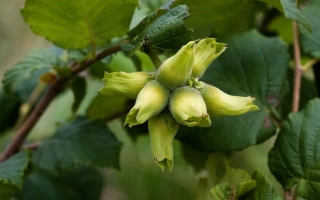
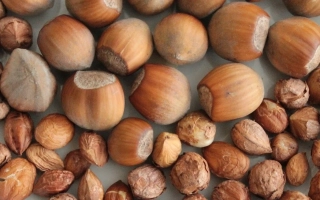
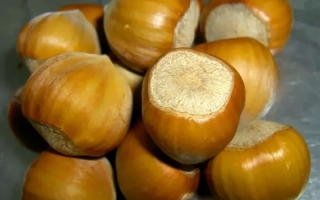
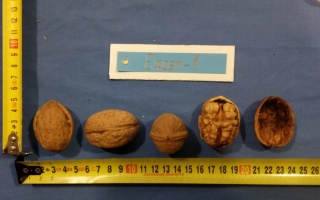
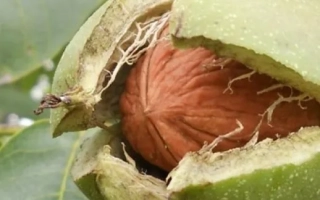
The fruits of the 'Galina' hazelnut are large: length about 26 mm, width 24 mm, shape round with a slightly pointed tip. Nuts are collected in inflorescences of 2–8 pieces (on average 4–6). The husk consists of two lobes and separates easily upon ripening. The shell is of medium thickness (1–1.1 mm), light brown, and the kernel occupies 48–50% of the total nut mass and contains about 69% fat, 17% protein, B-group vitamins, and vitamin E. Nuts retain their quality in controlled conditions for up to three years.
The variety is characterized by high yield – up to 1.9–2 t/hg of dry nuts in shells – and stable fruiting. It shows medium resistance to frost, drought, and pests (weevil, gall mite, hazel borer). Self-fertility is 0.92–0.95, pollen viability is 75–80%. 'Galina' is successfully grown in a standard form and is suitable for mechanized harvest collection.
The fruits of the 'Galina' hazelnut are large: length about 26 mm, width 24 mm, shape round with a slightly pointed tip. Nuts are collected in inflorescences of 2–8 pieces (on average 4–6). The husk consists of two lobes and separates easily upon ripening. The shell is of medium thickness (1–1.1 mm), light brown, and the kernel occupies 48–50% of the total nut mass and contains about 69% fat, 17% protein, B-group vitamins, and vitamin E. Nuts retain their quality in controlled conditions for up to three years.
The variety is characterized by high yield – up to 1.9–2 t/hg of dry nuts in shells – and stable fruiting. It shows medium resistance to frost, drought, and pests (weevil, gall mite, hazel borer). Self-fertility is 0.92–0.95, pollen viability is 75–80%. 'Galina' is successfully grown in a standard form and is suitable for mechanized harvest collection.
Specifications
| Nut; Shape | |
|---|---|
| Registration year | 2019 |
| Catalog | Catalog → Hazelnut |
| Legal data |
Show · 2
|
| Country | Georgia |
Not yet комментариев. Be the first!






See also
Often considered together with this variety



Recently viewed
Products you’ve viewed on this site
Reviews · 0