Spontaneous anthocyanic mutant of the Williams variety. Approved for the North Caucasus region.
Small tree, less vigorous than Williams. Open, pyramidal crown, more compact than Williams. Main branches diverge at 30-40° angles from the lower trunk, then arch downward. Bark on the trunk has cracks; on main branches it is smooth, light gray, with medium leaf coverage. Bears fruit mainly on 3-4-year-old wood and multi-year fruit buds.
Shoots are upright, curved, medium in length and thickness, brownish-green with a burgundy blush on sun-exposed sides, turning brown with maturity. Petioles are light-brown, small, elongated, barely noticeable. Moderate shoot-forming ability. Buds on one-year shoots are densely packed, small, elongated-conical, pointed, slightly swollen, dark brown, situated on small bark swellings. Good bud break; young branches are covered with numerous fruit buds. Leaves medium-sized, dark green, glossy, elongated-oval in shape. Leaf margins are slightly uplifted upward; central vein is straight; on one-year shoots leaves are curved along the central vein. Bark and leaves on shoot tips are burgundy-red and hairy.
Blooms in mid-late season, flowers are moderately frost-resistant.
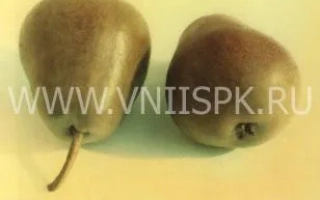
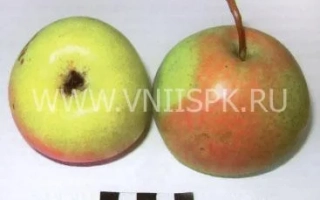
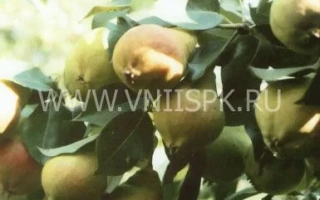
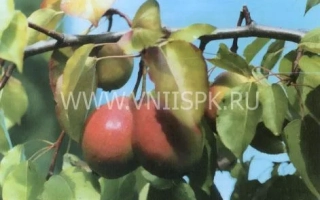
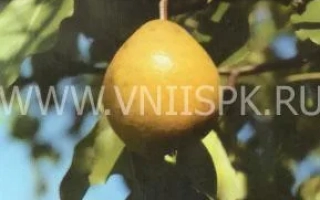
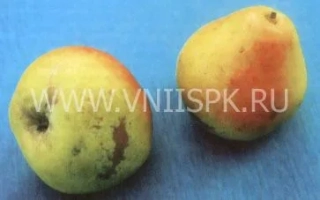
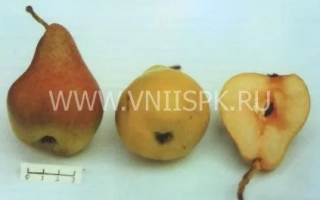
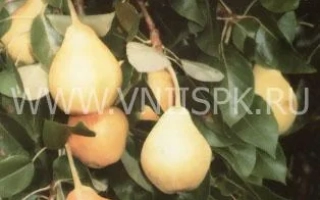
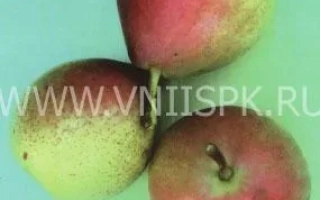
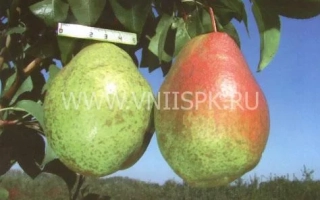
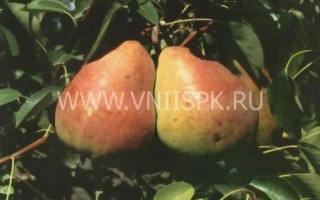
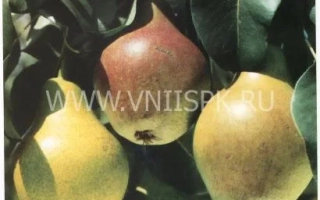
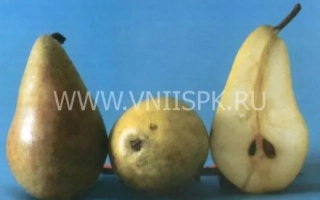
Fruits are above-average size, pear-shaped, with slightly warty surface. Skin is thin, tender, glossy, uniformly covered with dark burgundy blush, turning bright red on fully ripe fruits. Numerous small yellow or yellowish-pink subcutaneous dots are visible throughout the fruit, sometimes with small rust spots. Ripe fruits are very attractive. Fruit stalks are medium-sized, expanded at the attachment point to the branch, straight, brown. Calyx tube is narrow, shallow, with warty edges, often rusted. Depression in the calyx is small, wide, ribbed. Calyx is small, open.
Flesh is yellowish-white, tender, juicy, melting, tart-sweet, with a musky flavor, excellent taste, containing: dry matter — 12.9%, sugars — 8.4%, titratable acids — 0.38%, ascorbic acid — 6.3 mg/100g, P-active catechins — 37.8 mg/100g dry matter.
Harvesting maturity occurs at the end of August. Ripens in 15-20 days in storage. Stored in cooled fruit storage until November. Transportability is satisfactory. Used fresh and for making high-quality processed products (compotes, jams, jellies).
Best pollinators are varieties: 'Lubimitsa Klappa', 'Bere Ziffar', 'Bere Gardi', 'Lesnaya Krasavitsa', 'Olivier de Serre'. Low soil-climate requirements, but should be grown with intermediate spacing and only on high-fertility, medium-textured, deep soils with regular irrigation. Demands good agronomic practices, highly responsive to organic fertilization.
Begins fruiting in the 5th year after planting. Yield is slightly lower than the original variety. Moderate winter and drought resistance. Disease resistance is comparable to Williams variety.
Advantages of the variety: low tree vigor and early fruiting, high commercial and taste quality of fruit.
Disadvantages of the variety: relatively low winter and drought resistance.
Williams Royal Delbar, like other mutants of this type, tends to revert: on some branches, fruits with uncolored stripes and yellow coloration appear. Such branches should be removed and cuttings should not be taken from them.
Promising for intensive orchard cultivation. Of interest for breeding programs. Tends to pass on to offspring (up to 50% seedlings) restrained tree growth, early fruiting, and fruit coloration.