Summer variety developed at the Krasnoyarsk Experimental Station for Fruit Growing by N. N. Tikhonov and A. S. Tolmacheva from crossing Ussuri pear No. 212 with seedling 'Lesnaya Krasavitsa' 13-67-8.
The variety is widely grown, mainly in the forest-steppe subzone of southern Krasnoyarsk Krai, in Khakassia, where it has shown good performance. The variety is included in the State Register for Altai, Krasnoyarsk Krai, Kemerovskaya, Novosibirskaya, Omskaya, Tomskaya, Tyumenaya, Irkutskaya, Chita regions, and republics of Altai, Buryatia, Tuva, and Khakassia.
Tree — semi-dwarf, with a sparse pyramidal crown. Bark of young branches is gray-green, then (from age 8) — gray.
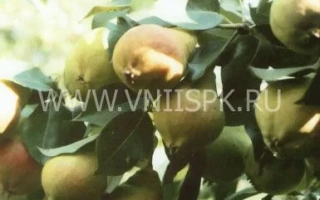
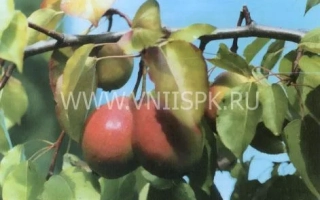
Shoots of medium thickness, slightly curved, round in cross-section, red, bare, with a coating on one side. Buds numerous, medium-sized, elongated, convex on 2-year-old wood. Buds are pressed, small, conical, smooth. Leaves small, elongated, broadly egg-shaped, short-pointed, light green with a yellowish tint, smooth, glossy, with delicate venation, very small hairs. Leaf margin toothed. Petiole thin, very long, bare. Bears fruit on 2-4-year-old wood, on simple and complex rings, spear-shaped.
Flowers large, small-cup-shaped, white, weakly aromatic. Petals egg-shaped. Style of pistils very short, without hairs. Stigmas equal to stamens.
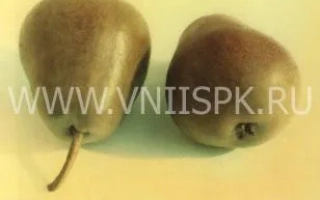
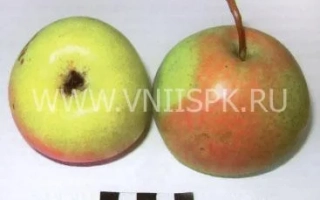
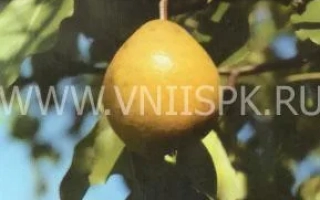
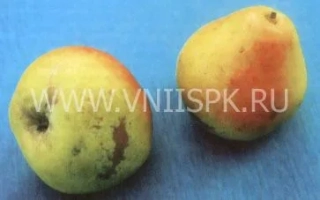
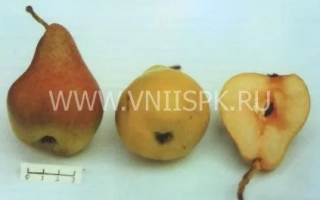
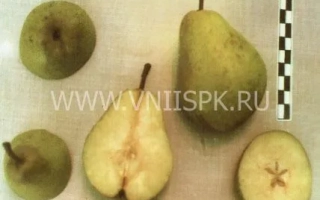
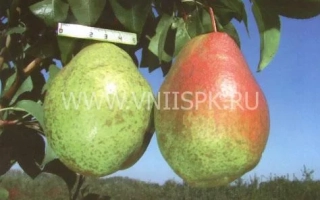
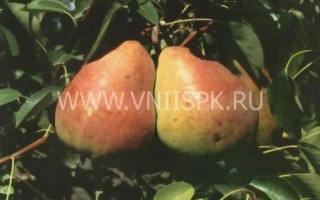
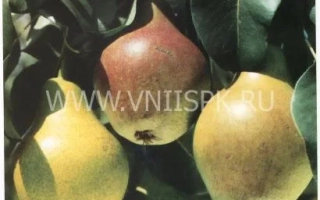
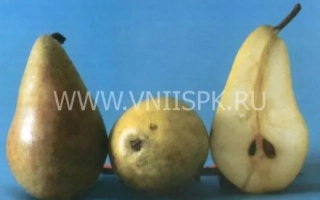
Fruits small, broad-pear-shaped. Fruit surface smooth. Skin tender, smooth, oily. Color greenish, with a brown-red blush covering 2/3 of the fruit. Few small, gray, clearly visible lenticels. Fruit stalk medium length and thickness, sometimes curved. Calyx half-open, on average, narrow dish. Calyx tube medium, cup-shaped, central cavity small, not connected to seed chambers.
Flesh white, medium density, tender, very juicy, with granulation around chambers in dry years. Flavor sweet. Aroma strong, characteristic of southern pears. Chemical composition of fruits: dry matter — 12.7%, sugar — 9.0%, titratable acids — 0.50%, sugar-to-acid ratio 17.9, ascorbic acid — 5.60 mg/100g, vitamin P — 107 mg/100g.
Summer variety.
Fruits ripen on August 25 and remain fresh for only 7–10 days. Primary use — fresh consumption.
Self-sterile variety. Best pollinators — Krasnoyarsk Large, Nevellchka, Malinovka.
Fruit production begins at age 6, commercial yield starts at age 8, highest yield at age 19 — 158 centners/ha. Trees produced fruit even after unfavorable winters of the 1980s.
Winter hardiness satisfactory. Resistant to scab.
Advantages of the variety: good fruit flavor, resistance to scab, semi-dwarf tree habit.
Disadvantages of the variety: small fruits, poor storability and transportability.