


SKU #3619
·
1 032 views
Williams
Pear
User rating
0 votes0% positive reviews
No ratings yet — be the first.
Type of Sort
Summer variety of pear
Prices in stores
from3.2 €per seedling
pack from 3.2 € per 1 pcs
4 offers from 4 stores
Store offers · 4 from 4 stores
Prices are updated on loadLoading offers…
Available at: AgronomVIP · ВіоСад · Дворик · Pitomnik · Posadka
Aggregator catalog: prices are collected automatically from store websites, normalized by AI and converted at the current exchange rate. Before ordering, confirm the price and availability on the store's website. This block is not indexed by search engines — the data is loaded after the page opens.
About product

This classic late-summer pear was developed around 1796 in Berkshire (England) by Wiler; it was later propagated by R. Williams, who gave it his name. It is regionally adapted to the North Caucasus region. The variety is widely distributed in southern regions of Russia: Dagestan, Kabardino-Balkaria, North Ossetia, Stavropol and Krasnodar regions, Rostov and Kaliningrad Oblasts, as well as in Ukra…
Type of Sort
Summer variety of pear
Description
This classic late-summer pear was developed around 1796 in Berkshire (England) by Wiler; it was later propagated by R. Williams, who gave it his name. It is regionally adapted to the North Caucasus region. The variety is widely distributed in southern regions of Russia: Dagestan, Kabardino-Balkaria, North Ossetia, Stavropol and Krasnodar regions, Rostov and Kaliningrad Oblasts, as well as in Ukraine, Uzbekistan, Turkmenistan, Tajikistan, Kyrgyzstan, Azerbaijan, Latvia, Georgia, Moldova. A summer variety, it is rightfully considered a world standard and benchmark for other varieties. One of the best dessert varieties for commercial, amateur, and garden cultivation.
Tree is weak- or medium-growing, with a broad-pyramidal, widely leafy, asymmetrical crown; bark on the trunk and main scaffold branches is gray and smooth.
Shoots are thick, slightly curved or straight, bare, with few stipules, medium-sized, light-yellow. Leaves are large, egg-shaped, short-pointed, smooth, shiny, slightly folded like a boat. Lateral veins are light-colored, characteristic of this variety, raised. Leaf margin is finely toothed, tip short. Leaf buds are short, pointed, slightly separated from the shoot, seated on swollen cushions.
Flowers are medium-sized, 6-7 per cluster. Flowering is late and fairly prolonged; flowers are not especially sensitive to adverse weather conditions.
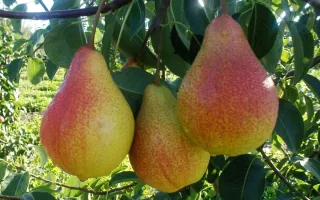
Fruits are medium to large, averaging 170 g (up to 180 g on young trees), pear-shaped, with slightly warty surface. Skin is fragrant, thin, shiny, greenish-yellow at harvest, turning waxy-yellow with small gray spots upon ripening. Occasionally, brownish spots appear on the fruit, spreading toward the poles; the sunny side may have a slight blush. Peduncle is medium-length, thick, slightly curved, sometimes with a flared tip at the upper end. Calyx is open or half-open, small. Seed cavity is small, elliptical, weakly defined. Seed chambers are medium-sized, elongated-oval, tapering toward the base of the fruit, with a hollow axis. Seeds are small, egg-shaped, dark-brown.
Flesh is yellowish-white, tender, melting, juicy, vinous-sweet with a distinctive nutmeg aroma, excellent dessert flavor.
Fruits contain 13.8% dry solids, 8.3% sugars, 0.42% titratable acids, 5.4 mg/100g ascorbic acid, and 42.6 mg/100g raw mass of P-active catechins.
Fruits set in pairs or triplets, remain firmly attached to the tree, well-anchored to the peduncle. Harvesting maturity occurs in the second decade of August. Harvested prematurely (before skin turns yellow), fruits can be stored for up to 15 days and withstand transportation well during this time. Stored in refrigerators for up to 45 days. Versatile variety. Excellent for making compotes and drying, producing products of outstanding quality. Dried fruits have a beautiful cream-yellow color, excellent flesh texture, and good flavor.
Self-sterile. Best pollinators — Clapp's Favorite, Forest Beauty, Olivier de Serre. Grows well on pear and quince rootstocks. For dwarf plantings of this variety, fertile, nutrient-rich soils with adequate moisture are necessary; otherwise, trees quickly exhaust and die prematurely.
Enters fruiting stage very early: trees grafted onto pear — at 5-6 years; grafted onto quince — at 3-4 years. Yield varies significantly depending on growing conditions: in Moldova, average yield per tree is 230-250 kg. Average yield in central Kuban region at 12-17 years — 100-120 centners/ha; in mountainous areas — 200 centners/ha. In Crimea, 18-20-year-old trees yield 150 kg or more; in Chernovitsky region, 28-year-old trees average 93 kg; in central Ukrainian steppes, 19-year-old trees yield 69 kg (Drozdenko R.P. et al.).
Cold and drought resistance of this variety is low, especially in young trees; it is not demanding on soil conditions, but performs best on fertile, well-watered soils. Sensitive to air drought, so trees should be planted on sites protected from wind. Affected by mild powdery mildew, strongly attacked by aphids and mealybugs.
Advantages of the variety: regular good yield, early fruiting, high fruit quality.
Disadvantages of the variety: low drought and cold resistance of trees.
Widely used in breeding.
Crop & resistance
Crop
Specifications
| Type of Sort | |
|---|---|
| Catalog | Catalog → Pear |
Not yet комментариев. Be the first!
Alternatives
Pear saplings · similar varieties





See also
Often considered together with this variety




Recently viewed
Products you’ve viewed on this site
Reviews · 0