


Prices in stores
from3.83 €per seedling
pack from 1.85 € per pack
4 offers from 4 stores
Usage Group
Wine
Ripening Period
Late
Frost Resistance
Low (up to -18°C)
Resistance to Mildew
Low
Your mark
0 votes
0% positive ratings
Store offers · 4 from 4 stores
4 offers in 4 stores — from 3.83 € per seedling.
Available at: avrora-cn-ua · noblerootsnursery-com · Sadovnikoff · Sezon
Prices are collected automatically from store websites and converted at the current exchange rate. Check the price and availability on the store website before ordering.
Description
Petit Verdot is a French technical red grape variety belonging to the Western European eco-geographical group. The variety is believed to have originated in the Bordeaux region, where it is traditionally grown in Medoc, Graves, Moulis-en-Medoc, and Pessac-Leognan. Despite the fact that vineyard areas for this variety do not exceed 5%, it is valued by winemakers for its ability to impart a deep color and special qualities to the wine. In recent years, Petit Verdot has gained popularity in other wine regions, such as Southern Europe, America, Australia, Italy, Spain, Portugal, Chile, and Argentina.
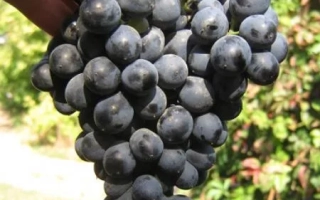
Petit Verdot vines are characterized by medium vigor and good shoot ripening. Leaves are medium-sized, three- or five-lobed, with a smooth upper surface and dense hairy indumentum on the underside. Bunches are small to medium-sized, cylindrical-conical or conical in shape, and loose. Berries are small, round, black in color with a dense waxy bloom, have thick and coarse skins, and juicy pulp. The berry flavor is neutral, without a pronounced varietal aroma, and the juice is uncolored. Sugar content varies between 17-20 g/100 cm3, acidity is 4-5 g/dm3. Yield for the variety is low, and the ripening period is late - mid-September or October.
Petit Verdot has moderate resistance to oidium but is severely affected by mildew and grape cluster tortrix. The variety's winter hardiness is moderate; it can withstand frosts down to -18°C without the death of the central bud. The grape is used primarily for the production of fortified wines, often in blends with other varieties, where it imparts a rich color and additional flavor nuances. Due to its characteristics and unique properties, Petit Verdot is becoming a valuable component in winemaking in various regions of the world.
Petit Verdot vines are characterized by medium vigor and good shoot ripening. Leaves are medium-sized, three- or five-lobed, with a smooth upper surface and dense hairy indumentum on the underside. Bunches are small to medium-sized, cylindrical-conical or conical in shape, and loose. Berries are small, round, black in color with a dense waxy bloom, have thick and coarse skins, and juicy pulp. The berry flavor is neutral, without a pronounced varietal aroma, and the juice is uncolored. Sugar content varies between 17-20 g/100 cm3, acidity is 4-5 g/dm3. Yield for the variety is low, and the ripening period is late - mid-September or October.
Petit Verdot has moderate resistance to oidium but is severely affected by mildew and grape cluster tortrix. The variety's winter hardiness is moderate; it can withstand frosts down to -18°C without the death of the central bud. The grape is used primarily for the production of fortified wines, often in blends with other varieties, where it imparts a rich color and additional flavor nuances. Due to its characteristics and unique properties, Petit Verdot is becoming a valuable component in winemaking in various regions of the world.
Video · 9 videos
Suggest a video →Crop & resistance
Crop
Specifications
| Usage Group | |
|---|---|
| Ripening Period | Late |
| Frost Resistance | |
| Resistance to Mildew | |
| Resistance to oidium | |
| Yield | Low |
| Bush Growth Power | |
| Bunch Size | Small (up to 300 g) |
| Berry Size | Small (<2 g) |
| Berry Color | |
| Flavor | |
| Sugar Content | Average (16–20%) |
| Purpose | |
| Registration year | 2017 |
| Catalog | Catalog → Grape |
| Manufacturer | Production and Agrarian Association "Massandra" |
| Legal data |
Show · 2 |
| Country | Russia |
No reviews yet. Be the first to share your experience.
Alternatives
Grapevine saplings · similar varieties

ITALY MUSCAT
Production and Agrarian Association "Massandra"
059 10 offers
2.87 €per seedling ≈ 146 ₴


Saperavi
Omsk State Agrarian University named after P.A. Stolypin
066 4 offers
3.86 €per seedling ≈ 197 ₴
See also
Often considered together with this variety


Recently viewed
Products you’ve viewed on this site
Reviews