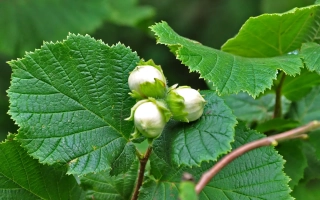
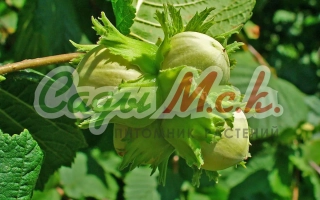
Tambowsky Early is a self-fertile hazelnut (filbert) variety obtained in 1957 by the selection of R. F. Kudashov and introduced in 1980 from the Ivanteevsky nursery of VNIILM. The bush is vigorous, reaching a height of up to 4 m and a crown diameter of about 3.5 m. It is characterized by a compact, narrow pyramidal crown with spreading branches of medium density that diverge from the trunk at an obtuse angle. The bark is grayish, and the shoots are straight, slightly drooping, and covered with "lenticels." The leaves are large (10–12 cm in length), light green in color, smooth with a light fuzz on the underside.
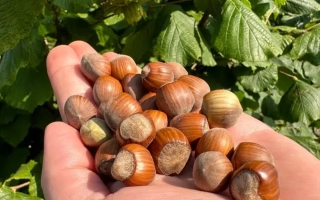
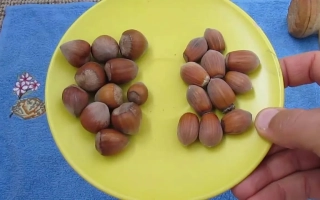
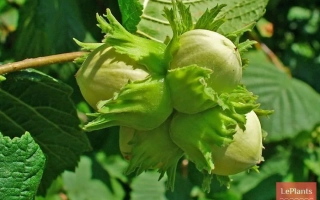
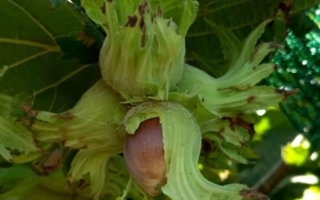
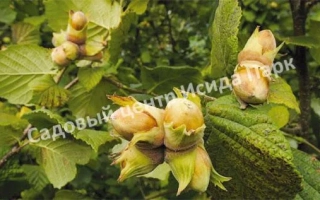
The variety is distinguished by its early maturation period: nuts are harvested in mid-August, and the flowering of male and female inflorescences coincides, ensuring a good yield. The nuts are of medium size (about 2 g), have an elongated shape, a golden-yellow color, and a thin shell with a thickness of 0.8 mm. The kernel contains about 73% oil, 18% protein, and B-vitamins, which makes it valuable both for the food industry and for consumers seeking dessert nuts with a high oily taste.
Tambowsky Early has high frost resistance – it withstands frosts down to −46 °C (in some sources, down to −42 °C) – and is resistant to drought, as well as to pests such as the hazelnut weevil, bud mite, and longhorn beetle. The yield is 0.8–1 t/ha of dry nuts in the shell; under optimal conditions, up to 3–4 kg can be collected from one bush. The nuts retain their taste qualities at room temperature for 3–4 years, which makes the variety convenient for long-term storage and transportation.
As a pollinator, Tambowsky Early is also valued for its large number of male inflorescences, ensuring good cross-pollination of other hazelnut and filbert varieties. Thanks to the combination of high nut quality, resistance to adverse climatic conditions, and convenience of storage, this variety remains one of the most in demand for industrial and household use.