


SKU #70529
·
57 views
Anastasia
Hazelnut
User rating
0 votes0% positive reviews
No ratings yet — be the first.
Nut; Shape
Round
Registration year
2019
About product

Hazelnut 'Anastasia' is an early-maturing variety developed in 1992 and recognized as a breeding achievement. It features large round nuts about 26 mm long and 24 mm wide, harvested in clusters of 4–8 nuts. The fruit has a dense kernel comprising approximately half its weight, with high fat content (70%) and protein (17%). Due to its resistance to frost, drought, and pests such as the hazelnut wee…
Nut; Shape
Round
Registration year
2019
Description
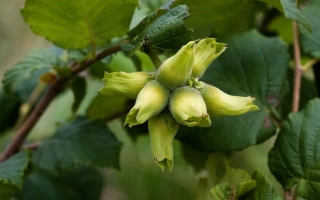
Hazelnut 'Anastasia' is an early-maturing variety developed in 1992 and recognized as a breeding achievement. It features large round nuts about 26 mm long and 24 mm wide, harvested in clusters of 4–8 nuts. The fruit has a dense kernel comprising approximately half its weight, with high fat content (70%) and protein (17%). Due to its resistance to frost, drought, and pests such as the hazelnut weevil, bud mite, and longhorn beetle, 'Anastasia' ensures a stable yield of 1.5–2 tons/hectare of dry nuts.
The bush is of medium height, reaching up to 3 meters with a crown diameter of 3–3.5 meters. Leaves are of medium size (8–10 cm long, 6–8 cm wide), with an elongated-oval shape, smooth surface, and slightly hairy underside. Flowering lasts 3–4 weeks: female inflorescences cluster in groups of 8–12, while male ones form cylindrical 'catkins' of 4–6. This ensures good self-fertility (0.92–0.95) and high pollen viability.
The variety is suitable for both bush and standard cultivation. In bush form, it displays a compact crown with dense root suckers, while in standard form, it yields high harvests with mechanized collection. For planting seedlings, autumn (end of September–December) or spring (March–April) is recommended when buds are not growing. Thanks to its high frost resistance and pest resistance, 'Anastasia' is a universal choice for commercial hazelnut production.
The bush is of medium height, reaching up to 3 meters with a crown diameter of 3–3.5 meters. Leaves are of medium size (8–10 cm long, 6–8 cm wide), with an elongated-oval shape, smooth surface, and slightly hairy underside. Flowering lasts 3–4 weeks: female inflorescences cluster in groups of 8–12, while male ones form cylindrical 'catkins' of 4–6. This ensures good self-fertility (0.92–0.95) and high pollen viability.
The variety is suitable for both bush and standard cultivation. In bush form, it displays a compact crown with dense root suckers, while in standard form, it yields high harvests with mechanized collection. For planting seedlings, autumn (end of September–December) or spring (March–April) is recommended when buds are not growing. Thanks to its high frost resistance and pest resistance, 'Anastasia' is a universal choice for commercial hazelnut production.
Crop & resistance
Pest resistance
Specifications
| Nut; Shape | |
|---|---|
| Registration year | 2019 |
| Catalog | Catalog → Hazelnut |
| Legal data |
Show · 2
|
| Country | Georgia |
Store offers
Prices are updated on loadLoading offers…
Aggregator catalog: prices are collected automatically from store websites, normalized by AI and converted at the current exchange rate. Before ordering, confirm the price and availability on the store's website. This block is not indexed by search engines — the data is loaded after the page opens.
Not yet комментариев. Be the first!







See also
Often considered together with this variety



Recently viewed
Products you’ve viewed on this site
Reviews · 0