


SKU #3885
·
550 views
Sweet cherry Ostheimer Sour Cherry
Cherry, Sour Cherry
User rating
0 votes0% positive reviews
No ratings yet — be the first.
Type of Sort
Cherry
Store offers · 3 from 3 stores
Prices are updated on loadLoading offers…
Available at: Agro-Shop · Экосад · Posadka
Aggregator catalog: prices are collected automatically from store websites, normalized by AI and converted at the current exchange rate. Before ordering, confirm the price and availability on the store's website. This block is not indexed by search engines — the data is loaded after the page opens.
About product

Ostheimer Weichsel, Ostheim Griotte, Ostheim Sour Cherry
According to various versions, this is an old variety from Spain, first described in 1796. It became widely cultivated and popular in Western European countries. It was registered in Russia since 1947 and included in the State Register for the Northwest (Kaliningrad region), Central Chernozem, North Caucasus, and Lower Volga regions.…
Type of Sort
Cherry
Description
Ostheimer Weichsel, Ostheim Griotte, Ostheim Sour Cherry
According to various versions, this is an old variety from Spain, first described in 1796. It became widely cultivated and popular in Western European countries. It was registered in Russia since 1947 and included in the State Register for the Northwest (Kaliningrad region), Central Chernozem, North Caucasus, and Lower Volga regions.
Medium-sized trees, reaching 4 meters in height at 15 years of age, with dense, round-spreading crowns. Main branches are spreading, quickly bare, with dark brown bark covered by a grayish-silver coating. Two- to three-year-old branches are drooping; one-year-old branches are thin, drooping, brownish, with a silvery coating. Vegetative buds are acute-conical; generative buds are oval. Leaves are small — 80 x 38 mm, matte, ranging from elongated-oval to elongated-inverted-egg-shaped, with a gradually tapering apex and elongated base, slightly folded along the midrib or flat; leaf margins are finely toothed; petioles 20-30 mm, slender, green with anthocyanic coloring; small brown-red glands are located 1-2 on the petiole base or leaf blade base. Flowers occur in clusters of 3-5, medium-sized — 28 mm, dish-shaped, with broadly oval, overlapping petals; styles 8 mm long, stamens 4-9 mm, stigma located below or at the level of anthers; calyx cup-shaped, strongly anthocyanic; pedicel 22 mm, slender. Fruit set is mixed — more fruit form on one-year-old shoots, less on flower clusters.
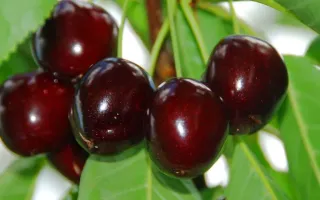
Fruits measure 18 x 20 x 18 mm, weighing 3-3.5 g, round, slightly compressed in height, black-red, with a barely noticeable ventral suture, slightly indented or flat apex, with a faint stigma scar. Flesh is tender, dark-red with pink veins, tart-sweet, with good flavor qualities; juice is intensely red. Flesh contains dry matter — 17.8%, sugars — 11.0%, free acids — 1.3%, ascorbic acid — 8.6 mg per 100 g of fresh weight. Pit measures 10 x 8.5 x 7 mm, from round to broadly oval-egg-shaped, with a sharp dorsal and broad protruding ventral suture, weighing 0.2 g, accounting for 8.3% of total fruit weight, easily separates from flesh. Peduncle is long, up to 40-50 mm, slender, easily detaches from fruit; overripe fruits may drop off. This variety is versatile, suitable for fresh consumption as well as for making high-quality jams and other processed products.
Grafted plants begin fruiting in the 3rd year after planting, productivity increases rapidly each year. In terms of flowering and ripening, it belongs to the early-mid group. Self-sterile, best pollinators include Anadolskaya, Early English, Vladimirskaya, Lyubskaya, Podbelsky, Rastunyia, Tambovchanka, Shubinka, and many other cherry varieties. Belongs to varieties with high potential productivity due to abundant generative bud formation. In southern fruit-growing zones, yields average 20 kg per tree; in full fruiting, yields reach 60-90 kg or more. Regarding low winter temperatures, it is moderately cold-resistant, and suffers significant damage, especially to generative buds, in severe winters. Moderately affected by moniliosis, susceptible to coccomycosis up to 4 points. Chlorosis on carbonate soils manifests at moderate levels.
Ostheimer Sour Cherry is a good industrial variety for southern fruit-growing zones, but in northern and mid-latitude regions it significantly lags behind many varieties from central Russia in biological and agronomic traits.
Advantages: early fruiting and high productivity, excellent flavor qualities of fruits for table and technical use.
Disadvantages: insufficient cold hardiness, susceptibility to coccomycosis.
Crop & resistance
Crop
Specifications
| Type of Sort | |
|---|---|
| Catalog | Catalog → Cherry, Sour Cherry |
Not yet комментариев. Be the first!
Alternatives
Cherry saplings · similar varieties




See also
Often considered together with this variety


Recently viewed
Products you’ve viewed on this site
Reviews · 0