


SKU #3888
·
340 views
Desertnaya Volzhskaya
Cherry, Sour Cherry
User rating
0 votes0% positive reviews
No ratings yet — be the first.
Type of Sort
Cherry
About product

Introduced by E.P. Finaev at the Kuybyshev Experimental Station for Horticulture from a cross between Vladimirskaya and Krasa Severa. Entered into the State Register in 1959 for the Middle Volga region. Medium-sized tree, 2.8–3.0 m tall, with an oval-round, moderately dense, and slightly spreading crown. Crown diameter 3.5 m. In young age, it fruits on fruiting spurs and bouquet branches; in full…
Type of Sort
Cherry
Description
Introduced by E.P. Finaev at the Kuybyshev Experimental Station for Horticulture from a cross between Vladimirskaya and Krasa Severa. Entered into the State Register in 1959 for the Middle Volga region.
Medium-sized tree, 2.8–3.0 m tall, with an oval-round, moderately dense, and slightly spreading crown. Crown diameter 3.5 m. In young age, it fruits on fruiting spurs and bouquet branches; in full fruiting period — primarily on one-year wood. Bark on trunk and main branches is smooth, dark brown, with grayish coating. Shoots are medium, straight, brownish-gray, covered with dense grayish coating. Buds are few, small, white. Leaves are medium, oval or inversely egg-shaped, slightly pointed, dark green, wrinkled, matte. Leaf blade is concave like a boat, slightly curved downward, sharply transitions into the tip, base is pointed, no pubescence. Leaf margin is serrated-toothed. Petiole is medium in length and thickness, pigmented at base. Stipules are medium, weakly divided, early falling. Stipular glands are small, usually 2, round, colored. Inflorescence — umbel (5–6 flowers). Flowers are medium, white.
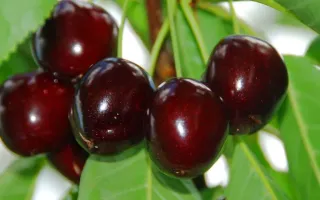
Fruits are medium, one-dimensional, average weight 3.2 g. Fruit shape is flat-round, slightly compressed on sides. Fruit apex is flat-round. Fruit base has a depression of medium depth and width. Seed scar is small, barely noticeable. Pedicel is long, thin; fruits detach easily from the pedicel but do not drop off upon ripening. Fruit color is dark red, solid. Amount of lenticels is moderate, barely noticeable. Skin is medium, smooth, glossy; easily removable. Flesh is pink-red, tender, juicy; cavity color is uniform with flesh. Juice is red, sour-sweet, very good — 4.5 points. Stone separates easily, medium, round, smooth. External fruit appearance rating — 4.5 points.
Flowering begins on May 11–12; ends May 21–22. Medium-early ripening. Fruit harvest begins July 8–12, ends July 15–18. Fruit consumption period is July 18–30. Transportability is medium. Fruits contain 16–22% dry matter, 12.03% sugars, 1.9% acids, 28.2 mg/100g ascorbic acid. Universal use variety.
Essentially self-fertile. Best pollinators: Ukrainian, Zarya Povolzhya, Vladimirskaya, Rastunyaya, Finaevskaya. Grafted trees begin fruiting on 2–3 years; rootstock trees — on 3–4 years. High annual yield: in young trees (5–7 years) — 4–12 kg per tree; at 12 years — 18 kg (data from OPX 'Samarskoe' and OPX 'Sokskoe'). Yield increases rapidly from 5 years of age; trees fruit regularly. Fruits are firmly attached to the tree.
High winter hardiness, with enhanced frost resistance of flower buds (higher than Vladimirskaya and not lower than Ukrainian). During the severe winter of 1955–1956, with January minimums of -34°C, February -37°C, and average temperature of cold period (November–March) -12.9°C (versus long-term average -9.5°C), showed average frost damage: for age group 4–7 years — 0.8 points; for age group 12–13 years — 1.2 points. Severe winters of 1968–1969, 1978–1979, and 1986–1987 were tolerated without tree loss. Drought resistance is medium, not lower than Ukrainian. Moderately resistant to gummosis (damage 0.3–0.5 points), related to frost damage of bark and wood. Fruits are not affected by gray rot. Affected by cherry slug at similar rates as Vladimirskaya and Ukrainian (1.5–2%), but less than Kostychevskaya.
Mainly propagated by grafting on seedling and rootstock understocks of Rastunyaya, Karmaleevskaya, Vladimirskaya. Easily propagated by green cuttings (up to 50–60%). Trees require elevated positions and sheltered from strong winds. Grows well and fruits well on light-textured soils. Forms well on single-tier system in half-trunk and low-stem forms. Pruning is mainly used for shaping and thinning the crown. Rootstock trees develop a skeletal root system with deep root placement, with good development.
Advantages of the variety: good winter hardiness, enhanced frost resistance of flower buds, early fruiting and high yield — not lower than Ukrainian, good fruit taste, suitability for various technical processing methods.
Disadvantages of the variety: bark and skeletal branch scalding during severe winters, shorter tree lifespan, moderately large fruits, moderate infection by coccomycosis.
Video · 1 video
Suggest a video →Crop & resistance
Crop
Disease resistance
Pest resistance
Specifications
| Type of Sort | |
|---|---|
| Catalog | Catalog → Cherry, Sour Cherry |
Store offers
Prices are updated on loadLoading offers…
Aggregator catalog: prices are collected automatically from store websites, normalized by AI and converted at the current exchange rate. Before ordering, confirm the price and availability on the store's website. This block is not indexed by search engines — the data is loaded after the page opens.
Not yet комментариев. Be the first!
Alternatives
Cherry saplings · similar varieties




See also
Often considered together with this variety


Recently viewed
Products you’ve viewed on this site
Reviews · 0