


SKU #3886
·
240 views
Sweet cherry Griot Rossohskiy
Cherry, Sour Cherry
User rating
0 votes0% positive reviews
No ratings yet — be the first.
Type of Sort
Cherry
Store offers · 5 from 4 stores
Prices are updated on loadLoading offers…
Available at: Арбор · Экосад · Posadka · Садовая Деревня
Aggregator catalog: prices are collected automatically from store websites, normalized by AI and converted at the current exchange rate. Before ordering, confirm the price and availability on the store's website. This block is not indexed by search engines — the data is loaded after the page opens.
About product

This variety was developed at the Rossohskaya Zonal Experimental Station for Horticulture by A.Y. Voronchikhina through the sowing of seeds of the Griot Ostgheim variety from open pollination. Since 1993, it has been officially approved for cultivation in the Nizhnevolsky region. Currently, it is poorly represented in commercial orchards.
The tree is vigorous, reaching a height of 5-6 m in mat…
Type of Sort
Cherry
Description
This variety was developed at the Rossohskaya Zonal Experimental Station for Horticulture by A.Y. Voronchikhina through the sowing of seeds of the Griot Ostgheim variety from open pollination. Since 1993, it has been officially approved for cultivation in the Nizhnevolsky region. Currently, it is poorly represented in commercial orchards.
The tree is vigorous, reaching a height of 5-6 m in maturity; the crown is oval or broad-pyramidal, of medium density, with medium to strong foliage. The bark on the trunk is dark gray, turning black-gray on older trees. The bark surface is slightly or moderately rough, with no or weak longitudinal cracking; lenticels are convex, long (20-30 mm), narrow or medium-sized, densely arranged. The trunk is not knotted. Branches are straight, occasionally slightly curved, with medium to long internodes; in young trees, the bark is greenish-brown, later turning grayish-brown, with no pubescence. Vegetative buds are medium-sized, 3-4 mm long, with rounded tips, broadly conical or egg-shaped; generative buds are also medium-sized, 3-4 mm long, egg-shaped with rounded tips, set apart from the branches. The leaf blade is oval or inversely egg-shaped, with a pointed or strongly pointed apex; base ranges from rounded to broadly wedge-shaped, 9-13 cm long and 5-7 cm wide on one-year shoots, greenish on top, matte, glabrous, and gray-green beneath with very sparse pubescence, mostly along lateral veins, doubly toothed with medium serration, elastic. The petiole is 20-25 mm long, medium thickness, pubescent on top, glabrous beneath, with 1-2 small glandular hairs, often absent, light green beneath and with slight brownish-red anthocyanic coloration on top, stipules absent. Inflorescences contain 2-3 flowers, rarely one, flowers of medium size, 25-30 mm in diameter, white, slightly pinkish at the end of flowering; petals are rounded, concave, often with a noticeable convex keel in the center extending to the petal margin, closely or nearly closed; flower is broadly cup-shaped or flat, stigma often hooked, positioned level with stamens or slightly above them, stamen length 8-11 mm, stigma with ovary 11-13 mm; calyx is broadly bell-shaped, swollen at the base, calyx lobes broadly lanceolate, equal in length to the calyx or slightly shorter, with small, barely noticeable teeth, partially bent backward but often remaining in horizontal plane, turning magenta at the end of flowering, giving the flower center a magenta appearance. Fruit set occurs on cluster branches and one-year growth.
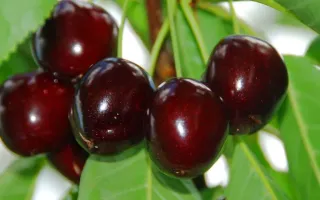
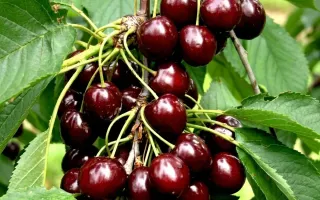
Fruits average 3.6 g in weight, 20 mm high, 25 mm wide, 20 mm thick, with a flat-oval shape, slightly or moderately flattened on sides, wide shallow depression, flat apex, stigma remains in a small wide depression. Skin color is dark cherry-red. Flesh is dark red, homogeneous, tender, soft, juice dark red. Taste is slightly tart-sweet, with a strong pleasant cherry flavor, tasting score 4.2 points. Fruits contain 12.2-19.4% soluble solids, 9.9-12.6% sugars, 1.3-2.1% titratable acids, 0.08-0.14% tannins and coloring substances. Fruit stalk is 30-35 mm long and 1-1.2 mm thick, easily detaches from the fruit, but detachment is moist, causing skin damage and juice leakage. Pit weighs 0.33 g, accounting for 9.2% of fruit weight; round, often unequal-sided, apex rounded, base flat and uncut; fresh pit color is light brownish with reddish hue, separates fairly well from flesh. Due to tender flesh and moist detachment, the variety is poorly transportable and its main use is processing. Technological qualities of fruits are high, juice dark-colored with strong pleasant aroma, compotes averaged 4.6 points for appearance and 4.5 points for taste over 8 years.
Flowering occurs in mid-season, the variety is self-fertile. Fruits ripen early to mid-season, at the end of June in southern Central Chernozem region. Grafted trees on antipka begin fruiting 3-4 years after planting in orchards, with good early fruiting. At age 3, yield may reach 6 kg/tree, at 5 years, average yield 17.4 kg/tree. Average yield over 6 years of fruiting (age 6-11 years) was 16.7 kg/tree.
Winter hardiness of the tree in southern Central Chernozem region is good, even in severe winters, degree of freezing does not exceed 1.0-1.5 points. Flower bud mortality averaged 6.9% over 7 years, maximum not exceeding 13.0%. Affected by coccomycosis to a severe degree, comparable to or higher than varieties such as Griot Ostgheim, Zhukovskaya, Kentskaya. Moderately resistant to moniliosis.
Advantages of the variety: good yield, high-quality fruits with good technological properties.
Disadvantages of the variety: vigorous tree, poor transportability of fruits.
Crop & resistance
Crop
Specifications
| Type of Sort | |
|---|---|
| Catalog | Catalog → Cherry, Sour Cherry |
Not yet комментариев. Be the first!
Alternatives
Cherry saplings · similar varieties



See also
Often considered together with this variety


Recently viewed
Products you’ve viewed on this site
Reviews · 0