


SKU #3903
·
446 views
Sweet cherry Abundant
Cherry, Sour Cherry
User rating
0 votes0% positive reviews
No ratings yet — be the first.
Type of Sort
Cherry
Prices in stores
from6.17 €per seedling
pack from 2.94 € per 1 pcs
7 offers from 6 stores
Store offers · 7 from 6 stores
Prices are updated on loadLoading offers…
Available at: Зеленый Сад · Magazin Flora · Vashnil · Питомник растений · Царь Сад · Sadovaya Kollektsiya
Aggregator catalog: prices are collected automatically from store websites, normalized by AI and converted at the current exchange rate. Before ordering, confirm the price and availability on the store's website. This block is not indexed by search engines — the data is loaded after the page opens.
About product

This variety was obtained by selection from seedlings of open-pollinated Michurin cherry varieties, sent in one-year-old seedlings from VNIIGiSPR. Originator — Sverdlovsk Selection Station for Horticulture. Authors: N.I. Gvozdikova, M.G. Isakova, S.V. Zhukov. Introduced into the State Register in 1992 for the Volgo-Vyat and Ural regions. Bush up to 2.5-3 m tall with a compact, medium-dense, round…
Type of Sort
Cherry
Description
This variety was obtained by selection from seedlings of open-pollinated Michurin cherry varieties, sent in one-year-old seedlings from VNIIGiSPR. Originator — Sverdlovsk Selection Station for Horticulture. Authors: N.I. Gvozdikova, M.G. Isakova, S.V. Zhukov. Introduced into the State Register in 1992 for the Volgo-Vyat and Ural regions.
Bush up to 2.5-3 m tall with a compact, medium-dense, round-oval crown. Bud 3.1 mm, oval, slightly deviated from the shoot. Leaf narrowly oval, dark green. Apex acuminate, base narrowly wedge-shaped, doubly serrated. Leaf blade glossy, slightly concave. Stipules 2-4, located at the base of the leaf. Petiole: length 9 mm, thickness 1 mm, light green. Number of flowers per inflorescence — 4-7. Corolla diameter 19 mm, flat. Petals white, loosely arranged. Stigma of the pistil higher than the stamens. Pistil length 9.5 mm, stamen length 4.4 mm. Calyx bowl-shaped, medium serration of the calyx lobes. Fruits borne on flower clusters and one-year shoots.
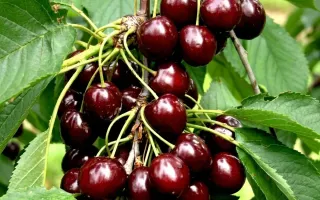
Fruits weighing 2.5-3 g. Round, height 15 mm, width 16 mm, thickness 14.5 mm, slightly compressed at the seam. Fruit depression small, apex rounded. Fruits dark red, flesh red, tender, juice rose-colored. Pedicel length 28 mm, thickness 0.78 mm. Stone oval-rounded, mass 0.21 g, which is 7.5% of the fruit mass, brown. Apex narrowly rounded, base broadly rounded. Stone separates from flesh moderately.
Fruits contain dry extractives — 13.1%, sugars — 7.9%, acids — 1.7%, ascorbic acid — 14.1 mg/100g, vitamin P — 341.6 mg/100g. Fruit appearance rating — 4 points, flesh juicy, sweet-tart flavor quite satisfactory. Fresh fruit taste rating 3.8 points. Fruit detachment from pedicel dry. Fruits resistant to cracking. Used fresh, but more for technological processing into compote, jam, juice.
Flowering late — May 30 — June 8. Self-fertile. Ripening late, in the second half of August, asynchronous. Enters fruiting on the 3rd-4th year. Annual yield high. Longevity of rootstock plants great — over 30 years, with timely rejuvenating pruning. High wood and bud winter hardiness. Due to late flowering, the variety often escapes spring frosts. Drought-resistant. Moderate susceptibility to coccomycosis and moniliosis. Occasionally damaged by cherry sawfly and cherry aphid.
The variety has high production rating in Sverdlovsk and Chelyabinsk regions' collective farms. Suitable for industrial, amateur cultivation, as well as a selection resource (winter hardiness, yield, late flowering, self-fertility). Suitable for intensive cultivation.
Advantages of the variety: winter hardiness, self-fertility, high annual yield, late flowering.
Disadvantages: small fruits, asynchronous, very late ripening. In amateur gardens, late ripening is not considered a disadvantage, as it extends the period of fresh fruit consumption.
Crop & resistance
Crop
Specifications
| Type of Sort | |
|---|---|
| Catalog | Catalog → Cherry, Sour Cherry |
Not yet комментариев. Be the first!
Alternatives
Cherry saplings · similar varieties




See also
Often considered together with this variety


Recently viewed
Products you’ve viewed on this site
Reviews · 0