Agronomic portal Agronom.info
Categories
Language
Currency
My account
Cherry, Sour Cherry

Kalitvyanka

Cultures
Fruit
Offers: 23
Where to buy
Price range
50 - 25 000 UAH
Views
202
Reviews
0
Producer
Description Kalitvyanka
This variety was developed at the Rossoshanskaya Zonalnaya Experimental Station for Gardening by A.Y. Voronchikhina through crossing Stakhanovka with Zhukovskaya. Since 1988, the variety has undergone state variety testing. It is currently distributed only weakly, mainly in suburban gardens in the southern part of Voronezh Oblast and the northern part of Rostov Oblast.
The tree is weakly or moderately tall, reaching a height of no more than 3-4 m in maturity; the crown is round, fairly dense, with good leaf coverage, and the scaffold branches diverge almost at a right angle. The bark on the trunk is gray with a cherry-like sheen, black-gray in older trees, slightly or moderately rough, slightly peeling, with weak or moderate longitudinal cracking; the lenticels are convex, long and very long, of medium width, usually with longitudinal light-brown cracks, arranged at medium density; the trunk is not twisted. The shoots are straight, fairly thick, with medium and long internodes, the bark color initially greenish-brown, then silvery-gray, especially at the base; the lenticels are medium and small, oval, whitish, arranged fairly densely. Vegetative buds are large, 4-5 mm long, round-oval with rounded tips (a characteristic feature rarely found in other cherry varieties), distant. Generative buds are smaller, 3-4 mm long, short-oval with a short-pointed tip, distant, grouped in 6-8 on very short flower clusters (a characteristic feature). The leaf blade is elongated-oval with a pointed tip and rounded or arcuate base, 10-12 cm long, 5-6 cm wide on one-year shoots, green on top, slightly wrinkled along lateral veins, moderately concave along the midrib, slightly glossy; underneath light gray-green with clearly visible vein pattern, bare with slight hair along the sides of the midrib, which is tinged light pink, with large double-toothed margin, leathery. The petiole is long, 20-30 mm, fairly thick, with very sparse hairy pubescence, anthocyanin coloration very weak, dirty-pink or absent. Stipules 1-3, small or medium, light-colored, sometimes with a black spot in the center; stipules absent. In the inflorescence, usually 3-5 flowers, sometimes the number increases to 6, rarely 1-2 occur when flower buds in the bud die from frost; pedicels are fairly short. The flower is medium-sized, 25-30 mm in diameter, flat or even slightly backward-curving petals, round or broadly oval, concave, with raised margins, white, closed; the pistil is level with the stamens or slightly elevated above them, stamen length 7-11 mm, pistil 13-15 mm. A characteristic feature of this variety is the presence of long pedicels (up to 5-7 mm) in some flower clusters, as in some eastern Asian cherry species (panicle-like umbel); in certain years, the percentage of such flower clusters is very high. The calyx tube is bell-shaped, slightly swollen at the base, slightly warty; calyx lobes are not fused, bent backward and pressed against the tube, broad-lanceolate, significantly shorter than the tube, sometimes half as short, with barely noticeable teeth at the margins. The pedicel and calyx tube are almost unpigmented, the calyx lobes turn pink at the end of flowering, causing the center of the flower to become pink upon fading. Fruit set occurs mainly on flower clusters densely covering last year's growth.
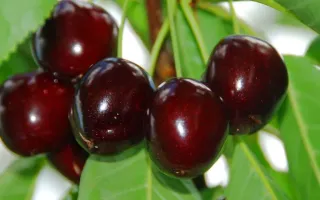
Fruits are large, average weight 5.7 g, height 20 mm, width 24 mm, thickness 21 mm, round, often not perfectly symmetrical, slightly compressed on the sides, shallow and narrow cavity, rounded apex, stigma remains in a barely noticeable small cavity. Skin color is red, dark red upon overripening. Flesh is red, fleshy, fairly firm, juice light-red. Taste is sour-sweet, pleasant, with a tasting score of 4.5 points. Fruits contain 11.3-15.6% soluble solids, 8.7-12.6% sugars, 0.8-1.5% titratable acids, 0.06-0.18% tannins and coloring substances. Pedicel 24-40 mm, thickness 1-1.5 mm, weakly attached to the stone and easily detachable, detachment at full ripeness is practically dry. Stone is large, average weight 0.54 g, which constitutes 9.5% of fruit weight, round, occasionally broadly oval, with strongly convex sides, rounded apex, often unequal-sided, sometimes with barely noticeable protruding beak, base in the form of a straight line, often slanted; color of stone in fresh state brownish-yellow, sometimes with pinkish tinge, poorly detaches from flesh. Technological qualities of fruits are fairly good: compotes are rated 4.3 points on appearance and 4.2 points on taste. Ripening occurs at medium time, in the southern part of Central Chernozem in early July.
Flowering occurs late; the variety is self-sterile, best pollinators are Lyubskaya, Zhukovskaya, Rossoshanskaya Black. Trees grafted onto antipka enter fruiting in 3-4 years after planting in the garden, with high fruiting capacity, 5-year-old trees yield up to 10 kg. Average yield in 5-8 years age was 11.2 kg/tree. During full fruiting, average yield over 4 years was 16.8 kg/tree, reaching 37.8 kg/tree in the most favorable years.
Winter hardiness of trees in the southern part of Central Chernozem is good, average frost damage even in the most unfavorable winters 1984-1985 and 1986-1987 did not exceed 2.1. Flower buds are less resistant: in severe winter 1978-1979 with temperatures down to -32.2° at the end of December to early January, 95.4% of flower buds died, in winter 1986-1987 with temperatures down to -36.4° in February, 97.8% of flower buds died. In ordinary winters for the southern part of Central Chernozem, flower bud mortality is usually not observed.
Variety Kalitvyanka is fairly resistant to coccomyces, and even in epidemic years average infection rating usually does not exceed 2, making it one of the most resistant varieties. However, it is fairly sensitive to moniliosis. During heavy rains during fruit ripening, fruits crack and are heavily infested with moniliosis. And since they hang in dense garlands, the rot quickly affects the entire harvest.
Advantages of the variety: small tree, high yield, large fruits.
Disadvantages: reduced winter hardiness of flower buds, insufficient intense fruit color.

Specifications Kalitvyanka
Cultures
Fruit
Cherry
Cherry
Type of Sort
Cherry
Catalog
Varieties
Stone Fruits
Where to buy Kalitvyanka
Loading...
Reviews Kalitvyanka
0comments
Sort by:Popular first
No comments yet.