


SKU #3937
·
447 views
Nadezhda
Cherry, Sour Cherry
User rating
1 vote0% positive reviews
No ratings yet — be the first.
Type of Sort
Cherry
Store offers · 2 from 2 stores
Prices are updated on loadLoading offers…
Available at: Agrosyla · Zberri
Aggregator catalog: prices are collected automatically from store websites, normalized by AI and converted at the current exchange rate. Before ordering, confirm the price and availability on the store's website. This block is not indexed by search engines — the data is loaded after the page opens.
About product

This variety was developed at the Rossoshanskaya Zonal Experimental Station for Horticulture by A.Ya. Voronchikhina through pollination of cherry blossoms of the 'Griot Ostgheim' variety with pollen mixtures of 'Northern' and 'Likernaya' plum varieties. In 1995, the variety was accepted for state variety testing in the Central Chernozem region. The tree is strong-growing, reaching 5-6 meters in m…
Type of Sort
Cherry
Description
This variety was developed at the Rossoshanskaya Zonal Experimental Station for Horticulture by A.Ya. Voronchikhina through pollination of cherry blossoms of the 'Griot Ostgheim' variety with pollen mixtures of 'Northern' and 'Likernaya' plum varieties. In 1995, the variety was accepted for state variety testing in the Central Chernozem region.
The tree is strong-growing, reaching 5-6 meters in maturity, with a rounded or broad-pyramidal crown of medium density and good leafing. The bark on the trunk is black-gray or dark-gray, moderately or strongly rough; longitudinal cracking of the trunk is medium or strong, and the twisting of the trunk is medium. Buds are convex, narrow, linear, ranging from short to very long, arranged with medium density. On young trees, the trunk shows characteristic longitudinal cracking with a young shiny silver-brown bark and older gray peeling bark. Branches are straight, with long internodes, initially greenish-brown, then brown with a reddish tint, and covered with numerous, very small, round, raised glands, bare. Vegetative buds are large, 5-6 mm, more elongated-oval than conical, with a moderately pointed apex, protruding. Flowering buds are also large, 4-5 mm, oval, rounded at the apex, set apart. Leaf blade ranges from oval to broadly obovate, with a sharply pointed apex and rounded or arcuate base, 10-11 cm long, 4-6 cm wide on one-year-old branches, green above, almost smooth, moderately or strongly concave along the midrib, matte, rarely slightly glossy, bare; below light green, with a pinkish midrib and very sparse hairy pubescence along lateral veins; serration is fine, double-toothed, blade consistency leathery. Petiole is short, 15-20 mm, medium thickness, hairy above, bare below, with dull dirty-pink anthocyanic coloration. Number of glands 1-2, very often absent, small or medium-sized; stipules absent. Inflorescence has 2-3 flowers, rarely 1, flowers large, 35-40 mm in diameter, white, with pink spots by the end of flowering; petals broadly obovate, spoon-shaped, frilled at the base, not fused; flower cup-shaped to nearly flat, stigma level with stamens or slightly lower; stamen length 10-12 mm, stigma with ovary — 13-15 mm. Tube of the calyx is wide-bell-shaped, slightly wrinkled; calyx lobes are broadly lanceolate, nearly entire-edged, with small sparse teeth, not fused, slightly shorter than the calyx tube, curled or partially curled by the end of flowering, almost uncolored. Flowering occurs early; the variety is self-sterile; best pollinators are Kent, Black Large, Lada.
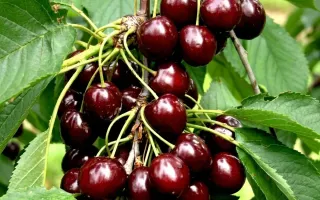
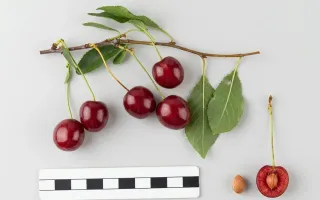
Fruits are large, average weight 5.8 g, height 20 mm, width 24 mm, thickness 23 mm, flat-round, rarely nearly round, slightly or moderately flattened on sides, skin dark-red. Flesh is dark-red, homogeneous, medium density, juice red. Flavor sweet with pleasant acidity, no astringency, pleasant cherry aroma, taste rating 4.5 points. Biochemical composition of fruits: 11.7-16.2% soluble solids; 9.1-14.0% sugars, 1.2-1.6% titratable acids, 0.10-0.15% tannins and coloring substances. Pedicel is short or medium length — 30-40 mm, fairly thick — 1.2-1.8 mm, separates fairly easily at full fruit maturity, dry or nearly dry. Pit average weight 0.38 g, which constitutes 6.6% of fruit weight, rounded, often unequal-sided, apex rounded with a small knob, base shaped like a straight line, beveled; fresh pit color light-brown, often with pinkish tinge, partially separates from flesh. Technological qualities of fruits are good: compotes are rated 4.6 points for appearance and 4.2 points for flavor.
Fruits ripen in mid-season, in southern part of the Central Chernozem region at the end of June to early July. Trees grafted on antipka enter fruiting 4-5 years after planting in the garden, with high fruiting capacity. Average yield over the first four years of fruiting was 16.4 kg/tree (control variety Kent 8.9 kg; this period was 1979, with an extremely harsh preceding winter). At full fruiting, Nadezhda yielded on average 21.6 kg/tree, compared to 15.0 kg/tree for Kent. In 2005, individual 15-year-old trees produced 50-60 kg of fruit.
Winter hardiness of the tree in southern Central Chernozem is good — average degree of freezing even in the most unfavorable winters of 1984-85 with temperatures down to -31.4º and 1986-1987 with absolute minimum -36.4º did not exceed 1.6 points. Flower buds suffer more: in winter 1978-1979 with frosts down to -32.2º, 71.6% of flower buds died, and in winter 1986-1987, 95.9% of flower buds died. But in normal winters with absolute minimum down to -30º, no significant flower bud death was observed. Resistance of the variety Nadezhda to coccomycosis is good, at the level and above varieties Mолодежная, Память Вавилова, Калитвянка. As with plums, it is weakly affected by moniliosis.
Advantages of the variety: large dessert fruits, high yield, disease resistance.
Disadvantages of the variety: strong-growing tree.
Video · 2 videos
Suggest a video →Crop & resistance
Crop
Specifications
| Type of Sort | |
|---|---|
| Catalog | Catalog → Cherry, Sour Cherry |
Not yet комментариев. Be the first!
Alternatives
Cherry saplings · similar varieties



See also
Often considered together with this variety




Recently viewed
Products you’ve viewed on this site
Reviews · 0