


SKU #3866
·
361 views
Sweet cherry Amorel Nikiforova
Cherry, Sour Cherry
Prices in stores
from3.68 €per seedling
pack from 5.49 € per 1 l
14 offers from 2 stores
Type of Variety
Sour cherry
Your mark
0 votes
0% positive ratings
Store offers · 14 from 2 stores
14 offers in 2 stores — from 3.68 € per seedling.
Available at: Сады Семирамиды · Agromir
Prices are collected automatically from store websites and converted at the current exchange rate. Check the price and availability on the store website before ordering.
Description
Cultivar of amateur selection. Selected by F.D. Likhonos in a private garden in the Novgorod region. Morphologically and biologically, it is extremely similar to the Amorel Rosa variety, widely grown in central Russia and the Volga region, and also known as Amorel or Early Amorel. Included in the State Register for the Northwest region, in the Leningrad region, it has been officially evaluated since 1959.
The tree is weakly or moderately growing, reaching a height of no more than 2.5–3.0 m, with a rounded, medium-density, well-leafed, and spreading crown with age. The trunk is usually short, and the skeletal branches emerge at a sharp angle, brownish. Shoots are slightly curved, thin, slightly drooping, brown with a silvery sheen on the lower half to two-thirds of their length. Vegetative buds are oval-conical, slightly deviated from the shoots; generative buds are oval. Leaves are oval and elongated-ovate, shiny, medium-sized — 82 x 37 mm, dense, with a pointed apex and a narrowed base; leaf margins are doubly toothed; glandules are 1–2, small, bean-shaped, yellow, located at the base of the leaf blade; petiole is short — 15 mm, medium thickness, green with anthocyanin tint. Flowers are usually 2–3 per inflorescence, small — 25.4 mm, saucer-shaped, with rounded, slightly touching petals, slightly elongated base and rounded apex with a notch; stigma is positioned above the anthers, stigma length 8–10 mm; calyx is cup-shaped, ribbed, green with anthocyanin tint.
Fruit set is mixed — on one-year-old branches and flower clusters.
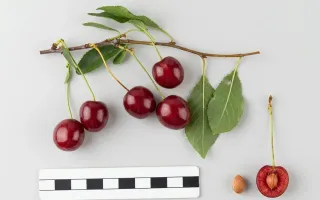
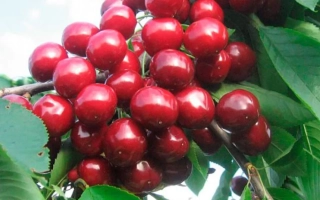
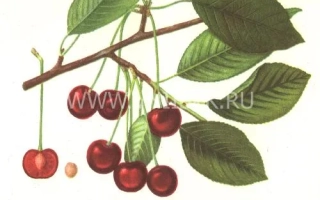
Fruits 18.5 x 16 x 18 mm, weighing up to 3.0 g, flat-round, with slightly sunken stigma scar, shallow depression, slightly flat ventral side, barely noticeable suture line. Skin is bright red, flesh is tender and juicy, creamy with yellow veins, slightly tart-sweet, with slight sugar predominance; juice is colorless. Flesh contains dry matter — 13.9%, sugars — 10.5%, free acids — 1.4%, ascorbic acid — 17.6 mg per 100 g fresh weight. Stone 8.5 x 9 x 7 mm, constitutes about 9% of the total fruit mass, semi-detachable from flesh, creamy, slightly asymmetrical, smooth surface, slightly wrinkled at base, rounded apex, broad-rounded base. Pedicel is short, 24–30 mm long, firmly attached to the fruit, detaches with a moist break. Fruits are primarily intended for fresh consumption.
Grafted plants begin to bear fruit on the 2nd–3rd year after planting. Flowering occurs early; fruits ripen early — in the Leningrad region from late July; from the start of ripening to eating readiness, it takes 15 days, from flowering to the start of ripening — 48 days. Self-sterile variety. Moderate productivity, averaging 4–6 kg of fruit per tree. Winter hardiness is satisfactory: over 10 years of observation, generative buds suffered 2.0 points of frost damage, branches — 1.1 points. During epidemic years of coccomycosis, the variety is significantly affected; in normal years — very weakly. Mild infestation by cherry sawfly is noted. Bacterial and physiological diseases are not observed. This variety is of interest for amateur gardening due to its early fruiting.
Advantages: small plant habit, early fruit ripening.
Disadvantages: creamy flesh and colorless juice reduce consumer value of fruits; during harvest, the crop is highly susceptible to bird damage, requiring netting.
Crop & resistance
Crop
Disease resistance
Pest resistance
Specifications
| Type of Variety | |
|---|---|
| Catalog | Catalog → Cherry, Sour Cherry |
No reviews yet. Be the first to share your experience.
Alternatives
Cherry saplings · similar varieties



See also
Often considered together with this variety




Recently viewed
Products you’ve viewed on this site
Reviews