


SKU #3921
·
314 views
Lyubskaya
Cherry, Sour Cherry
User rating
0 votes0% positive reviews
No ratings yet — be the first.
Type of Sort
Cherry
Prices in stores
from1.72 €per seedling
pack from 1.72 € per 1 pcs
23 offers from 17 stores
Store offers · 23 from 17 stores
Prices are updated on loadLoading offers…
Available at: 1sad · Agro-Shop · AgronomVIP · Добродар · Экосад · GreenBrothers · КиївСад · Kustik · Megasad · Розплідник Гуменюка · Панські Сади · Приватний плодорозсадник Таміла · Sadovnik-sam · Сади Валерії · Сади Сад · Сонцесад
Aggregator catalog: prices are collected automatically from store websites, normalized by AI and converted at the current exchange rate. Before ordering, confirm the price and availability on the store's website. This block is not indexed by search engines — the data is loaded after the page opens.
About product

The exact origin of this widely distributed variety in the middle belt of Russia is unknown. In its first description by N.I. Kichunov, it was stated that this is a long-established local variety cultivated in the Korchansky District of Kursk Oblast. It is included in the State Register for the Northwest, Central, Central Chernozem, North Caucasus, Middle Volga, and Lower Volga regions. It has be…
Type of Sort
Cherry
Description
The exact origin of this widely distributed variety in the middle belt of Russia is unknown. In its first description by N.I. Kichunov, it was stated that this is a long-established local variety cultivated in the Korchansky District of Kursk Oblast. It is included in the State Register for the Northwest, Central, Central Chernozem, North Caucasus, Middle Volga, and Lower Volga regions. It has been officially selected since 1947.
Trees of small size, up to 2.5 m tall, with wide-spreading, sparse crowns. The trunk has a brown-gray, cracked bark, and the branches bend off at angles close to 45°. One-year-old branches are drooping, brown, with a silvery sheen. Vegetative buds are rounded-conical, slightly deviating from the twig; generative buds are oval. Leaves are dense, slightly glossy, dark green, 87 x 50 mm, narrowly oval or elongated-ovate with a gradual or fairly abrupt transition to the apex and a pointed base; leaf margins are doubly serrated; stipules are small, awl-shaped and pointed. Stipules are small, round, yellow-brown or brown, located 1-2 per base of the leaf blade. Flowers occur 3-4 per inflorescence, 30-34 mm in diameter, with rounded, slightly concave, weakly ribbed petals having an elongated base and rounded apex with a notch. The calyx is cup-shaped, ribbed, greenish. The style is 1 cm long, the stigma is positioned lower or at the same level as the stamens, stamens up to 1 cm long. Pedicel 25-30 mm. In terms of fruiting habit, Lyubskaya belongs to the typical bushy cherry varieties, fruiting predominantly on one-year-old branches.
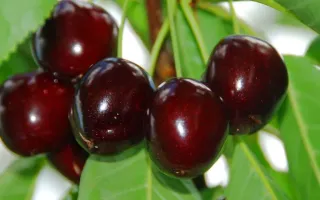
Fruits form 1-2, rarely 3-4, ranging from medium to large size, up to 4 g or more, rounded-ovate, dark red, with light-red or red juice; apex rounded and slightly blunted, small but wide pit, the ventral side of the fruit is lighter with a distinctly marked dark seam. Flesh is tender, very juicy, dark red, sweet-sour taste, contains in the middle belt of Russia: dry matter — 14.5%, sugars — 9.5%, free acids — 1.7%, ascorbic acid — 20.0 mg per 100 g of fresh weight; in the Krasnodar region: dry matter — 15.1%, sugars — 10%, free acids — 1.8%, ascorbic acid — 11.7 mg/100g. Stone is medium to large size — 10 x 8.5 x 7 mm, weight 0.2-0.3 g, accounting for 6-8% of the fruit's total mass, easily separates from flesh, oval to egg-shaped, slightly pointed at the apex and rounded at the base. Pedicel is long — 35 mm or more, firmly attached to the fruit in underripe condition, moderately attached at full maturity; fruits do not drop off. For fresh consumption, Lyubskaya fruits have mediocre taste, so this variety is primarily intended for technical use (compotes, jams, wine), quick freezing, and drying.
Plants enter fruiting early — in the 2-3rd year after planting and rapidly increase productivity. Flowering occurs in mid-late season, ripening is late — end of July to beginning of August. Flowering duration varies depending on weather conditions, lasting 5-8 days. Fruits remain on the branches for a long time, not dropping off, achieving optimal quality. Characterized by high self-fertility, best yields occur in mixed plantings with varieties Anadolskaya, Vladimirovskaya, Zhukovskaya, Lotovaya, Plodorodnaya Michurina, and Shpanka Rannaya. The variety has high potential productivity, but actual yield depends strongly on winter survival conditions, disease incidence, and overall tree health. In Central Russia, Lyubskaya yields 10-12 kg of fruit per tree, reaching up to 25 kg. Higher yields are known, reaching 35-50 kg. In the Krasnodar region, over 10 years of fruiting, from ages 7-16, the average yield was 10.3 kg per tree, with a maximum of 54 kg at age 11.
Trees show moderate cold and winter hardiness, often suffering bark and scaffold branch freezing, which limits their lifespan in the middle belt to 15 years, while in southern regions they live up to 20-25 years. Generative buds, on the other hand, exhibit high cold hardiness — significantly higher than in the Vladimirskaya variety. Lyubskaya cherry is susceptible to fungal diseases — coccomyces and moniliosis (up to 4 points).
Lyubskaya is a valuable industrial variety. Due to insufficient cold and winter hardiness of the wood, it is unsuitable for cultivation in northern latitudes; favorable conditions for its cultivation have developed in central and southern regions of Russia, where it is mainly distributed. The variety requires fertile soils and care, especially optimal doses of organic and mineral fertilizers. Lyubskaya cherry tends to form bud mutations, differing in plant habit, ripening time, productivity, fruit size, and quality (Lyubskaya Pоздняя, Lyubskaya Urozhaynaya, Lyubskaya Buketnaya, etc.).
Advantages: small plant size, allowing for intensive gardening; high potential productivity; good transportability of fruits.
Disadvantages: susceptibility to fungal diseases; insufficient cold hardiness of plants; excessive acidity of fruits.
Video · 2 videos
Suggest a video →Crop & resistance
Crop
Specifications
| Type of Sort | |
|---|---|
| Catalog | Catalog → Cherry, Sour Cherry |
Not yet комментариев. Be the first!
Alternatives
Cherry saplings · similar varieties




See also
Often considered together with this variety


Recently viewed
Products you’ve viewed on this site
Reviews · 0