


SKU #3947
·
417 views
Oktava
Cherry, Sour Cherry
User rating
0 votes0% positive reviews
No ratings yet — be the first.
Type of Sort
Cherry
Store offers · 9 from 9 stores
Prices are updated on loadLoading offers…
Available at: Agro-market · Agrosvit Sad · Biosad · Чудеса Саду · Экосад · Райська Долина · Sadovnik-sam · Сади Буковини · Saduua · Yablochko
Aggregator catalog: prices are collected automatically from store websites, normalized by AI and converted at the current exchange rate. Before ordering, confirm the price and availability on the store's website. This block is not indexed by search engines — the data is loaded after the page opens.
About product

Selected from seedlings of cultivated varieties based on marker characteristics in a nursery. Developed at the Bryansk State Agricultural Experimental Station (now VNIILUPIN). Breeders: A.I. Astakhov, M.V. Kanshina. Introduced into the State Register in 1986 for the Central region. Trees are low-growing with compact, dense, rounded crowns. Shoots are medium, slender, straight, and hairless. Leave…
Type of Sort
Cherry
Description
Selected from seedlings of cultivated varieties based on marker characteristics in a nursery. Developed at the Bryansk State Agricultural Experimental Station (now VNIILUPIN). Breeders: A.I. Astakhov, M.V. Kanshina. Introduced into the State Register in 1986 for the Central region.
Trees are low-growing with compact, dense, rounded crowns. Shoots are medium, slender, straight, and hairless. Leaves are small, narrow, elliptical, elongated and pointed, light green, matte, without gloss. Leaf blades are concave in the shape of a boat. Leaf margins are not wavy, but finely toothed. Petioles are medium-sized, weakly pigmented. Stipules are small and yellowish. Inflorescences contain 5-6 flowers; flowers are medium, white, with a cup-shaped corolla, petals touching each other, stigma level with stamens, calyx cup-shaped, without teeth, stamens and stigma are long.
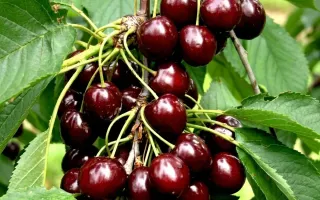
Fruits are medium-sized, weighing 3.9 g, dark cherry-red, nearly black, round-oval. Fruit flesh is dark cherry-red, juicy, tender, juice dark-colored. Fruits have excellent flavor, sweet with a slightly bitter taste, rich in chemical composition. Stone is small, round, easily separates. Fruits are attractive, dry-detaching, good for transport, contain 18% dry matter, 15.5% sugars, 1.1% acids, 13.7 mg/100g ascorbic acid.
The variety is early-fruiting and self-fertile, fruit buds are mostly formed in nurseries on one-year-old shoots. Yield in favorable years reaches over 100 centners/ha. Winter hardiness of trees is moderate, flower buds have high resistance. Resistance to coccomycosis and moniliosis is moderate. The variety is suitable for planting intensive orchards (4 x 3) and requires enhanced fertilizer background.
Advantages of the variety: high winter hardiness of flower buds, self-fertility, good fruit quality.
Crop & resistance
Crop
Specifications
| Type of Sort | |
|---|---|
| Catalog | Catalog → Cherry, Sour Cherry |
Not yet комментариев. Be the first!
Alternatives
Cherry saplings · similar varieties



See also
Often considered together with this variety


Recently viewed
Products you’ve viewed on this site
Reviews · 0