The variety was developed at the Rossohskaya Zonal Experimental Station for Horticulture under A.Y. Voronchikhina through crossing the varieties Zhukovskaya and Krasa Severa. In 2000, the variety was included in the State Register for the North Caucasus region. It is currently distributed only slightly, mainly in suburban gardens in the southern Voronezh and northern Rostov regions.
The tree is weakly or moderately vigorous, reaching a height of no more than 3-4 meters in maturity; the crown is rounded, medium density, with good leafing, branches diverging almost at a right angle. The bark on the trunk is gray with a cherry-like sheen, dark-gray in older trees, slightly flaking, weakly rough. Longitudinal cracking is absent or weak; lenticels are convex, long and very long, medium or fairly wide, sparsely arranged. Stem swelling is absent.
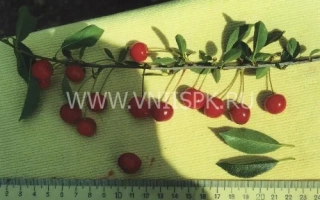
Shoots are straight, with long internodes, reddish-brown, with longitudinal stripes alternating reddish-brown and silver-gray at the base; lenticels are oval, light-brown or whitish, sparsely arranged. Vegetative buds are medium-sized, 3-4 mm long, short-oval, with a short-pointed apex, distant. Generative buds are smaller, 2-3 mm long, rarely up to 4 mm, more rounded, also short-oval with a short-pointed apex, distant from the shoot. Leaf blade is broadly oval to nearly round, with a sharply pointed apex, base varies from rounded to broadly wedge-shaped, often slightly unequal-sided, 8-12 cm long, 5-7 cm wide on one-year shoots, green above, nearly smooth, glabrous, moderately to strongly concave along the midrib and often spirally curled relative to it, weakly glossy; below light gray-green, midrib with light-magenta anthocyanic coloration, especially at the base, nearly glabrous, with slight pubescence at the angles of lateral vein departure; serration double-toothed, very large, especially in the upper half of the leaf, blade elastic. Petiole long, 20-30 mm, fairly thick, glabrous or very slightly pubescent above, with intense brown-magenta anthocyanic coloration. Stipules absent. Inflorescence has 3-5 flowers, rarely 1-2, pedicels very long. Flowers large, 35-40 mm in diameter, white; petals rounded, concave, frilled at the base, closed or nearly closed; flower wide-cup-shaped, stigma significantly higher than stamens by 2-3 mm, stamen length 9-12 mm, stigma with ovary 13-15 mm. Calyx tube is wide-bell-shaped, very wrinkled, calyx lobes broadly triangular, concave, with small teeth at the edges, equal in length to the calyx tube or slightly longer, bent backward, usually pressed against the calyx tube, rarely remaining in horizontal plane. Pedicel, calyx tube, and calyx lobes uncolored. Flowering occurs late; the variety is self-fertile.
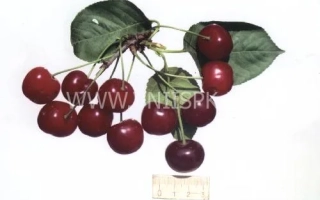
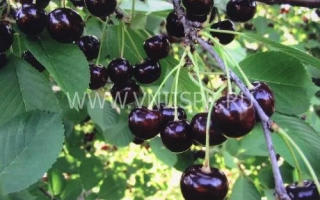
Fruits are large, average weight 6.1 g, fruit height 22 mm, width 24 mm, thickness 22 mm; fruit shape ranges from heart-shaped to round-conical with narrowing toward the apex, fruits with clearly defined ridges, sides slightly flattened, pit wide and shallow, apex flat with a small shallow pit, skin color dark red. Flesh bright red with small light veins, fleshy, tender, juice light red. Taste sour-sweet, pleasant, with a tasting score of 4.2 points. Biochemical composition of fruits: 10.7-19.8% soluble solids, 8.7-14.0% sugars, 1.5-2.0% titratable acids, 0.03-0.16% tannins and coloring substances. Pedicel 40-50 mm long and 1.2-1.5 mm thick, firmly attached to the pit, dry detachment at full ripeness, but in slightly underripe fruits a piece of skin with flesh detaches. This variety often produces twin fruits: two fruits on one pedicel, associated with the presence of two stigmas in individual flowers. Pit is large, average pit weight 0.44 g, which constitutes 7.2% of fruit weight; oval or broadly oval with rounded apex, base often in the form of a straight line and beveled; fresh pit color light brownish with a pinkish tint, separates well from flesh. Technological qualities of fruits are good: compotes are on average rated 4.4 points for appearance and 4.2 points for taste.
Fruits ripen in early-to-medium season, in late June in the southern Central Chernozem region. Trees grafted onto Antipka begin fruiting 3-4 years after planting in gardens, with good early fruiting; average yield over the first four fruiting years was 8.7 kg/tree. During full fruiting, average yield was 24.7 kg/tree, with up to 55-60 kg per tree in the most favorable years.
Winter hardiness of trees in the southern Central Chernozem region is good, frost damage rating even in the most unfavorable winters did not exceed 2. Flower buds are less resistant, although in typical winters for the southern Central Chernozem region, no bud death was observed. In the harsh winter of 1978-1979 with temperatures down to -32.2º in late December – early January, 56.4% of flower buds died; in the winter of 1986-1987 with temperatures down to -36.7º in February, 85.0% of flower buds died.
Resistance to coccomyces is moderate, usually infection does not exceed 1.5-2 points, but in wet years may reach 4-5 points. The variety has increased resistance to moniliosis.
Advantages of the variety: small tree, high yield, large fruits.
Disadvantages of the variety: overly tender flesh, reducing transportability, insufficiently high taste qualities.