


SKU #3987
·
245 views
Sweet cherry Finayevskaya
Cherry, Sour Cherry
User rating
0 votes0% positive reviews
No ratings yet — be the first.
Type of Sort
Cherry
About product

Introduced by E.P. Finayev and P.P. Ivanov at the Kuybyshev Experimental Station for Horticulture in 1957 as a result of open pollination of the 'Desertnaya Volzhskaya' variety seeds. Registered in the State Register in 1988 for the Middle Volga region. Medium-sized, moderately growing tree. Pyramidal-branching crown, slightly raised, medium density. Fruit set on one-year shoots — up to 60%, on f…
Type of Sort
Cherry
Description
Introduced by E.P. Finayev and P.P. Ivanov at the Kuybyshev Experimental Station for Horticulture in 1957 as a result of open pollination of the 'Desertnaya Volzhskaya' variety seeds. Registered in the State Register in 1988 for the Middle Volga region.
Medium-sized, moderately growing tree. Pyramidal-branching crown, slightly raised, medium density. Fruit set on one-year shoots — up to 60%, on flower clusters — up to 40%. Bark on trunk and main branches smooth, brown. Shoots medium, straight, brown, bare. Pods few, medium, yellow. Leaves medium, broad, inversely egg-shaped, short-tipped, dark green, wrinkled, matte. Leaf blade concave (like a boat), curved upward. Leaf apex sharply pointed, base pointed, no pubescence. Leaf margin doubly serrated. Petioles short, weakly incised, early falling. Petiole medium, thin, green. Stipules small, 1-2, yellow, oval. Inflorescence — umbel, flowers triple, rose-like, medium, white.
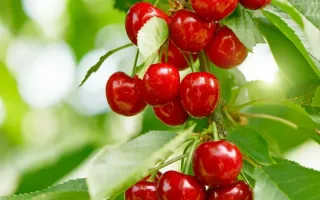
Fruits large, medium uniformity, average weight 3.5 g. Fruit shape round, apex rounded, base without depression, pit small and wide. Absence of ventral suture. Fruit pedicel medium, poor detachment from branch, strong attachment to stone. Fruit color dark red. No lenticels. Skin medium, smooth, difficult to remove. Flesh dark red, tender, juicy, cavity color uniform with flesh. Juice dark red. Taste character sour-sweet, rating 4.6 points. Appearance attractive — 4.8 points. Stone detaches from flesh moderately, large, inversely egg-shaped, blunt, smooth. Fruits contain dry matter — 19.64%, sugars — 12.62%, acids — 2.04%, ascorbic acid — 9.5 mg/100g. Fruit transportability good. Variety of universal use.
Self-fertile variety. Higher yields are obtained with pollination by Vladimirskaya, Desertnaya Volzhskaya, Lyubskaya. Flowering begins — May 14, ends — May 22. Fruit maturation late. Harvesting period — July 22 to August 1. Trees enter fruiting at 3-4 years and quickly increase yield. In young 6-7-year-old trees, yield reaches 8-10 kg, in mature 12-year-old trees — 15-18 kg per tree. Annual fruiting. Fruits remain well on the tree.
The variety has high winter hardiness of wood and flower buds. In severe winter 1968-1969, at minimum temperature -40°C, 71.6% of flower buds were killed. Overall frost damage level was 1.5 points. Drought resistance high. Affected by coccomycosis at 1.5-2 points. Affected by cherry slug in some years up to 40%, by sticky sawfly up to 20%.
Mainly propagated by grafting onto seedling and rootstock clones of Rastuny, Vladimirskaya, Kostychevskaya. Recommended to grow on elevated, wind-protected sites, on soils predominantly of light mechanical composition. Recommended planting schemes 4x4 and 5x2.5 m. Requires pruning and shaping, otherwise grows as a bush, which yields less. Suitability for mechanized harvesting not tested.
Advantages of the variety: high winter hardiness of wood and flower buds; good fruit quality at high yield places Finayevskaya above Lyubskaya.
Disadvantage of the variety is damage by gum exudation on trunk and main branches on heavy soils.
Crop & resistance
Crop
Disease resistance
Specifications
| Type of Sort | |
|---|---|
| Catalog | Catalog → Cherry, Sour Cherry |
Store offers
Prices are updated on loadLoading offers…
Aggregator catalog: prices are collected automatically from store websites, normalized by AI and converted at the current exchange rate. Before ordering, confirm the price and availability on the store's website. This block is not indexed by search engines — the data is loaded after the page opens.
Not yet комментариев. Be the first!
Alternatives
Cherry saplings · similar varieties


See also
Often considered together with this variety




Recently viewed
Products you’ve viewed on this site
Reviews · 0