



SKU #3989
·
1 409 views
Sweet cherry Khutoryanka
Cherry, Sour Cherry
User rating
2 votes100% positive reviews
No ratings yet — be the first.
Type of Sort
Cherry
Prices in stores
from4.56 €per seedling
pack from 8.93 € per 1 pcs
8 offers from 3 stores
Store offers · 8 from 3 stores
Prices are updated on loadLoading offers…
Available at: AgronomVIP · Королевский сад · Лучший Сад
Aggregator catalog: prices are collected automatically from store websites, normalized by AI and converted at the current exchange rate. Before ordering, confirm the price and availability on the store's website. This block is not indexed by search engines — the data is loaded after the page opens.
About product
This variety was developed at the Rossoshanskaya Zonal Experimental Station for Horticulture from a cross between the varieties Rossoshanskaya Chornaya and Chernaya Krupnaya. Breeders: A.Y. Voronchikina, A.I. Sychov. In 2004, the variety was included in the State Register of Selection Achievements approved for use in the Central Chernozem region. It is currently relatively little distributed. The…
Type of Sort
Cherry
Description
This variety was developed at the Rossoshanskaya Zonal Experimental Station for Horticulture from a cross between the varieties Rossoshanskaya Chornaya and Chernaya Krupnaya. Breeders: A.Y. Voronchikina, A.I. Sychov. In 2004, the variety was included in the State Register of Selection Achievements approved for use in the Central Chernozem region. It is currently relatively little distributed.
The tree is medium or low-growing, not exceeding 3-4 m in mature state, with a pyramidal or broom-like dense crown, good foliage. Due to the overly sharp angle of branch divergence, trees often break during harvest. Bark on the trunk is gray-brown with a purplish tint, glossy, smooth or slightly rough, slightly peeling on older trees. Longitudinal cracking of the trunk is weak or absent, and twisting is absent. Buds are convex, elongated-oval, long and wide, arranged with medium density. Shoots are straight, fairly thick, internodes are medium and long, initially greenish-brown, then acquiring a silvery-gray tint; buds are prominent, fairly large, especially in the lower part of the shoot, usually round, yellowish-cream, densely arranged. Vegetative buds are large, 5-6 mm, conical with slight narrowing at the base, pointed apex, protruding. Generative buds are smaller, 4-5 mm, egg-shaped with rounded apex, set apart. Leaf blade is oval or slightly inverted-egg-shaped with sharply pointed apex, base is arcuate or broadly cuneate, often unequal-sided, length 11-12 cm, width 6-7 cm on one-year shoots; upper surface dark green, slightly wrinkled along veins, slightly or moderately concave along midrib, glossy; underside light gray-green, almost bare with slight pubescence at angles of lateral vein divergence, very fine serration, single- or occasionally double-toothed with small black glands at tips of teeth, blade consistency leathery. Petiole 20-25 mm long, fairly thick, upper surface with sparse pubescent hairs, lower surface bare, with weak brownish-purple anthocyanic coloration, especially on upper surface. Glands 2-4, large, dark-colored and often deeply transversely cracked (characteristic feature). Stipules are narrow-lanceolate, deeply serrated, long, 10-15 mm, persist for a long time. Inflorescence usually has 3 flowers, flowers medium-sized, white.
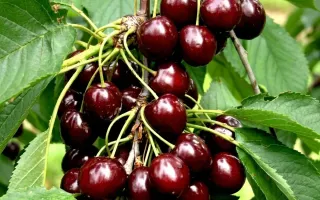
Fruits have average mass of 4.0 g, height 20 mm, width 22 mm, thickness 22 mm, ranging from flat-round to round and heart-shaped, slightly flattened or rarely moderately flattened on sides. Skin color is dark cherry-red, almost black; flesh dark cherry-red, uniform color, dense and very dense for cherry, juice dark red. Taste sweet with pleasant acidity and barely noticeable astringency, no foreign flavors, sensory evaluation 4.5 points. Biochemical composition of fruits: 13.9-16.5% dry soluble solids; 9.0-10.9% sugars, 1.9-2.0% titratable acids, 0.18-0.27% tannins and coloring substances. Peduncle 35-45 mm long and 1-1.2 mm thick, loosely attached to stone, dry or nearly dry detachment from fully ripe fruits. Stone has average mass of 0.35 g, which constitutes 8.8% of fruit mass, rounded or occasionally rounded-oval, not entirely regular, base rounded; fresh stone color is light brownish with red tint, poorly separates from flesh. Due to unusually high flesh density for cherry and nearly dry detachment, fruits have very high transportability and can be stored for a long time — up to 7-10 days, maintaining high market quality. Therefore, Hutoryanka is especially suitable for fresh marketing. Technological qualities of fruits are also very high: compotes are generally rated 4.9 points for appearance and 4.2 points for taste. Among all varieties studied at the station, Hutoryanka consistently ranks first in technological qualities.
Flowering occurs at medium timing, variety is self-fertile. Fruits ripen at medium timing, in southern Central Chernozem region by late June — early July. Trees grafted on Antipka enter fruiting 3-4 years after planting in the orchard, with low early fruiting. Average yield over first four years of fruiting was 1.8 kg (control variety Zhukovskaya 2.1 kg; this period coincided with 1994, extremely unfavorable winter). At full fruiting, Hutoryanka yields an average of 12.3 kg/tree, with 18-20 kg/tree in most favorable years; yield is fairly regular year-to-year.
Winter hardiness of trees in southern Central Chernozem is good. During extremely unfavorable winter of 1993-94, average degree of frost damage to trees was 1.2 points (control variety Zhukovskaya 1.7 points). Winter hardiness of flower buds is good, maximum percentage of bud mortality occurred during winter 1993-1994 and amounted to 25.5% (Zhukovskaya 85.0%). Variety is insufficiently resistant to coccomyces and is heavily affected by this disease during epidemic years. Moniliosis affects it comparatively weakly, maximum degree of damage does not exceed 1.0 point.
Advantages of the variety: dense-fleshed, transportable fruits with high consumer and technological qualities.
Disadvantages of the variety: pyramidal crown with branches that break during harvest, moderate fruiting and yield.
Crop & resistance
Crop
Specifications
| Type of Sort | |
|---|---|
| Catalog | Catalog → Cherry, Sour Cherry |
Not yet комментариев. Be the first!
Alternatives
Cherry saplings · similar varieties


See also
Often considered together with this variety



Recently viewed
Products you’ve viewed on this site
Reviews · 0