


SKU #3876
·
1 388 views
Vladimirskaya
Cherry, Sour Cherry
User rating
3 votes67% positive reviews
No ratings yet — be the first.
Type of Sort
Cherry
Prices in stores
from2.57 €per seedling
pack from 0.44 € per pack
9 offers from 8 stores
Store offers · 9 from 8 stores
Prices are updated on loadLoading offers…
Available at: 1sad · AgronomVIP · Голден Сад · Knip · lemsad-com-ua · Megasad · Наша Дача · Sadovnik-sam · Сади Сад · Плодопитомник Сад
Aggregator catalog: prices are collected automatically from store websites, normalized by AI and converted at the current exchange rate. Before ordering, confirm the price and availability on the store's website. This block is not indexed by search engines — the data is loaded after the page opens.
About product

Roditeleyeva, Vyaznikovskaya, Dobroсельская, Gorbatovskaya, Izbyletskaya
Very old sort, widely spread in Russia. Its origin is lost far back in history, and it is unlikely that its exact beginning can be reconstructed. There is a version that in the XVI century, wandering monks brought it from southern countries, and it acclimatized and spread throughout the Vladimir region and surrounding pr…
Type of Sort
Cherry
Description
Roditeleyeva, Vyaznikovskaya, Dobroсельская, Gorbatovskaya, Izbyletskaya
Very old sort, widely spread in Russia. Its origin is lost far back in history, and it is unlikely that its exact beginning can be reconstructed. There is a version that in the XVI century, wandering monks brought it from southern countries, and it acclimatized and spread throughout the Vladimir region and surrounding provinces. Over centuries, it has been propagated not only by shoots but also by seeds — hence the great variety of forms; nowadays, the Vladimir cherry is a collective term referring to existing clones and seedlings with all their positive and negative traits and properties. The Vladimir cherry is included in the State Register for the North-Western, Central, Volga-Vyatka, Central Chernozem, and Middle Volga regions; it was zoned from 1947.
This is a typical bush cherry. Rooted plants form multi-stemmed bushes that are 2.5–5.0 m or more tall. When grafted, it forms single-stem trees. The trunk and the main branches have an ashen gray color; the bark is flaky with longitudinal cracks. The crown is round, spreading with age, weeping, and weakly leafy inside; the main branches are bent upwards at a 45–60° angle from the trunk. One-year-old shoots are yellowish brown with a silvery coating closer to the base, arching downward. Vegetative buds are conical, small, leaning away from the shoot, generative ones — oval. A characteristic feature of the leaves is their folding along the main vein in a boat shape. They are medium-sized — 83 x 39 mm, matte, elongated-oval or elongated-egg-shaped with gradually tapering tips and weakly pointed bases; leaf blade edges have double serrated notches; petiole is 12 mm long, moderately thick, with significant anthocyanin pigmentation; glands are 1–3 in number, located at the base of the petiole on the lamina, less often — on the base of the lamina, small and dark red. Flowers are up to 5–7 in a cluster, medium-sized — 28 mm, saucer-shaped, with widely oval tips that slightly touch each other; the stigma is at the level of the anthers, column length is 8 mm, filament lengths are 5–6 mm; calyx is cup-shaped, anthocyanin colored on the sunny side; pedicel is 18–23 mm long, with an anthocyanin coating. It bears fruit in a bush-type manner — more than 80% of fruits are located on one-year shoots.
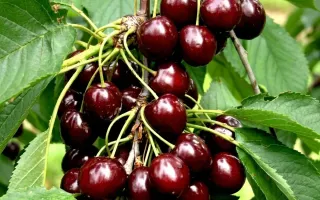
Fruits range from small (12.1 x 13.7 x 12.5 mm) to medium size (16 x 20 x 17.5 mm), weighing between 2.5 and 3.4 g, flat-rounded, slightly compressed along the ventral suture, with a rounded tip and a small, dense funnel; the ventral suture is barely noticeable. The skin is dark red, covered with numerous gray dots; the pulp is dark red, firm, fibrous, juicy, has an excellent sour-sweet, harmonious taste; the juice is thick and dark cherry colored. The flesh contains in northern cultivation conditions (Saint Petersburg): 16.4% of dry matter, 10.9% of sugars, 1.7% of free acids, and 26.6 mg of ascorbic acid per 100 g of raw mass; in the Krasnodar region (Maykop) conditions: 18.5% of dry matter, 11.46% of sugars, 0.67% of free acids, and 4.6 mg/100g of ascorbic acid. The stone is easily separated, weighing 0.3 g; it accounts for 8.3% of the total fruit mass, brown, measuring 10 x 8 x 7 mm — from wide-oval to egg-shaped. Pedicel length is 29–45 mm, thin and separates very easily with a dry break when the fruits are fully ripe.
Grafted plants start bearing fruit in their second or third year after planting. It belongs to the middle group by flowering and fruiting time; it takes 60 days from the beginning of flowering to the beginning of ripening. In the central part of Russia, the fruits ripen in mid-July. Fruits do not ripen at the same time; delayed harvesting can lead to their falling off. The variety is self-infertile. The best pollinators are Pink Amorel’, Vasilievskaya, Moskovsky Griot, Lotovaya, Lyubskaya, Michurina’s Productive, Rastun’ya, Turgenevka, and Black Shkirpotreb. Tree frost resistance is good; however, generative buds can be significantly damaged by low winter temperatures, which often leads to poor harvests and prevents the variety from being advanced in northern areas of central Russia. Observations indicate that damage to generative buds over 10 years in Leningrad Oblast averaged 1.1 (from 1 to 3 points per year). Yield varies greatly depending on the cultivation area, weather conditions during wintering, and is generally characterized as moderate to good. In the middle part of Russia, in favorable years (during full plant fruiting), the yield can reach up to 20–25 kg of fruit per tree; in northern latitudes (Leningrad Oblast) at age 10, it yields only up to 5 kg.
Vladimirskaya cherry fruits have excellent taste qualities and are versatile; they are suitable for producing high-quality processed products: jams, compotes, dried fruit, and quick freezing. The variety is used for large industrial plantations in the middle part of Russia and amateur gardening. Selection of high-yielding clones with better biological and economic indicators is required. It has limited interest for more northern latitudes and southern fruit growing regions.
Advantages: high-quality fruits suitable for a wide range of uses.
Disadvantages: low frost resistance of generative buds, susceptibility to fungal diseases — coccomycosis and moniliosis.
Video · 8 videos
Suggest a video →Crop & resistance
Crop
Specifications
| Type of Sort | |
|---|---|
| Catalog | Catalog → Cherry, Sour Cherry |
Not yet комментариев. Be the first!
Alternatives
Cherry saplings · similar varieties


See also
Often considered together with this variety


Recently viewed
Products you’ve viewed on this site
Reviews · 0