


SKU #4079
·
708 views
Apricot Son of Krasnochekoy
Apricot
Purpose
Universal
Fruit Size
3.7-4.5
Fruit Color
Orange
Zoning
Southern regions
Your mark
0 votes
0% positive ratings
Store offers · 10 from 6 stores
10 offers in 6 stores — from 5.09 € per seedling.
Available at: Agro-market · AgronomVIP · plodovyimir-ru · rassadacvetov-ru · Sadovnik-sam · Интернет магазин садовых растений Все Сорта
Prices are collected automatically from store websites and converted at the current exchange rate. Check the price and availability on the store website before ordering.
Description
This variety was developed at the Rossoshanskaya Zonal Experimental Station for Horticulture by M.M. Ulyanishchev from crossing the varieties Zolotoe Leto and Krasnochekiy. Since 1974, it has been officially approved for the Astrakhan region. Currently, it is listed in the State Register for the Nizhnevолжский region.
The tree is medium to tall, with an oval or broadly oval, raised, dense crown and good foliage. The bark on the trunk is gray-brown or brown, with a slight sheen, medium to strongly rough, with strong longitudinal cracking; the trunk is either absent or weakly swollen. The lenticels are convex, very short, medium width, densely arranged.
Branches are straight or slightly curved, with rather short internodes; on the sunny side they are brown, in the shade greenish, covered with numerous, very small, oval, whitish lenticels that barely protrude or do not protrude at all. The variety tends to produce strong secondary growth annually from several upper buds, colored bright red, thus the one-year-old branches are branched. The bud scar is medium-sized. Vegetative buds are small, 2-3 mm long, broad-conical, with a pointed apex, pressed or slightly separated. Flowering buds are similarly small, 2-3 mm, significantly narrower than vegetative ones, elongated-oval, with a pointed apex; primarily located on one-year-old branches and short fruiting spurs, with few spurs. Leaf blade is rounded, with a short, often curled sideways apex and a heart-shaped base, medium size, 6-9 cm long and wide on one-year-old branches; upper surface dark green, smooth, bare, slightly glossy, slightly concave along the midrib; lower surface gray-green, slightly hairy at the angles of lateral vein departure; leaf margins are usually single-toothed at the base, doubly toothed closer to the apex, with medium serration, no undulation; leaf blade is thin, leathery consistency. Petiole is long, 20-40 mm long, medium thickness, bare, with a bright burgundy anthocyanic coloration on the upper side, slightly less intense on the lower side; glands in number 3-4, small to medium, strongly convex, greenish with a black top. Flowers are large, 25-30 mm in diameter, pure white, blooming from pure white buds; sepals 5-8, reddish-brown, curved backward; calyx bell-shaped or cup-shaped, not wide; petals rounded to inversely egg-shaped, sharply narrowing at the base to a claw, in quantity 5-7, tightly closed or even overlapping each other, stigma level with stamens, apex curved into a hook.
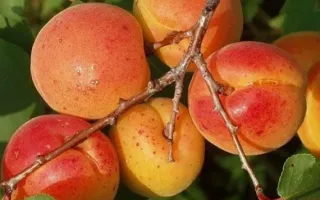
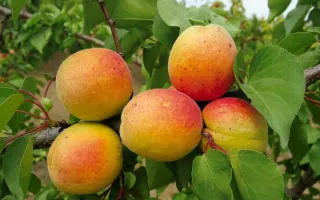
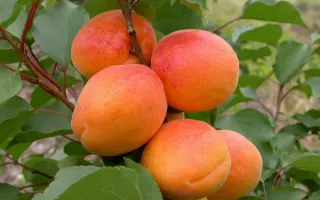
Fruits with average mass of 30-35 g, height 40-45 mm, width 37-38 mm, thickness 34-35 mm; largest fruits reach 55-60 g, oval or round-oval, slightly or moderately flattened on sides, fairly regular, although the ventral half is often slightly heavier than the dorsal half, fruit apex rounded, usually with a very small nipple at the end of the ventral suture, suture narrow, medium depth. Skin orange, with a blurred orange-red blush on the sunny side, medium pubescence. Stone is medium, weighing 2-3 g, which constitutes 6.5-8.5% of fruit mass, oval, apex broadly rounded, base narrowly rounded, dorsal suture closed, ventral suture narrow or medium width, central ridge well-expressed, sharp, lateral ridges also well-expressed, much more blunt than central; stone surface bumpy but smooth, color of fresh stone brown; stone lies in a large cavity, free, kernel bitter. Flesh is bright orange, fairly dense, solid consistency, juicy, sweet with slight pleasant acidity and barely perceptible bitterness, free of powdery mildew, with pleasant apricot aroma, taste rating high — 4.7 points. Biochemical composition of fruits: 8.9% sugars, of which 1.9% are monosaccharides and 7.0% sucrose, 2.6% titratable acids.
Fruits are used both for fresh consumption and processing. Compotes have good quality with overall rating of 4.0 points (4.1 points for appearance and 3.7 points for taste).
Flowering occurs in mid to late season. Ripening is mid-season, in southern Central Chernozem in late second to early third decade of July. Trees grafted onto seedlings of small-fruited apricot 'Zherdel' enter fruiting in 4-5 years, with good early fruiting. Yield depends primarily on winter survival of flower buds. With successful winter survival in 1961-62, six-year-old trees averaged 28.5 kg per tree. Under favorable weather conditions during winter 1962-1965, average yield was 19.4 kg/tree, and in the following three years only 4.1 kg/tree.
Winter hardiness of the tree in southern Central Chernozem is good. In severe winters, overall degree of freezing did not exceed 2.5 points. Such freezing did not significantly affect overall tree condition, and at ten years of age it was rated at 4.2 points. Flower buds are more sensitive to unfavorable winter conditions. Average percentage of flower bud freezing over the period 1962-1968 was 71.0%, with the most severe freezing observed in winters with sharp temperature fluctuations. In even cold winters, even with temperatures dropping to -34°, 20-30% of living flower buds remain, ensuring average yield.
Slightly affected by clasterosporiosis — up to 1-2 points in epidemic years. Moderately resistant to monilial burn.
Advantages of the variety: large, attractive fruits with good taste, sufficient adaptation of the tree to conditions of southern Central Chernozem.
Disadvantages of the variety: irregular yield due to freezing of flower buds.
Video · 6 videos
Suggest a video →Crop & resistance
Crop
Specifications
| Purpose | |
|---|---|
| Fruit Size | 3.7-4.5 |
| Fruit Color | |
| Zoning | |
| Catalog | Catalog → Apricot |
No reviews yet. Be the first to share your experience.
Alternatives
Apricot saplings · similar varieties


See also
Often considered together with this variety



Recently viewed
Products you’ve viewed on this site
Reviews