


SKU #4083
·
283 views
Apricot
Apricot
User rating
0 votes0% positive reviews
No ratings yet — be the first.
Assignment
Universal
Ripening Period
5-10
Flavor
Sweet
Core
Easily removable
Prices in stores
from7.05 €per seedling
pack from 14.89 € per pack
6 offers from 1 store
Store offers · 6 from 1 stores
Prices are updated on loadLoading offers…
Available at: Agromir
Aggregator catalog: prices are collected automatically from store websites, normalized by AI and converted at the current exchange rate. Before ordering, confirm the price and availability on the store's website. This block is not indexed by search engines — the data is loaded after the page opens.
About product

New selection variety from the Dagestan Fruit Breeding Station (DSCPK), seedling from open pollination of the Kursadik variety. Authors: Sh.G. Batyrkhannov, A.A. Pokrovskaya, N.V. Malinovskaya. Introduced into the State Register since 2000. Medium-sized, fast-growing tree. Crown is spherical-oval, moderately dense, moderately leafy. Shoots are medium, straight, thick at the base, thin at the tip,…
Assignment
Universal
Ripening Period
5-10
Flavor
Sweet
Core
Easily removable
Description
New selection variety from the Dagestan Fruit Breeding Station (DSCPK), seedling from open pollination of the Kursadik variety. Authors: Sh.G. Batyrkhannov, A.A. Pokrovskaya, N.V. Malinovskaya. Introduced into the State Register since 2000.
Medium-sized, fast-growing tree. Crown is spherical-oval, moderately dense, moderately leafy. Shoots are medium, straight, thick at the base, thin at the tip, brownish-burly. Young shoots are medium-sized, tip is reddish, numerous small white stipules on one-year shoots. The protrusion under the vegetative bud is distinctly visible. Branching of one-year shoots is good, producing 2-3 waves of premature shoots. Buds are grouped, up to 8 buds in leaf axils, lateral generative and central vegetative, medium-sized, half of them are reserve buds. Vegetative buds are terminal or central in groups, small, pointed, pressed against the shoot. Generative buds are rounded, detached from the shoot, visible space between the bud and shoot. Leaves are large, broad, elliptical, long-pointed, dark green, glossy, blade concave like a boat, leaf apex gradually pointed, base pointed, leaf margin serrated-toothed, stipules short. Petiole is long (35 mm), pigmented, medium-sized glands, two, one above the other, brown, rounded. Flowers are rose-shaped, medium-sized, pinkish, solitary, stigma below stamens, petals rounded, moderately open. Calyx is cup-shaped, pedicel medium.
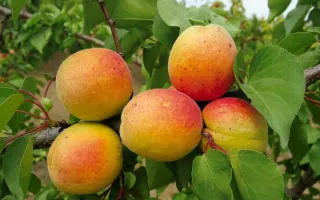
Fruits are medium-sized (40 g), medium one-dimensional, round shape, apex rounded, no depression, with a 'nose', small wide pit, prominent ventral suture to the apex, deep at the base, pedicel short, easily separates from the branch, attachment to stone is weak. Main fruit color is lemon-orange with blush, covering yellow. Skin is slightly hairy, almost bare, medium peelability. Flesh is lemon-colored, tender, melting, cavity color pale yellow, juice colorless, taste sweet. Stone separates well from flesh, average stone weight is 6.07% of fruit mass, asymmetric oval, surface with bumps, light-brown. Kernel is sweet. Fruit appearance is attractive, 4.7 points; flesh is sugary, harmonious acidity, distinctive aroma, fruit taste rating 4.7 points. Pedicel detaches well from fruit; fruits are transportable, store for 10-12 days. Technological use for compotes, jams, dried fruits, rating 4.7 each. Fruits contain dry matter 16.23%, sugars 11.17%, acids 1.4%, ascorbic acid 17.79 mg/100g, up to 24.2 mg/100g in some years.
Flowering period is medium — April 14-24; ripening is early, July 5-10, fruiting age at 5 years of life. Young variety, but trees planted in 1962 are still fruiting normally.
Flowering and fruiting type on spurs and mixed one-year shoots, part of generative buds are reserve, flower and fruit drop after frost, confirmed after -6°C frosts in 1999, 2000, 2001, when flowers and fruits died. Yield is regular, partially self-fertile.
No damage to shoots and branches by winter frosts. Damage to generative buds at -25°C on March 10, 1985, was 42%. Drought resistance is high. Monilial burn affects the variety at 1 point, clasterosporiosis — 2 points. No other diseases or pest damage observed since 1997. Average fruit yield from 1984-2001 — 98.8 centners/ha, maximum 248 centners/ha.
Variety is used to increase yield and extend the fruit consumption and processing season. Suitable for intensive orchards.
Advantages: stable annual yield, high processing qualities of fruit, relative disease resistance, resilience to anomalies — secondary flowering after frost.
Disadvantages: medium fruit size.
Crop & resistance
Crop
Disease resistance
Specifications hover over for a hint about the specification
| Assignment | |
|---|---|
|
Ripening Period
Ripening Period
It takes 70-100 days until pepper reaches flowering stage, 130-160 days until technical fruit ripeness, and 135-180 days until physiological ripeness. |
5-10 |
| Flavor | |
| Core | |
|
Fruit Color
Fruit Color
The fruit color of tomato varieties is influenced by the combination of skin and flesh color. Some varieties have transparent skin, others — yellow. When combined differently, the fruits can acquire quite diverse colors. The fruit color is affected by pigments (lycopene) and thei... |
|
| Frost Resistance | |
| Self-fertility | |
| Transportability | |
| Features | |
| Catalog | Catalog → Apricot |
Not yet комментариев. Be the first!
Alternatives
Apricot saplings · similar varieties




See also
Often considered together with this variety



Recently viewed
Products you’ve viewed on this site
Reviews · 0