


SKU #3410
·
227 views
Shevchenko's Favorite (Cornflower)
Apple
User rating
0 votes0% positive reviews
No ratings yet — be the first.
Type of Sort
Autumn Apple Variety
Store offers · 4 from 4 stores
Prices are updated on loadLoading offers…
Available at: Baza Proraba · Kostiuk · lemsad-com-ua · Zakladka
Aggregator catalog: prices are collected automatically from store websites, normalized by AI and converted at the current exchange rate. Before ordering, confirm the price and availability on the store's website. This block is not indexed by search engines — the data is loaded after the page opens.
About product

Autumn variety, developed at the Minusinsk Experimental Station for Horticulture and Melon Cultivation by crossing an early-ripening type variety 'Tagarskoe' with large-fruited varieties 'Limonka' and 'Vetluzhanka' in 1956. Breeders: V. A. Shevchenko, V. I. Shevchenko. Included in the State Register of Selection Achievements approved for use in the East Siberian region since 1991. Widely grown in…
Type of Sort
Autumn Apple Variety
Description
Autumn variety, developed at the Minusinsk Experimental Station for Horticulture and Melon Cultivation by crossing an early-ripening type variety 'Tagarskoe' with large-fruited varieties 'Limonka' and 'Vetluzhanka' in 1956. Breeders: V. A. Shevchenko, V. I. Shevchenko. Included in the State Register of Selection Achievements approved for use in the East Siberian region since 1991. Widely grown in Krasnoyarsk Krai, Khakassia, Tuva.
Medium-sized tree, height 3.1-3.3 m, moderately growing. Medium-density crown, rounded. Branches straight, diverge from the trunk at nearly a right angle, compactly arranged, ends directed upward. Bark on the trunk and main branches smooth, light-brown. Predominant type of fruiting structures — simple rings and fruiting twigs.
Medium-sized, round-sectioned, brown, slightly hairy shoots. Buds small, barely noticeable, few in number. Buds pressed, medium-sized, round, slightly hairy. Leaves large, egg-shaped, short-pointed, dark green, smooth, with delicate venation, glossy. Leaf blade concave, curved downward, weakly hairy. Leaf margin finely serrated. Petiole short, slightly hairy, medium thickness. Stipules small, lanceolate.
Flowers medium-sized, small-cup-shaped, pinkish, aromatic. Petals oval, stamens short. Style medium length. Stigma above the anthers.
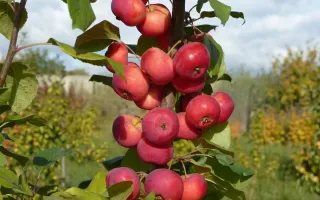
Fruits one-dimensional, average weight — 22 g, maximum — 32 g, round, fruit surface broadly ribbed. Skin tender, smooth, oily, glossy, with bloom. Color at consumer maturity: main — yellow, covering — over the entire fruit, strongly expressed, blurred, purplish. Numerous small dots, medium size, clearly visible, gray. External appearance attractiveness 4.6 points. Peduncle medium or long, thick, straight. Calyx wide, blunt-conical, deep, with medium rusting. Calyx persistent, closed. Dish medium, wide, ribbed. Heart medium, onion-like. Chambers closed, medium. Subcalyx tube short, wide, cup-shaped. Seeds medium, conical, light-brown.
Flesh creamy, medium density, tender, finely grained, juicy. Taste slightly sour-sweet, with mild aroma. Taste evaluation 4.2 points. Fruits contain: dry matter — 13.2%, ascorbic acid — 15.8 mg/100g, sugars — 8.5%, titratable acids — 0.64%.
Early autumn ripening variety — beginning of September. High fruit commercial value, good transportability. Storage period 2 months. Universal use variety, suitable for producing compotes, jams, natural juices with added sugar or blended with sweeter juices.
Self-incompatible, best pollinators — 'Tubinskoe', 'Martynovskoe', 'Zaprotchennoe'. Early fruiting, enters fruiting stage on 3-4 year after planting (4-5 years after grafting in nurseries). Productivity increases slowly. Average yield of 10-year-old trees — 68 centners/ha, or 10.2 kg/tree, maximum — 128 centners/ha. Fruit bearing periodicity expressed at medium level.
Fruits do not drop.
Propagation methods — budding and whip grafting, rootstock — seedlings of 'Purpurovaya Ranetka'. Recommended planting scheme 5 x 3 m. Responds well to fertilizer application and watering. Crown forms freely growing, trunked, with two tiers of main structural branches. Later, crown thinning and rejuvenating pruning on multi-year wood is required.
High winter hardiness (in 1980, at -42.8°C air temperature, overall freezing degree 0.9 points, slight drying of one-year shoots observed). Drought and heat resistance medium. Affected by scab in weak degree, during epiphytotic years disease severity on leaves up to 1.1 points, on fruits up to 0.7 points.
Advantages of the variety: high winter hardiness, early fruiting, resistance to scab, fruits with good consumer qualities.
Disadvantages of the variety: slow productivity increase, rapid tree aging, medium-expressed fruiting periodicity.
Crop & resistance
Crop
Disease resistance
Specifications
| Type of Sort | |
|---|---|
| Catalog | Catalog → Apple |
Not yet комментариев. Be the first!
Alternatives
Apple saplings · similar varieties


See also
Often considered together with this variety




Recently viewed
Products you’ve viewed on this site
Reviews · 0