


SKU #3413
·
205 views
Majornoe
Apple
User rating
0 votes0% positive reviews
No ratings yet — be the first.
Type of Sort
Autumn Apple Variety
About product

Autumn variety selected at the Dubovsky Experimental Station for fruit crops of the Nizhnevolskii NIISS, obtained by hybridization of the Belfler-Chinese variety with the Renet Champagne variety. Breeders: R. V. Korneev and L. K. Zhukova. Widely grown in the Volgograd region. Trees are small, with round or broadly round crowns formed by thick branches. Fruit set is mainly concentrated on long,…
Type of Sort
Autumn Apple Variety
Description
Autumn variety selected at the Dubovsky Experimental Station for fruit crops of the Nizhnevolskii NIISS, obtained by hybridization of the Belfler-Chinese variety with the Renet Champagne variety. Breeders: R. V. Korneev and L. K. Zhukova. Widely grown in the Volgograd region.
Trees are small, with round or broadly round crowns formed by thick branches. Fruit set is mainly concentrated on long, thin spurs and tips of the previous year's growth. Fruit bags are thick and short.
Shoots are light-brown, reddish, and moderately hairy. Buds are small and round. Leaves are large, oval or egg-shaped, with rounded bases, dark green, with very dense hairs, strongly curved and folded, wrinkled. Leaf margins are wavy, with large teeth. Teeth are saw-toothed. Petioles are thick and medium-length. Stipules are small, lanceolate.
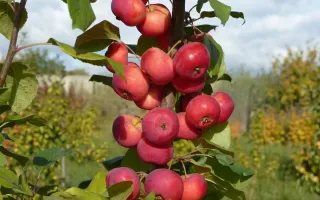
Fruits are above-average size, average weight 130–190 g, round, slightly elongated, with regular shape. Color at consumer maturity: main — light yellow, covering — almost entirely a pink-striped blush. Peduncle is medium or short. Calyx tube is deep and wide, slightly rusty at the base. Calyx is medium, closed or half-open. Receptacle is medium in depth and width. Heart is medium, upper, bulbous, weakly expressed. Chambers are medium, half-open. Seeds are medium, conical, full, dark brown. Sub-calyx tube is long, narrow, conical.
Flesh is white, medium density, slightly sour-sweet-spicy, excellent taste.
Fruits hold well on the tree. Variety ripens in autumn. Harvesting and consumer maturity occur at the end of September. Storage capacity — until December.
Trees begin fruiting at 5–6 years after planting in the garden as one-year-old seedlings. Yield is high, but the variety tends to alternate bearing. Winter hardiness is good. Moderately resistant to scab and powdery mildew.
Advantages of the variety: high yield, winter hardiness, commercial and consumer qualities of fruits.
Disadvantages of the variety: tendency to alternate bearing, short storage period.
Crop & resistance
Crop
Specifications
| Type of Sort | |
|---|---|
| Catalog | Catalog → Apple |
Store offers
Prices are updated on loadLoading offers…
Aggregator catalog: prices are collected automatically from store websites, normalized by AI and converted at the current exchange rate. Before ordering, confirm the price and availability on the store's website. This block is not indexed by search engines — the data is loaded after the page opens.
Not yet комментариев. Be the first!
Alternatives
Apple saplings · similar varieties


See also
Often considered together with this variety




Recently viewed
Products you’ve viewed on this site
Reviews · 0