


SKU #3415
·
249 views
Apple Malychenkovo (Youthful)
Apple
User rating
0 votes0% positive reviews
No ratings yet — be the first.
Type of Sort
Winter Apple Variety
About product

Early winter variety selected at the Volgograd Experimental Station of the All-Union Institute of Plant Growing named after N.I. Vavilov, obtained by crossing Boyken with Zhigulsky. Breeders: V.V. Malychenko and L.N. Balandina. It has been regionalized for the Nizhnevolsky region and is promising for southern areas of Ukraine. Tree with restrained growth, medium-sized, with a rounded, dense cr…
Type of Sort
Winter Apple Variety
Description
Early winter variety selected at the Volgograd Experimental Station of the All-Union Institute of Plant Growing named after N.I. Vavilov, obtained by crossing Boyken with Zhigulsky. Breeders: V.V. Malychenko and L.N. Balandina. It has been regionalized for the Nizhnevolsky region and is promising for southern areas of Ukraine.
Tree with restrained growth, medium-sized, with a rounded, dense crown and slightly drooping branches. Main scaffold branches are gray, curved, thick, with a relatively large angle of departure. The trunk has a dark brown color, its surface cracks and flakes. Fruit type is mixed: on long, thin, curved spurs and, often located on multi-year wood, rings. Fruit bags are elongated and large.
Shoots are thick, curved, moderately hairy, brown. Buds are large and medium-sized, round. Internodes are of medium length, alternating with short ones. Leaves are fairly large, but more often medium in size and width, oval, with a rounded base, broad-lanceolate apex, and a rather short, moderately tapering tip, almost flat, slightly lobed, weakly curved. Leaf blade is equilateral, slightly wrinkled, moderately hairy, with distinctly wavy, doubly toothed-lobed edges. Petiole is of medium length and thickness. Colored with weak anthocyanin without transition to the central vein. Stipules are lanceolate.
Buds have dark pink and red coloring. Inflorescence is a corymbose raceme. Flowers are fairly large, saucer-shaped, usually white with a slight pinkish tint and dark pink venation. Style of the pistil is low, densely hairy, with the pistil positioned below the stamens.
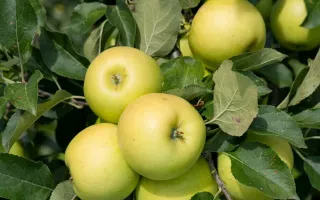
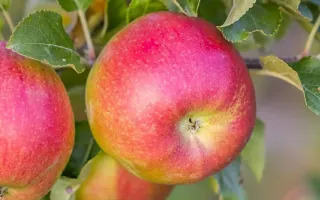
Fruits (see photo) are large, strongly flattened, broad-conical, convex at the apex, strongly ribbed, surface smooth with very weak waxy coating. Main color is light green with a yellowish tinge, covering — uniform, blurred, dense red blush covering most or entire fruit surface. On the blush background, stripes and lines are almost indistinguishable, blending into the overall covering color. Many lenticels are present, mostly large, with some small ones clearly visible on the covering color. Peduncle is short, thick, usually fully enclosed within the cup. Cup is very deep and very wide, irregularly shaped, wrinkled, uneven and bumpy at the edge. Receptacle is large, closed or semi-closed, placed within a deep, wide, wrinkled dish. Sub-receptacle tube is more often conical, rarely cup-shaped, very wide, of medium depth. Axial cavity is very small, weakly expressed, sometimes absent. Seed cavity is located in the center of the fruit or slightly shifted toward its apex.
Flesh is white or slightly yellowish, quite tender, juicy, of excellent dessert quality with a sweet-tart flavor and aromatic. Chemical composition of fruits: dry matter — 15.7% (max 20.2%), total sugars — 10.6% (12.8%), titratable acids — 0.42% (0.54%) on fresh weight, ascorbic acid — 9.0 mg/100g (11.3), sugar-to-acid ratio — 26.5 (34.1), P-active substances: flavonols — 20 mg/100g (2-29), catechins — 127 mg/100g (28-370), total phenolic compounds — 261 mg/100g (121-340), pectin substances — 0.41% (0.38-0.59%) on fresh weight.
Fruits ripen late autumn or early winter. Harvesting maturity occurs mid to late September, fruits can be stored in a normal cellar for up to 90 days.
Fruits remain firmly attached to the tree until harvest. Fruit transportability is relatively high. Fruit quality is high — 90-92%, including 56% first grade and 34% second grade.
Fruits are consumed fresh and for making juices, compotes, jams, and pastries.
Self-incompatible variety; best pollinators include: Snowy Calville, Miltoh, Johnred, Autumn Striped, and Lithuanian Pepin.
Trees begin fruiting early, starting from the 4th-5th year after planting in a garden. The variety’s productivity is very high and consistent year-to-year, ranging 125-175 centners per hectare at 15-20 years of age.
Winter hardiness in the Lower Volga region ensures sufficient resistance of trees and buds to extreme winter conditions. The variety has relatively weak drought resistance, moderate heat tolerance. The variety exhibits relatively high resistance to powdery mildew and scab. In individual years, epiphytic infection by powdery mildew reaches up to two points.
Advantages of the variety: restrained growth, tree adaptability to soil conditions, significant ecological adaptability and high yield, large, high-quality fruits.
Disadvantages of the variety: relatively short fruit storage duration, weak drought resistance, which has minimal impact on tree condition under irrigation.
Crop & resistance
Crop
Specifications
| Type of Sort | |
|---|---|
| Catalog | Catalog → Apple |
Store offers
Prices are updated on loadLoading offers…
Aggregator catalog: prices are collected automatically from store websites, normalized by AI and converted at the current exchange rate. Before ordering, confirm the price and availability on the store's website. This block is not indexed by search engines — the data is loaded after the page opens.
Not yet комментариев. Be the first!
Alternatives
Apple saplings · similar varieties




See also
Often considered together with this variety


Recently viewed
Products you’ve viewed on this site
Reviews · 0