


SKU #3380
·
765 views
Cinnamon Striped (Cinnamon, Brown)
Apple
User rating
1 vote100% positive reviews
No ratings yet — be the first.
Type of Sort
Autumn Apple Variety
Store offers · 4 from 4 stores
Prices are updated on loadLoading offers…
Available at: 1sad · Агро-Ра · AgronomVIP · erika-vrn-ru · Все для сада
Aggregator catalog: prices are collected automatically from store websites, normalized by AI and converted at the current exchange rate. Before ordering, confirm the price and availability on the store's website. This block is not indexed by search engines — the data is loaded after the page opens.
About product

An old variety of folk selection with early autumn ripening fruit, grows in many regions, especially in central and northern areas of Russia. Included in the State Register for the Northern, Northwestern, Volga-Vyatka, Central Chernozem, and Middle Volga regions. The first mention of the 'Cinnamon' variety in literature was in 1810 in V. A. Levshin's book 'The Administrator or Practical Guidance…
Type of Sort
Autumn Apple Variety
Description
An old variety of folk selection with early autumn ripening fruit, grows in many regions, especially in central and northern areas of Russia. Included in the State Register for the Northern, Northwestern, Volga-Vyatka, Central Chernozem, and Middle Volga regions.
The first mention of the 'Cinnamon' variety in literature was in 1810 in V. A. Levshin's book 'The Administrator or Practical Guidance in All Aspects of Agriculture'. More detailed information about this variety was provided by the Moscow fruit grower N. A. Krasnoglazov in 1848.
Trees are moderately vigorous. The crown is broad-pyramidal or broom-like in young trees and broadly round with hanging branches in mature trees. Branches are long, thin, bare at the lower part, weakly leafed, emerging from the trunk at a sharp angle. Few branches are covered with leaves. The main fruit mass on young trees forms at the tips of last year's shoots and on twigs, while on mature trees — also on buds.
Shoots are medium-thick, dark brown, slightly hairy. In nurseries, Cinnamon Striped forms straight, medium-thick one-year shoots. Bark of shoots is smooth, dark-red, slightly shiny. Upper part of one-year shoots is moderately hairy. Vegetative buds are small, slightly convex, with a rounded apex and slight hairiness. Leaves are elongated, narrowed at the base, with a strongly elongated tip, rough to the touch, with a textured ('shagreen') surface, dull, grayish or light-green, slightly hairy. Leaf margin is irregularly serrated, large, uneven, toothed. In nurseries and on young trees, leaf blades are often inversely folded 'sickle-shaped'. Petiole is short or medium, with small lanceolate or awl-shaped stipules.
Flowers are medium-sized, buds are light-pink, petals are moderately closed.
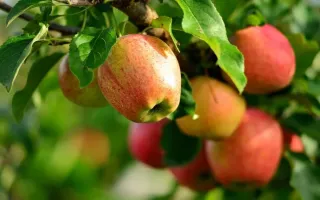
Fruits (see image) are medium or slightly smaller, strongly flattened, radish-shaped, without ribs or with small ridges. Base color is greenish at harvest and yellow at consumer ripeness. Cover color is dark-red, sharply defined stripes and spots on a weakly expressed reddish background on the sunny side. Two clones of Cinnamon are known with more intense fruit color: Cinnamon Smoky with a blush in the form of merging stripes and a bluish coating on the fruit surface, and Cinnamon Pineapple with a dense, uniform cover blush. Skin is smooth, shiny, dry. Subcutaneous points are white, few, barely noticeable. Pit is medium depth and width, with slight olive-colored rusting. Fruit stalk is fairly long. Calyx is small, wide, with five clearly visible swellings ('pearls') at the base of the calyx lobes. Calyx is closed or half-open. Subcalyx tube is wide and deep, conical. Seed chamber is bulbous or radish-like. Seed chambers are large, closed. Seeds are medium-sized, broad, dark brown.
Fruit flesh is firm, yellowish, occasionally pinkish beneath the skin, slightly sour-sweet, tender, with a cinnamon-like aroma and dessert flavor.
Fruits are consumed fresh and are the best raw material for making jams. Chemical composition of fruits: total sugar — 10.0%, titratable acids — 0.54%, ascorbic acid — 4.9 mg/100g, P-active substances — 131 mg/100g, pectic substances — 9.5%.
In the conditions of the Oryol region, fruit ripeness occurs in the third decade of August. Fruits can be stored for two to three months.
The variety is characterized by late fruiting onset and moderate yield.
The Cinnamon Striped variety has the highest cold hardiness among widely known varieties in the middle belt of Russia. Even after the extremely severe winter of 1955-1956, when temperatures in the Oryol region dropped to -37 to -38ºC and on the snow surface to -40 to -41ºC, Cinnamon Striped trees were damaged very slightly — 0.4 points (on a 5-point scale), whereas trees of even such cold-hardy varieties as Moscow Pear, Red Anise, and Ordinary Antonovka suffered more severely and received average frost damage scores of 1.0; 1.4 and 1.6 respectively.
Moderately resistant to fruit and leaf scab.
Advantages of the variety: outstanding cold hardiness, high fruit flavor quality.
Disadvantages of the variety: late fruiting onset, insufficiently high yield, main branches diverge from the trunk at a sharp angle and the wood is easily split (which often leads to trunk rupture).
About 20 new varieties have been developed using Cinnamon Striped, including varieties from the All-Russian Research Institute of Fruit Growing named after I. V. Michurin: Cinnamon New, Autumn Joy, and Young Naturalist (all from crossbreeding Cinnamon Striped x Welles).
Video · 7 videos
Suggest a video →Crop & resistance
Crop
Disease resistance
Specifications
| Type of Sort | |
|---|---|
| Catalog | Catalog → Apple |
Not yet комментариев. Be the first!
Alternatives
Apple saplings · similar varieties


See also
Often considered together with this variety





Helios
Фгбоу Во Кубанский Государственный Аграрный Университет Имени И.Т.Трубилина
052 6 offers
0.54 €per seedling ≈ 28 ₴
EXPECTED
Фгбоу Во Кубанский Государственный Аграрный Университет Имени И.Т.Трубилина
049 10 offers
2.58 €per seedling ≈ 133 ₴
Recently viewed
Products you’ve viewed on this site
Reviews · 0