


SKU #3569
·
662 views
Apple Black Tree
Apple
Type of Variety
Autumn Apple Variety
Your mark
0 votes
0% positive ratings
Store offers · 10 from 6 stores
10 offers in 6 stores — from 1.02 € per seedling.
Available at: filterpoint-in-ua · g-hos-com-ua · hcleane-com-ua · servis-opt-com-ua · technodream-com-ua · vistamarket-in-ua
Prices are collected automatically from store websites and converted at the current exchange rate. Check the price and availability on the store website before ordering.
Description
Autumn Volga cultivar of folk selection, known in culture for more than 100 years (S. I. Isaev). Found individually in the Middle Belt of Russia, especially in the Volga region. It is cultivated on the right bank of the Saratov region and on both banks of the Volga in the Volgograd region. With the emergence of new varieties, Black Tree has almost ceased propagation in Volga nurseries.
Medium-sized trees with oval and broadly oval crown shapes. Branches are long, produce few lateral shoots, with medium leafiness.
Shoots are dark brown with a brownish-dark tint, weakly hairy with numerous stipules; they are numerous, large, round.
Leaves are medium-sized, elongated-oval, occasionally broad-oval, wrinkled, weakly glossy, with weakly complex and curved forms, but significantly twisted. Leaf blade margins are wavy, coarsely and moderately single-toothed and toothed. Leaf pubescence is medium. Petiole is strongly colored with anthocyanin, transitioning to the central vein.
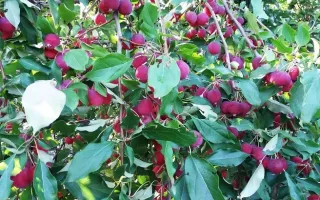
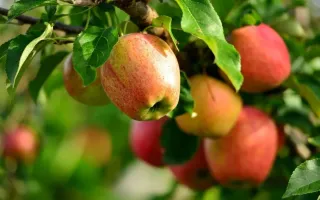
Fruits are medium to slightly smaller, irregularly shaped, flat-round, smooth, and well-formed. Ribbing is hardly noticeable. Main color is yellowish-green, turning golden at full maturity, without covering color or with slight reddish sunburn on the sunny side. Numerous subcutaneous dots, large, whitish. Fruit stalk is medium-sized, emerging from a depression, obliquely positioned, dark green with a brownish tint. Pit has rough and delicate rust-colored rust, emerging from the depression.
Flesh is tender, creamy, occasionally with greenish tint, fine-grained, juicy, pleasant, slightly tart-sweet, more precisely wine-sweet flavor with slight spice and aromatic qualities, noticeable when eaten fresh.
Autumn variety, fruits remain until January, harvesting is performed at the end of September. Delaying harvest is not recommended, as fruits ripen simultaneously and drop heavily. Apples are excellent for making jam.
Yield of this variety is moderate, often low. Winter hardiness is insufficient. The variety is little affected by scab and is not resistant to sunburn and black canker.
Advantages of the variety: excellent fruit taste, good transportability, relatively resistant to scab.
Disadvantages of the variety: weak winter hardiness, low yield, trees suffer from sunburn and black canker infection.
Video · 9 videos
Suggest a video →Crop & resistance
Crop
Disease resistance
Specifications
| Type of Variety | |
|---|---|
| Catalog | Catalog → Apple |
No reviews yet. Be the first to share your experience.
Alternatives
Apple saplings · similar varieties


See also
Often considered together with this variety



Recently viewed
Products you’ve viewed on this site
Reviews