


SKU #45913
·
64 views
Golden Delicious
Apple
User rating
0 votes0% positive reviews
No ratings yet — be the first.
Type of Sort
Winter Apple Variety
Tree; Growth Power
Medium-height
Tree; Canopy Shape
Broad-pyramidal crown, Broad canopy
Fruit; Fruit Shape
Oblong-rounded-conical
Prices in stores
from2.95 €per seedling
pack from 3.44 € per 1 pcs
8 offers from 5 stores
Store offers · 8 from 5 stores
Prices are updated on loadLoading offers…
Available at: AYRIS · Добродар · Idea-Sad · Sadpavliuka · Сади Буковини · Yaskrava Klumba
Aggregator catalog: prices are collected automatically from store websites, normalized by AI and converted at the current exchange rate. Before ordering, confirm the price and availability on the store's website. This block is not indexed by search engines — the data is loaded after the page opens.
About product

The Golden Delicious apple tree is a high-yielding winter variety developed in the USA in 1890 and one of the most popular in the world. Trees are medium-sized, reaching 3-5 meters in height, with dense crowns that are conical in young trees and become broadly rounded or weeping willow-like in mature trees. The bark of the trunk and branches is smooth with a brownish tint; leaves are large, oval,…
Type of Sort
Winter Apple Variety
Tree; Growth Power
Medium-height
Tree; Canopy Shape
Broad-pyramidal crown, Broad canopy
Fruit; Fruit Shape
Oblong-rounded-conical
Description
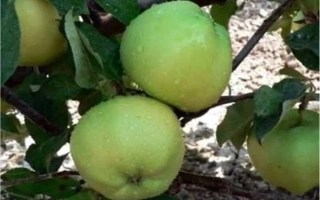
The Golden Delicious apple tree is a high-yielding winter variety developed in the USA in 1890 and one of the most popular in the world. Trees are medium-sized, reaching 3-5 meters in height, with dense crowns that are conical in young trees and become broadly rounded or weeping willow-like in mature trees. The bark of the trunk and branches is smooth with a brownish tint; leaves are large, oval, green, and shiny. Flowering occurs at the end of April to early May, with large white or pink flowers, fragrant, arranged in clusters of 3-5. Golden Delicious fruits are large, round-conical, weighing approximately 180-200 grams, with smooth, dry, slightly rough golden-yellow skin, sometimes with green speckles and occasionally a faint reddish blush on the sun-exposed side. The flesh is dense, juicy, sweet with a slight acidity, turning creamy or pale-yellow when stored, tender and dessert-like in flavor. Harvesting for consumption begins at the end of September, while commercial harvest occurs in January, with fruits remaining marketable until April, retaining their flavor and appearance. Fruits do not drop from the branches even during ripening, facilitating harvesting. The variety exhibits high resistance to scab, moderate resistance to brown spot and drought, as well as cold hardiness. Golden Delicious begins fruiting in the third year after planting, with regular fruiting maintained in early years, and yield reaching 45-60 kg per tree by the 8th-10th year, depending on region and growing conditions. The variety is self-sterile; for pollination, it is recommended to plant Jonathan and Delicious Spur varieties. Due to its high productivity, dessert qualities, and good disease resistance, Golden Delicious is widely used in commercial orchards and breeding programs.
Video · 9 videos
Suggest a video →Crop & resistance
Disease resistance
Specifications hover over for a hint about the specification
| Type of Sort | |
|---|---|
| Tree; Growth Power | |
| Tree; Canopy Shape | |
| Fruit; Fruit Shape | |
| Fruit; Fruit mass | 150-200 grams |
| Fruit; Fruit Color (Base Color) | |
| Fruit; Blush (Blush Color) | |
|
Fruit; flesh color
Fruit; flesh color
Color of the fruit flesh. There are red, pink, yellow, and brown colors. |
|
| Fruit; Lying | 3-4 months |
| Cold Resistance | |
| Registration year | 2025 |
| Catalog | Catalog → Apple |
| Country | Ukraine |
Not yet комментариев. Be the first!
Alternatives
Apple saplings · similar varieties






See also
Often considered together with this variety


Recently viewed
Products you’ve viewed on this site
Reviews · 0