


SKU #3529
·
450 views
Glory to the Victors (Glory to the Winners)
Apple
User rating
0 votes0% positive reviews
No ratings yet — be the first.
Type of Sort
Summer apple variety
Prices in stores
from0.98 €per seedling
pack from 2.28 € per pack
6 offers from 6 stores
Store offers · 6 from 6 stores
Prices are updated on loadLoading offers…
Available at: Biosad · Экосад · Pitomnik · Posadka · Profisad · Sadco · Yaskrava Klumba
Aggregator catalog: prices are collected automatically from store websites, normalized by AI and converted at the current exchange rate. Before ordering, confirm the price and availability on the store's website. This block is not indexed by search engines — the data is loaded after the page opens.
About product

Summer or late-summer variety selected by the Myliovskaya Experimental Station of Horticulture named after L. P. Simirenko, obtained by hybridization of the varieties Papировка and Mekintosh in 1928. Breeders L. M. Ro, P. E. Tsekhmistrenko. Autumn-ripening variety in central regions of Russia. Approved almost everywhere in industrial horticulture regions of Russia and the former Union.
Tree…
Type of Sort
Summer apple variety
Description
Summer or late-summer variety selected by the Myliovskaya Experimental Station of Horticulture named after L. P. Simirenko, obtained by hybridization of the varieties Papировка and Mekintosh in 1928. Breeders L. M. Ro, P. E. Tsekhmistrenko. Autumn-ripening variety in central regions of Russia. Approved almost everywhere in industrial horticulture regions of Russia and the former Union.
Tree is strong-growing with a broad-pyramidal crown, becoming high-oval or high-round with age. Main branches with brown bark, depart from the trunk at an acute angle and are raised upward, but over time spread sideways, moderately covered with ring-like buds and fruiting spurs. On good agrofons in southern orchards, fruiting is possible even on two-year-old wood.
Shoots are straight, brown, with small dense stipules. In nurseries, stems are reddish-brown, shiny, slightly knobby. Leaves are medium-sized, round or round-oval, with short-pointed tips, light green with slight yellowing, almost smooth, slightly hairy, finely wrinkled, flat, with slightly uplifted margins and doubly-toothed edges, depart from the stem at an acute angle, slightly curved at the base along the central vein. Petioles are lightly colored, stipules are small, lanceolate.
Flowers are saucer-shaped, pink with red bases of staminal filaments, with unpubescent style, stigma at the level of staminal anthers or slightly above them. Buds are red.
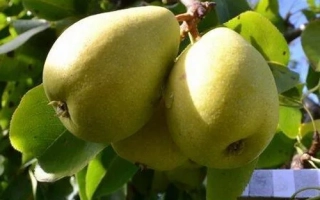
Fruits are large and medium-sized, attractive, elongated-round, round or slightly conical at the top, smooth or with barely noticeable single rib. Large fruits succeed in orchards with good soil and optimal air humidity. Skin is smooth. Main color at harvest is light greenish with a solid, ornate red blush, covering the entire fruit (if fruits are not harvested prematurely: gardeners rush, as fruits ripen quickly), with a slight waxy coating and numerous light subcutaneous dots, often with corky centers. Fruit stalks are medium in length and thickness. On lateral fruits, stalks are thinner and longer, protruding far from a smooth, fairly narrow calyx. Calyx is medium, closed, often with loosely closed sepals, situated in a shallow and narrow flat dish. Subcalyx tube is short, conical. Axial cavity is spacious. Seed chambers are voluminous, elongated vertically, open to the cavity with wide slits, contain 4-6 well-formed, small, round, slightly oval, dark-brown seeds.
Flesh is white, slightly cream-colored, very tender, juicy, aromatic, excellent sour-sweet taste. Chemical composition of fruits: total sugars — 13-14.4%, reducing sugars — 10.7%, titratable acids — 0.8%, ascorbic acid — 8 mg/100g, total P-active substances — 110 mg/100g.
Fruits ripen in early August on the Kuban, earlier — in late August further north. In the Oryol region — in early September and stored until December, in the south — two weeks.
Fruits do not hold well on the tree at full maturity. Fruit commercial value is 80-90%.
Variety is self-incompatible. Best pollinators: Borovinka, Vadimovka, Melba.
Trees begin fruiting in the south on weak-growing vegetative rootstocks at 4-5 years old, later further north. Early years of fruiting are regular, later — with periodicity, strongly influenced by agrofona level. Productivity of the variety is high or medium: in the central part of the Kuban — 195 centners/ha, in the steppe — 110 centners/ha. On new dwarf and semi-dwarf rootstocks, productivity increases to 300 centners/ha due to denser planting and higher agrofona.
Variety is fairly winter-hardy but not sufficiently drought-resistant, which affects fruit drop.
Advantages of the variety: tree yield and winter hardiness, high fruit quality.
Disadvantages of the variety: low drought resistance, especially in the last decade due to significant increase in sum of active temperatures; crown density, requiring increased attention to care.
In breeding, the variety is valuable for transmitting dessert taste and high commercial fruit quality. Many apple varieties have been developed in Ukraine, the North Caucasus, and other regions of the former Union.
Video · 4 videos
Suggest a video →Crop & resistance
Crop
Specifications
| Type of Sort | |
|---|---|
| Catalog | Catalog → Apple |
Not yet комментариев. Be the first!
Alternatives
Apple saplings · similar varieties


See also
Often considered together with this variety




Recently viewed
Products you’ve viewed on this site
Reviews · 0