


SKU #3320
·
311 views
Griv Ruzh (Griv Red)
Apple
User rating
0 votes0% positive reviews
No ratings yet — be the first.
Type of Sort
Autumn Apple Variety
Prices in stores
from5.85 €per seedling
pack from 6.05 € per 1 pcs
2 offers from 1 store
Store offers · 2 from 1 stores
Prices are updated on loadLoading offers…
Available at: Evrosag
Aggregator catalog: prices are collected automatically from store websites, normalized by AI and converted at the current exchange rate. Before ordering, confirm the price and availability on the store's website. This block is not indexed by search engines — the data is loaded after the page opens.
About product

Autumn variety of English origin. Approved for the North Caucasus region (entered into the State Register). Promising for cultivation in Astrakhan, southern areas of Volgograd Oblast, Kalmyk Republic, and other regions of the country with similar climatic conditions.
Medium-sized tree, reaching large dimensions, with a pyramidal crown that becomes flat-round with age, moderately leafy, relati…
Type of Sort
Autumn Apple Variety
Description
Autumn variety of English origin. Approved for the North Caucasus region (entered into the State Register). Promising for cultivation in Astrakhan, southern areas of Volgograd Oblast, Kalmyk Republic, and other regions of the country with similar climatic conditions.
Medium-sized tree, reaching large dimensions, with a pyramidal crown that becomes flat-round with age, moderately leafy, relatively densely branched. Main branches are fairly thick and straight, sometimes crooked, brown, second-order branches are dark gray. Lower branches branch off the trunk at an acute angle of about 45º, upper branches at an angle close to straight. Trunk of medium size, cracked, wavy surface, brown color. Main and semi-main branches bear lenticels and spurs, where fruiting occurs.
Shoots are brown and reddish-brown with a grayish tint, slightly curved or straight, thin, weakly to moderately hairy, with medium amount of stipules, light-colored, oval-shaped.
Leaves are dark green, small to medium, medium width, elongated, inversely egg-shaped or oval. Leaf apex is broadly wedge-shaped, with a moderately tapering, slightly expressed tip and broadly wedge-shaped base. Leaf blade is smooth, shiny, nearly flat, with very weakly expressed complexity and curvature. Leaf margin is smooth, single and double serrated. Pubescence is woolly.
Buds are pink, flowers are small, white, with a pinkish tint at the edges, petal edges are smooth, petals are oval, rarely egg-shaped, stigma is weakly hairy, almost bare, fused below the middle and positioned below stamens.
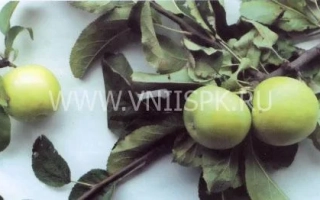
Fruits (see illustration) are large on young trees, become medium-sized with increasing yield, uniform, round, slightly to moderately flattened, slightly ribbed, slightly round-conical. Main color is light green and yellow upon full ripening, covering—a decorative, almost entire fruit surface, marbled, speckled orange-red blush, sometimes with pink streaks. Peduncle protrudes from the calyx. Calyx is wide, medium depth, rust-colored surface. Calyx tube is half-open, medium size, subcalyx tube is funnel-shaped, medium depth. Receptacle is small, narrow, wrinkled with pearls. Seed chambers are half-open, sometimes completely closed. Axial cavity is weakly expressed or absent.
Flesh is white with a pale yellow tint, firm, juicy, tart-sweet flavor with strong aroma. In storage, it becomes sweeter, pleasant, tender, juicy. Chemical composition of fruits: dry matter—15.9% (16.8%), total sugars—10.3% (11.2%), titratable acids—0.53% (0.6%) on fresh weight, ascorbic acid—8.4 (11.2) mg/100g, sugar-to-acid ratio—21.1 (35.6), polyphenols (catechins)—81 (62-96) mg/100g, flavonols—15 (10-26) mg/100g, total phenolic compounds—432 (190-752) mg/100g, pectic substances—0.47% (0.37-0.57%).
Autumn-ripening fruits, well tolerate transportation due to thick, firm skin.
Fruits can be used fresh or for making high-quality juice.
Early-bearing variety, distinguished by high yield, regular fruiting. Cold hardiness in Lower Volga region is weak, while in southern areas of Krasnodar Krai, trees are fully cold-hardy. Drought resistance is weak in the first case, and high in the second. Heat tolerance in Lower Volga is high. Variety is relatively resistant to fungal diseases.
Advantages of the variety: high ecological adaptability in southern regions of Russia, high, regular yield, high commercial and consumer qualities of fruits, and good transportability.
Disadvantages of the variety: weak cold and drought resistance, short fruit storage life.
Crop & resistance
Crop
Specifications
| Type of Sort | |
|---|---|
| Catalog | Catalog → Apple |
Not yet комментариев. Be the first!
Alternatives
Apple saplings · similar varieties




See also
Often considered together with this variety




Recently viewed
Products you’ve viewed on this site
Reviews · 0