


SKU #3477
·
1 157 views
Apple Apricot
Apple
User rating
0 votes0% positive reviews
No ratings yet — be the first.
Type of Sort
Winter Apple Variety
Store offers · 2 from 2 stores
Prices are updated on loadLoading offers…
Available at: Plodo Market · Sadim
Aggregator catalog: prices are collected automatically from store websites, normalized by AI and converted at the current exchange rate. Before ordering, confirm the price and availability on the store's website. This block is not indexed by search engines — the data is loaded after the page opens.
About product

Late winter apple variety of intensive type for short-cycle orchards of the North Caucasus regional institute of horticulture and viticulture, obtained from the varieties Kuban Spur and Calville Snowy using mutagenic selection. Authors: S. N. Artiukh, I. L. Efimova, T. G. Prichko. The variety was introduced into the State Register of Varieties for the North Caucasus region in 2002. It is widely…
Type of Sort
Winter Apple Variety
Description
Late winter apple variety of intensive type for short-cycle orchards of the North Caucasus regional institute of horticulture and viticulture, obtained from the varieties Kuban Spur and Calville Snowy using mutagenic selection. Authors: S. N. Artiukh, I. L. Efimova, T. G. Prichko.
The variety was introduced into the State Register of Varieties for the North Caucasus region in 2002. It is widely grown in industrial, OPH, collective farms, farmers' and amateur orchards in the North Caucasus region, covering more than 300 hectares, in Krasnodar and Stavropol regions, Rostov Oblast, North Ossetia, Kabardino-Balkaria. Promising for southern Russia and southern zones of the Central Chernozem region.
Medium-sized tree, spur-type. Bark of main branches is gray and smooth; branches grow at a sharp angle. Fruiting occurs on buds, spurs, located on two- to seven-year-old wood and one-year-old shoots. Under heavy fruiting, branch tips droop.
Shoots of medium thickness, straight or slightly curved, with short internodes. Dark green, heavily pubescent on upper parts of new growth, with many stipules. Buds are tightly pressed, large, round, pubescent. Leaves are directed upward, large, elliptical, spirally twisted, green, finely wrinkled, moderately glossy, slightly pubescent on underside, leaf blade concave, leaf margin finely toothed and wavy, petiole long, pink at base.
Flowers are medium-sized, small-cup-shaped, pink, petals free, fragrant; pubescent style long, stigma above the anther level. Anther bases are located at the tube's center. Flowering occurs in mid-season.
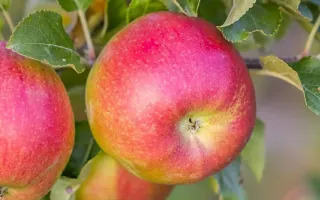
Fruits are very large, 250-270 g, conical, surface smooth or slightly ribbed, well-formed. Calyx is narrow and deep with moderate ridges; calyx tube is open with long sepals; subcalyx tube is long and narrow; cup is narrow, moderately deep, without browning. Fruit color at harvest is light green with a blurred pink-red blush on sun-exposed side and more intensely colored stripes. During storage, color intensifies. Entire surface covered with bloom. Skin is dense and oily. Subcutaneous spots are pale and inconspicuous. Core cavity is very narrow. Seed chambers are closed. Flesh is firm, pale cream-colored with a spicy aroma, slightly acidic-sweet. Seeds are brown, cup-shaped.
Fruit marketability — 90%. Fruit raw material has high evaluation for pectin content. Harvesting occurs in mid-September. Fruits can be stored until May and longer. Chemical composition: dry matter — 12-15%, sugars — 11-12.5%, acids — 0.45-0.65%, pectin — 17.2 mg, ascorbic acid — 14.5 mg/100g, total P-active substances — 172 mg/100g.
Trees in southern regions are winter- and drought-resistant; begin fruiting as early as the 2nd year in the orchard. By the 5th year, on a low-growing rootstock with planting density of 1000 trees/ha, yield reaches 100-150 centners/ha; by the 10th-14th year — 400-450 centners/ha. On elevated agrofond, yield increases to 500 centners/ha.
Self-sterile; best pollinators: Aydored, Korey, Din Art, Nympha, Prickuban, Kuban Renet, and others.
Advantages of the variety: high ecological adaptability; resistant to scab and powdery mildew; meets requirements of intensive and short-cycle orchards. High dessert, medicinal, and technological qualities of fruits.
Disadvantages: trees require special protection against various fruit moth species.
In breeding, the variety 'Apricot' serves as a donor for traits: early fruiting, enhanced winter hardiness, and drought resistance.
Crop & resistance
Crop
Disease resistance
Specifications
| Type of Sort | |
|---|---|
| Catalog | Catalog → Apple |
Not yet комментариев. Be the first!
Alternatives
Apple saplings · similar varieties




See also
Often considered together with this variety





Recently viewed
Products you’ve viewed on this site
Reviews · 0