
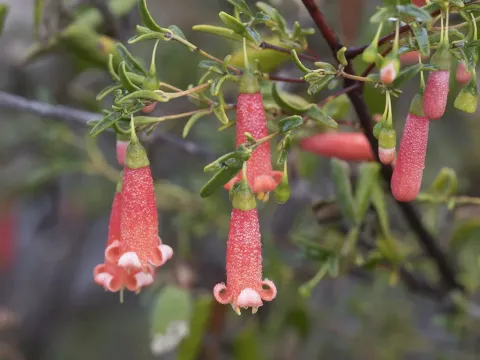
Correa
Correa Andrews
Correa is a genus of evergreen shrubs belonging to the Rutaceae family, native to the diverse landscapes of Australia and Tasmania. These plants are widely recognized for their distinct pendulous flowers that resemble small bells.
What the section contains
 Australian fuchsia
Correa pulchella J. Mackay ex Sweet
Australian fuchsia
Correa pulchella J. Mackay ex Sweet
 Correa
 decumbens F. Muell. x Correa reflexa (Labill.) Vent.
Correa
Correa decumbens F. Muell. x Correa reflexa (Labill.) Vent.
 Correa alba hybrid
Correa alba x C. pulchella
Correa alba hybrid
Correa alba x C. pulchella
 Correa hybrid
Hybrids between Correa pulchella and C. reflexa
Correa hybrid
Hybrids between Correa pulchella and C. reflexa
 Correa reflexa
 (Labill.) Vent.
Correa xbicolor
Correa xbicolor Paxton
Correa reflexa
Correa reflexa (Labill.) Vent.
Correa xbicolor
Correa xbicolor Paxton
 Rock Correa
Correa glabra Lindl.
Rock Correa
Correa glabra Lindl.
 Spreading Correa
Correa decumbens F. Muell.
White Correa
Correa alba Andrews
Spreading Correa
Correa decumbens F. Muell.
White Correa
Correa alba Andrews
Correa
To thrive in cultivation, Correa requires a well-draining, slightly acidic soil mix that mimics its natural habitat. Heavy, clay-based soils are generally unsuitable as they retain too much moisture and lead to root decay.
These plants perform best in bright, indirect light conditions. While they appreciate sunlight, intense direct exposure during summer months often leads to leaf scorch and dehydration.
Temperature management is critical for Correa. It prefers cool nights and mild days, ideally between 15°C and 20°C. In colder regions, they must be protected from frost and brought indoors during the winter season.
Pruning is essential after the flowering cycle has finished. Regular pinching of the tips encourages a bushier habit and promotes more profuse blooming in the following season.
Root rot is the most common threat to the health of Correa, usually triggered by excessive irrigation or poor drainage systems in containers.
Pests such as spider mites and aphids are known to target new growth. These pests thrive in dry environments and can quickly weaken the plant if left unchecked.
Maintaining proper air circulation around the canopy helps reduce the likelihood of fungal outbreaks, which can manifest as dark spots on the foliage.
If chemical intervention becomes necessary, it is vital to select products that are safe for the Rutaceae family, as some formulations can be phytotoxic to these species.
Regular monitoring of the undersides of leaves is recommended to identify the presence of pests at the earliest possible stage, allowing for swift and effective treatment.