
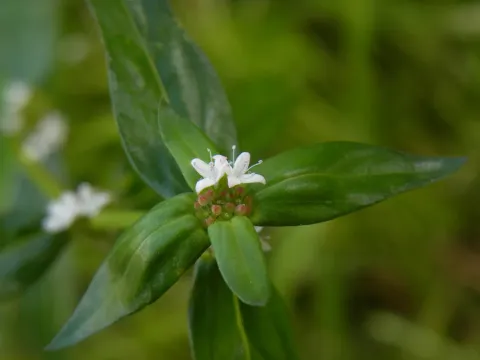
Smooth false buttonweed
Spermacoce laevis
Smooth false buttonweed (Spermacoce laevis) is a herbaceous plant within the Rubiaceae family. Primarily found in tropical regions, it displays a distinct architectural growth pattern with smooth stems and opposite leaves.
What the section contains
Smooth false buttonweed
The plant thrives in regions with high solar radiation and consistent moisture levels. It favors well-drained, nutrient-rich soils that allow for deep root penetration without the risk of waterlogging, which can be detrimental to its health.
Climatic requirements focus on tropical and subtropical heat. In cultivation, it is essential to ensure that the soil temperature remains warm to support the germination and vegetative growth stages throughout the season.
Botanically, it is recognized by its small white flowers tightly clustered in leaf axils. The root system is fibrous, allowing the plant to stabilize itself in various substrate types efficiently.
Economically, it is often utilized in ethnobotany. Its properties are being studied for various pharmaceutical applications, making it a plant of interest for niche cultivation in specific global markets.
Common phytopathological issues include root rot caused by stagnant water or soil pathogens that flourish in overly compact, heavy soil environments during the rainy season.
Pest pressures primarily include aphids and mites, which can cause significant foliar damage and weaken the plant's overall vigor if left unmonitored during the early vegetative phase.
Integrated pest management (IPM) strategies, including biological control and proper field spacing, are recommended to minimize reliance on synthetic pesticides.
Weed competition management is crucial during the early stages of establishment, as Spermacoce laevis can be outcompeted by more aggressive local weed species if the canopy is not closed early.
Regular scouting and soil analysis are fundamental practices to ensure the long-term health and productivity of the crop, especially when grown under intensive conditions.